

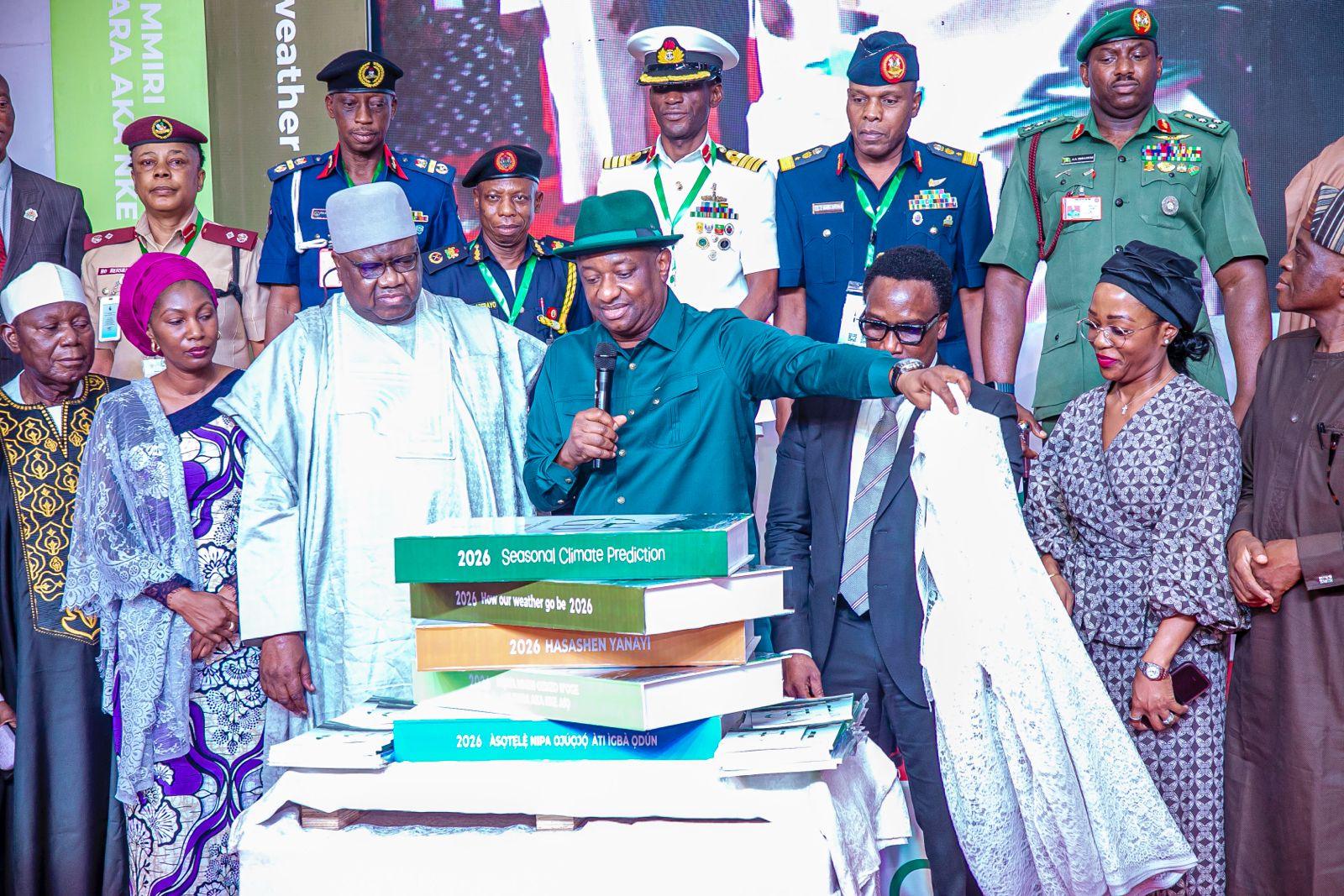
The Nigerian Meteorological Agency, NiMET, has unveiled the 2026 Seasonal Climate Prediction (SCP) and the 2025 State of the Climate in Nigeria, reaffirming its commitment to science-based planning and climate resilience.
Key highlights of the 2026 SCP indicate a largely neutral El Niño–Southern Oscillation (ENSO) phase, with generally normal rainfall across most parts of the country.
Also, early rainfall onset is expected in several southern and central states, while late onset is anticipated in Borno State, as well as variations in rainfall cessation, length of the rainy season, dry spells, a prolonged August Break in parts of the Southwest, and warmer-than-average temperatures in early 2026 were also projected.
Marking the 140 years of meteorological forecast in Nigeria, the Minister of Aviation and Aerospace Development, Festus Keyamo, said the SCP has become a vital national tool, helping to improve agricultural productivity, enhance disaster risk reduction, and support informed decision-making across government and the private sector.
He noted that climate variability and extreme weather events now directly affect aviation safety, food security, infrastructure, and national development, making timely and accurate climate information a strategic necessity.
“As the Minister of Aviation and Aerospace Development, and the minister in charge of meteorology, I recognise that safe, efficient, and sustainable aviation cannot exist without reliable meteorological input. Beyond the safety of daily air operations, our goal is to build an industry with the potential to meet and support the economic development of our growing population. Climate data remains a critical part of the resources we are relying on to achieve this. The Ministry has been very supportive to NiMet and will continue to do so, to ensure that the Nigerian people have access to the best weather and climate information and services available,” he said.
The Minister reiterated that the administration of President Bola Tinubu places strong emphasis on economic stability, food security, infrastructure resilience, and the protection of lives and livelihoods, adding that the SCP aligns with these priorities by translating complex climate data into actionable guidance.
“A normal annual rainfall amount is anticipated in most parts of Nigeria compared to the long-term average. Above-normal rainfall is expected in Borno, Sokoto, Kebbi, Kaduna, Enugu, Cross River, Abia, Ebonyi, Akwa Ibom States, and the Federal Capital Territory; while in parts of Katsina, Zamfara, Kwara, Oyo, and Ogun States, below-normal rainfall is expected,” he said.
New Technology
In his remarks, the Director-General of NiMet, Prof. Charles Anosike, said the Agency remains committed to providing authoritative, science-based weather and climate information to support national planning and climate resilience.
He disclosed that NiMet is integrating new technologies, including Artificial Intelligence, to strengthen forecasting and service delivery.
“We have recently set up a team of experts, charged with the responsibility of ensuring that the Agency is at the forefront of integrating and operationalising Artificial Intelligence in our forecasting responsibilities,” he said.
Prof. Anosike thanked the Federal Government for its sustained support and called for stronger partnerships, particularly with state governments, to further downscale climate information to local communities.
He reaffirmed NiMet’s resolve to serve as a trusted centre of excellence in weather and climate services for Nigeria’s sustainable development.
Meanwhile, World Meteorological Organisation Secretary General Celeste Saulo, while commending NiMet for its annual SCP, urged NiMet to invest in state-of-the-art forecasting techniques for better service delivery.
There were several keynote addresses from several government agencies, local and international partners.