

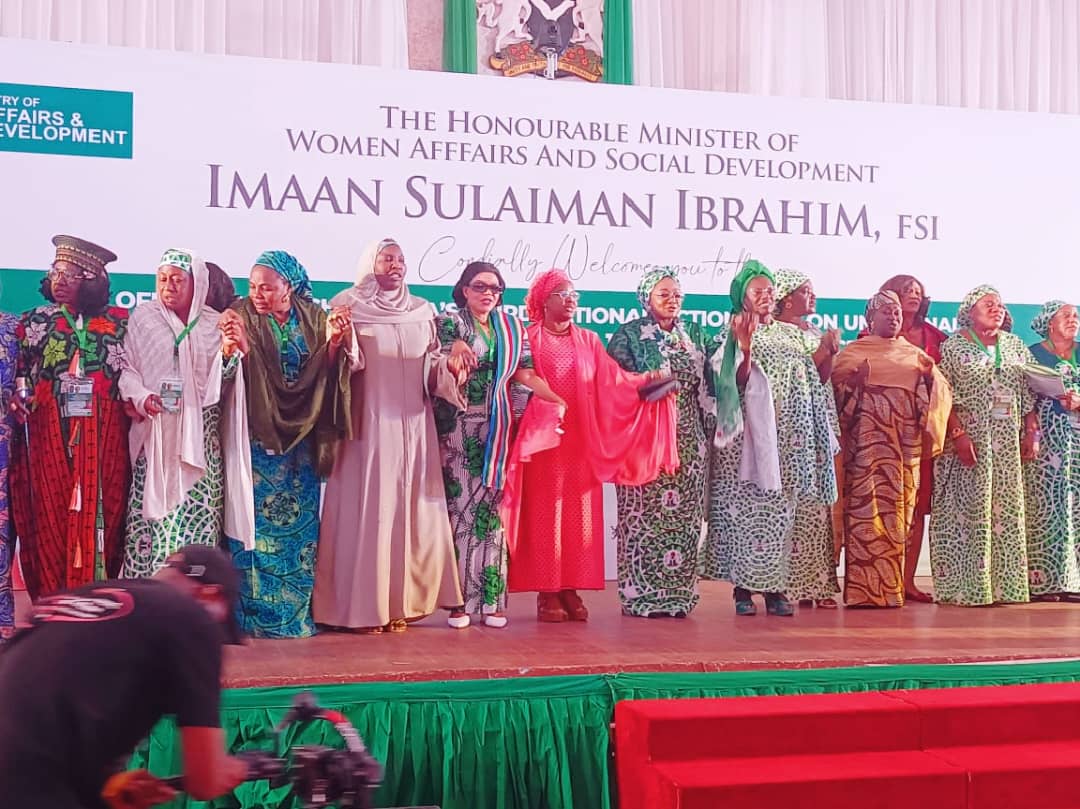
The Nigerian government has taken a decisive step toward strengthening inclusive peace and security with the official launch of its Third National Action Plan (NAP III) on the United Nations Security Council Resolution 1325 on Women, Peace and Security.
It reaffirmed national commitment to protecting women and girls while elevating women as key actors in conflict prevention and peacebuilding.
The Action Plan was formally launched at the State House Banquet Hall, Abuja, by the First Lady of the Federal Republic of Nigeria, Her Excellency Senator Oluremi Tinubu, whose address was delivered by the Wife of the Deputy Senate President, Hajia Laila Barau.
Hajia Barau described the launch as another chapter in the journey to build a nation where women and girls live in safety, dignity and have equal opportunities.
“When we invest in women, we secure our homes, our children’s future, and ultimately, our nation.” she said.
According to her, “the launch of NAP III is a bold continuation of Nigeria’s commitment to the global Women, Peace and Security (WPS) agenda, anchored on the Renewed Hope Agenda of President Bola Ahmed Tinubu, GCFR, which prioritises inclusion, stability and collective progress.”
She called on state governments, security agencies, traditional and faith leaders, civil society organisations, development partners, as well as men and boys, to champion the full implementation of the Action Plan.
Minister of Women Affairs and Social Development, Imaan Sulaiman-Ibrahim in her address, described the occasion as standing at the threshold of history and hope.
She noted that the launch coincides with major global and national milestones — 30 years of the Beijing Platform for Action, 25 years of UNSCR 1325, and three decades of the Federal Ministry of Women Affairs and Social Development.
“We gather not merely to unveil a policy document, but to affirm a national promise — that peace is strongest, most enduring, and most just when women are present, heard and empowered,” the Minister stated.
She revealed that NAP III, approved by President Bola Ahmed Tinubu, is fully aligned with the Renewed Hope Agenda and places women, children, families and vulnerable groups at the heart of national stability and sustainable peace.
The Minister highlighted Nigeria’s long and evolving history of women’s leadership in the security sector, citing trailblazers across the Armed Forces, Police, Immigration, intelligence and paramilitary services.
She noted that 2025 has emerged as a defining “Women O’Clock” year, with landmark appointments of women into senior security leadership positions, reinforcing Nigeria’s resolve to entrench gender-responsive governance.
A major highlight of the event was the inauguration of the National Technical Working Committee on Women, Peace and Security, chaired by the Federal Ministry of Women Affairs and Social Development, to drive coordinated implementation, monitoring, reporting and accountability of NAP III nationwide.
The Action Plan will also be localised across all 36 States and the FCT under the Renewed Hope Social Impact Intervention Programmes – 774.
The Permanent Secretary, Federal Ministry of Women Affairs and Social Development, Mrs. Nko Asanye Esuabana, described the launch as a testament to strong multisectoral collaboration among government, civil society and development partners.
She noted that NAP III is anchored on the pillars of participation, protection, prevention, relief and recovery, and offers a renewed framework for scaling up women-centred peace and security initiatives.
In her goodwill message Ms. Beatrice Eyong, a UN Women Representative to Nigeria and ECOWAS, represented by Ms. Wafaa Saeed, UNICEF, commended Nigeria’s leadership for sustaining momentum on the WPS agenda
. “This year is historic for multilateralism, women’s rights and peace and security. Nigeria’s launch of NAP III is a powerful addition to these global milestones,” she said, reaffirming UN Women’s continued commitment, with support from the Governments of Norway and Germany.
Also speaking, the Chairman, House Committee on Women Affairs and Social Development, Honourable Kafilat Ogbara, described NAP III as “a decisive political statement” that must move beyond paper commitments to concrete action.
“A plan without implementation is a broken promise,” she warned, assuring that the National Assembly would provide strong legislative oversight, budgetary support and accountability to ensure real impact at community level.
The launch ceremony brought together top government officials, lawmakers, security chiefs, traditional and faith leaders, women mediators, civil society organisations, development partners and the media, united in a shared resolve to advance peace, security and justice through women’s full and meaningful participation.
With the launch of NAP III, Nigeria has once again reaffirmed its leadership in advancing the Women, Peace and Security agenda, setting a renewed course toward a more inclusive, peaceful and prosperous nation.
Lateefah Ibrahim