

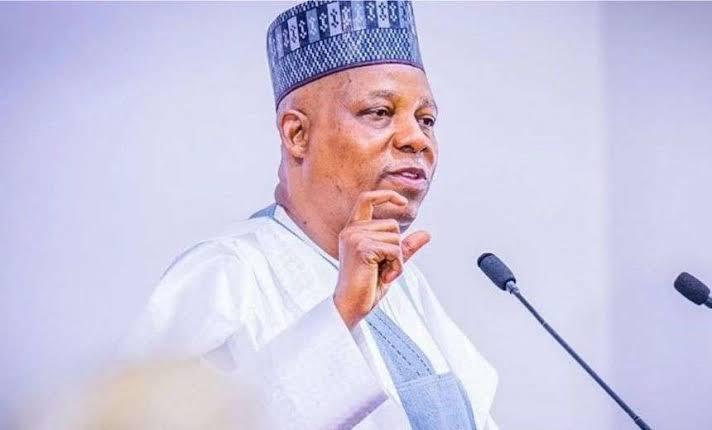
Vice President Kashim Shettima has launched the Asset Restoration Programme of the National Agency for Science and Engineering Infrastructure (NASENI) as part of ongoing efforts by the administration of President Bola Tinubu to restore and revive the nation’s industrial and agricultural capacity.
The programme, led by NASENI, seeks to restore over 26,000 broken but serviceable heavy-duty machines and repurpose nearly 500,000 component scraps that have been lying idle across the country.
Speaking during the launch of the Programme at the Borno State Agricultural Mechanization Farm Center in Maiduguri, the State’s capital, the Vice President said the objective of the programme is to reduce waste, cut unnecessary spending, and power national development through localised innovation and sustainable asset management.
Electricity
Shortly after inaugurating the National Asset Restoration Programme, VP Shettima proceeded to Borno State University, where he also inaugurated a power infrastructure project executed by the Niger Delta Power Holding Company Limited (NDPHC).
The power project implemented under the Distribution Intervention Projects, includes a 1X7.5MVA, 33/11KV injection substation, 3km of 33KV line, 2.5km of 11KV line, 2.5km of LT line, and 3 nos. 500KVA distribution transformers.
The Vice President said, “For so long, we have been profiled as a nation with a poor maintenance culture. This dysfunction cuts across both the private and public sectors, and we owe it to ourselves to say: enough is enough.”
VP Shettima reaffirmed that the current administration led by President Tinubu is committed to building a productive, self-reliant, and diversified economy, with strategic investments in infrastructure, innovation, and local capacity at the core of that transformation.
“This initiative is a response to our cross-generational dilemma about what to do with abandoned and poorly maintained assets of the nation—of the people. It’s a powerful shift in how we think about value, sustainability, and innovation,” the Vice President said.
Inventory
He stressed the need to have a national inventory of value waiting to be unlocked, and as such “We must commend NASENI for stepping forward with this brilliant idea to mitigate a national tragedy.”
The Vice President also noted NASENI’s contributions to national development through technology transfer, local engineering, and adaptive innovation, especially in areas such as compressed natural gas (CNG) retrofitting, renewable energy, and agricultural mechanization.
“We can’t create durable Nigerian solutions to Nigerian problems unless we localize global technologies. Relevant agencies must be supported to point us towards a stabler nation and a promising future,” the Vice President said.
Praising NASENI’s Executive Vice Chairman, Khalil Halilu, the Vice President noted that the agency’s renewed direction is marked by vision, urgency, and clarity of purpose.
“The direction NASENI is headed is one driven by action, impact, innovation, and awareness of what the nation needs,” he said.
Co-Owners
VP Shettima also called for public cooperation in safeguarding the assets that will be restored, explaining that these resources belong to the Nigerian people.
“If we restore these vital assets, we must all protect them. These machines, these tools, and these technologies are the property of each of you—of each Nigerian. It’s your collective national inheritance,” he added.
Earlier, the Governor of Borno State, Prof. Babagana Zulum, recalled that under the stewardship of Vice President Shettima as Governor of Borno State, 1,000 tractors and implements were procured, along with 1,000 units of planters; 250 units each of groundnut diggers, fertilizer broadcasters, rotovators, and bailers, as well as 25 units of combined harvesters, which is the single largest agricultural machinery investment in the state’s history.
“His training as an agricultural economist shone through every policy and decision, and today, that foresight is what has brought us here. This National Asset Restoration Programme we are launching would not have been possible without that foundational investment.
“It is not just a moment of celebration; it is a powerful testimony to the importance of continuity in leadership. And today, this proud son of Borno, now Vice President of the Federal Republic of Nigeria, is championing the Renewed Hope Agenda of His Excellency President Bola Ahmed Tinubu, GCFR – an agenda in which agriculture remains central to national development,” the Governor said.
Zulum noted that Nigeria requires a minimum of 750,000 functional tractors to meet its agricultural needs, yet less than 10 per cent of that number are currently operational across the country.
He said that according to the Food and Agriculture Organization’s recommendation, tractor density of 1.5 horsepower per hectare, “here in Borno, our mechanization drive has faced serious setbacks, especially following the devastating floods of September 2024, which damaged a significant number of our agricultural machines.
“That is why today’s intervention could not have come at a better time. The decision by NASENI to select Borno as the pilot state for the National Asset Restoration Programme is both strategic and timely. It offers us a lifeline to revive damaged assets and restore the capacity of our farmers to cultivate efficiently.”
The Executive Vice Chairman of NASENI, Khalil Halilu, said the Agency’s national survey revealed that Nigeria holds over 47,000 broken-down or serviceable agricultural and law enforcement assets, adding that the cost to replace them will exceed N14 trillion.
Also, the Minister of Agriculture and Food Security, Abubakar Kyari, said the launching of the programme marked a defining moment in the ministry’s efforts to bring productivity back to the core of public service delivery across sectors.
He added that the National Asset Restoration Programme is a cross-cutting effort led by NASENI aimed at rehabilitating, optimizing and returning government old equipment, infrastructure and technology to full working conditions whether agricultural, industrial or technological.