

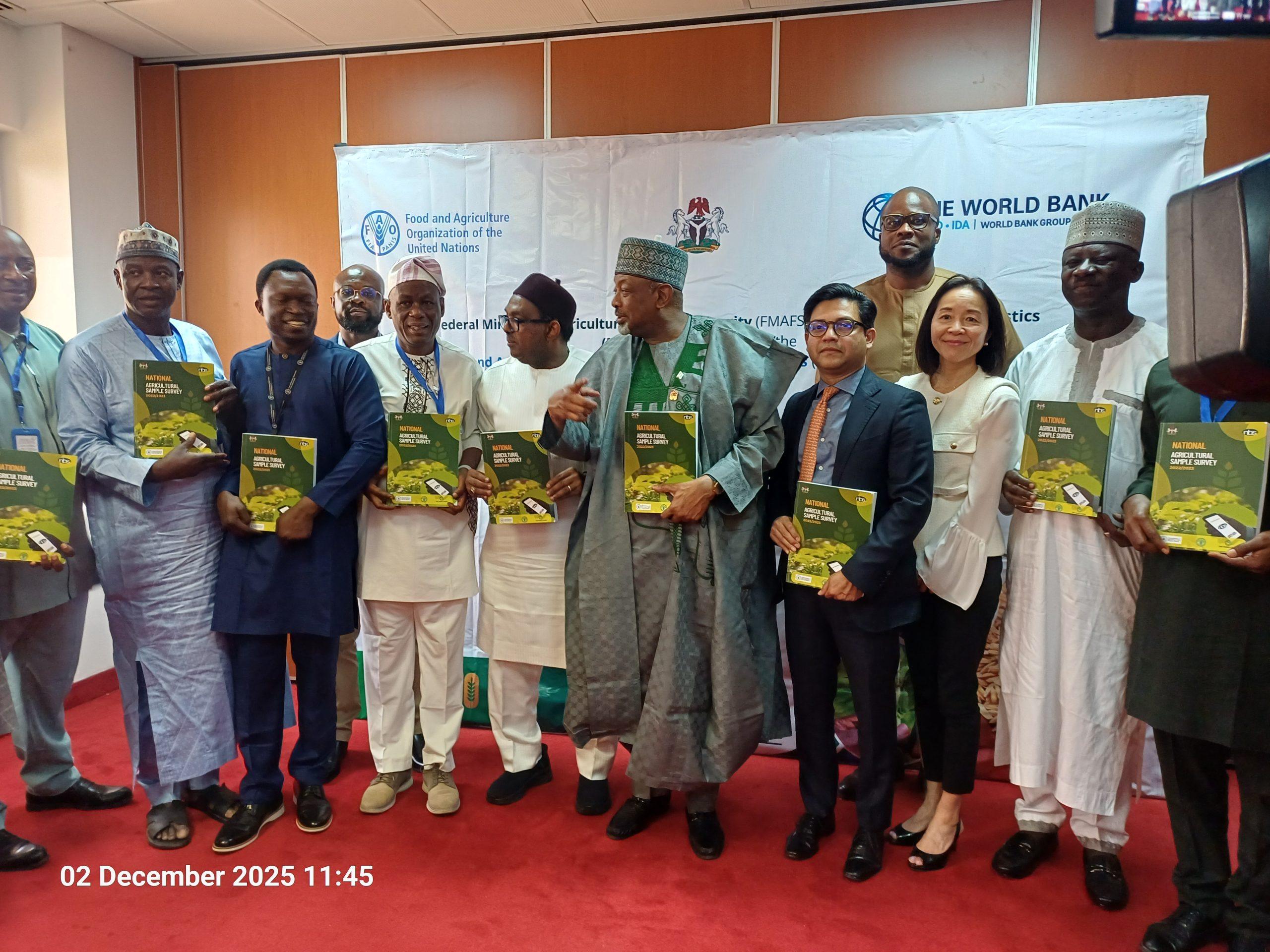
The Federal Government has unveiled the much-anticipated National Agricultural Sample Survey (NASS) 2022/2023 Report, marking a major milestone in Nigeria’s efforts to strengthen evidence-based agricultural policymaking and accelerate national food security goals.
Speaking at the event at the UN House in Abuja, FAO Representative in Nigeria and to ECOWAS, Hussein Gadain, said the NASS 2022/2023 report provides reliable, comprehensive, and credible data needed to guide transformative policies within Nigeria’s agriculture sector.
“Reliable data is the foundation upon which sound policies are built. These findings are not merely numbers; they are tools for transformation guiding decisions that address food security, enhance resilience, and unlock opportunities for sustainable growth,” he said.
Gadain highlighted that the survey offers detailed insights into crop production, livestock, fisheries, land use, post-harvest losses, farming systems, and the socio-economic realities of agricultural households. He noted that the report aligns with FAO’s Four Betters agenda—Better Production, Better Nutrition, Better Environment, and Better Life—as well as Nigeria’s Country Programming Framework (CPF).
He commended the Federal Ministry of Agriculture and Food Security, the National Bureau of Statistics (NBS), and the World Bank Group for their technical leadership and partnership, reaffirming FAO’s continued commitment to supporting Nigeria in strengthening agricultural statistics and driving food systems transformation.
“Together, we can transform data into decisions, and decisions into results that improve lives and livelihoods across the country,” Gadain added.
Speaking on behalf of the Statistician-General of the Federation and NBS Chief Executive, Prince Adeyemi Adeniran, the Director of Agriculture and Business Enterprise Statistics expressed gratitude to FAO and the World Bank for their “continued partnership and unwavering support” in producing reliable agricultural data.
The NBS said the 2023 survey provides essential statistics on crop production, livestock, aquaculture, labour, and farm input indicators critical for shaping effective programmes and national planning.
“The findings from the NASS 2023 represent a significant milestone in strengthening our national data system. They offer a clearer understanding of current realities across the agricultural value chain and highlight areas requiring targeted interventions,” the NBS said.
It emphasised that accurate agricultural statistics are central to designing strategies that enhance productivity, address food security challenges, and build the resilience of farming households nationwide. The Bureau reaffirmed its commitment to global best practices, noting improvements in survey methodology, field operations, digital data-capture tools, and quality assurance.
The NBS urged policymakers, researchers, development partners, and other stakeholders to fully utilise the evidence provided by the report.
“Let us translate the data into informed decisions, effective policies, and impactful programmes that will strengthen our agricultural sector, enhance food security, and support the livelihoods of millions of Nigerians,” it said.
Minister Kyari: “A Nation That Measures Well Governs Well”
In his keynote address, the Honourable Minister of Agriculture and Food Security, Senator Abubakar Kyari, described the survey as a critical tool for precise, accountable, and impactful agricultural planning.
“Every effective agricultural system rests on two pillars: the work of our farmers and the quality of the data that directs national policy. When these two align, progress becomes inevitable,” he stated.
Kyari highlighted that the survey covers all 36 states, the Federal Capital Territory, and 767 local government areas. He stressed that credible data is essential in a country of over 232 million people, where food demand continues to grow.
The Minister further disclosed key production statistics from the 2023 major cropping season:
-
Cassava – over 21 billion kilograms
-
Yams – 18.7 billion kilograms
-
Maize – 17.3 billion kilograms
-
Rice – over 13 billion kilograms
For the minor season, onions led with 2.67 billion kilograms, followed by tomatoes and rice, demonstrating year-round agricultural potential, particularly with improved irrigation and value-chain support.
Kyari noted that the survey aligns with regional commitments under the Comprehensive Africa Agriculture Development Programme (CAADP) and the Kampala Declaration, which emphasise accountability and measurable progress.
“Nigeria’s leadership in producing a survey of this quality strengthens Africa’s collective agricultural transformation efforts. A nation that measures well governs well. And food security begins with information security,” he concluded.
Olusola Akintonde