

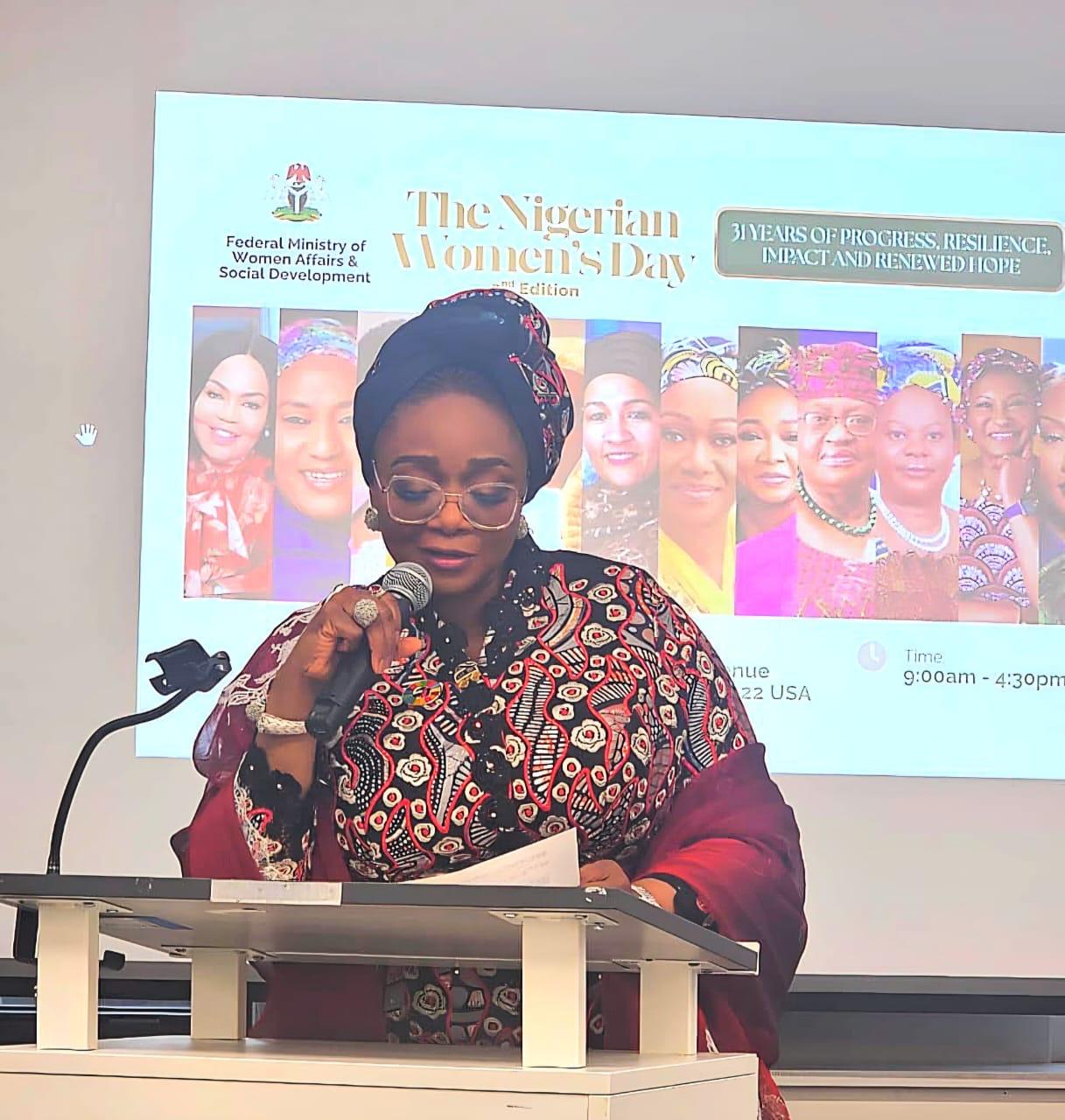
Nigeria’s Minister of Women Affairs and Social Development, Hajiya Imaan Sulaiman‑Ibrahim has presented a national framework aimed at transforming the lives of women and girls across the country.
Speaking at the Nigerian Women’s Day side event during the 70th Session of the Commission on the Status of Women, Sulaiman‑Ibrahim said the moment demands implementation beyond commitments.
“How do we move from decades of global commitments on women’s rights to measurable transformation in the daily lives of women and girls? Thirty-one years after Beijing the aspiration is clear, the evidence is overwhelming, and the urgency is undeniable.
“The world no longer needs more declarations; it needs accelerated implementation, bold investment, and systems that place women at the centre of national development,” She said.
Sulaiman‑Ibrahim highlighted the Renewed Hope Social Impact Interventions 774, designed to reach women in all 774 local government areas through nine pillars covering energy, agriculture, digital inclusion, health protection, innovation, leadership, education, child development, and family support.
According to the Minister, the programmes include; clean energy expansion through WINGS and PowerHer774 to combat “energy poverty barriers to women’s productivity,” agricultural support for women farmers under the Women Agro-Value Expansion programme, and digital empowerment through the Digital Harmony initiative.”
Also, Health Safeguard addresses gender-based violence, maternal health, and social protection, while Women’s Resource and Innovation Centres promote technology and creative enterprise among women.
Other pillars include; the SheLeads initiative to strengthen women’s leadership, mentorship, and political participation; expanded education, empowerment, and enterprise support for women and girls; the Child Advancement and Achievement Programme for child protection and educational opportunities; and the Families First Initiative, which recognises the care economy.
Sulaiman‑Ibrahim noted that “unpaid care work, long ignored in economic planning is finally being recognised as a critical component of national productivity and social stability.”
Urging stronger collaboration, the Minister stated that “women’s empowerment is not a social programme; it is an economic strategy, a security strategy, and a development imperative.”
She called for increased investment, She-for-She solidarity, coordinated programmes, action against gender-based violence, and expanded education for girls.
“We must build a stronger ‘She-for-She’ movement, where women advocate for one another, support one another, and celebrate one another’s success,”Sulaiman‑Ibrahim said.
While thanking President Bola Ahmed Tinubu for his strategic declaration of 2026 as the Year of Families and Social Development in Nigeria, she said: “It affirms a national understanding that the strength of any nation is rooted in the stability of its families, and that women, children, and households must be placed firmly at the centre of economic policy, social investment, and national development planning.”
Sulaiman-Ibrahim outlined six actions to accelerate progress. These are; increased investments in women’s empowerment and gender-responsive social protection; strengthening a “She-for-She” solidarity movement among women; improved coordination among governments, development partners, and civil society; intensified grassroots action against gender-based violence; expanded education and skills opportunities for girls; and sustained implementation with urgency.