

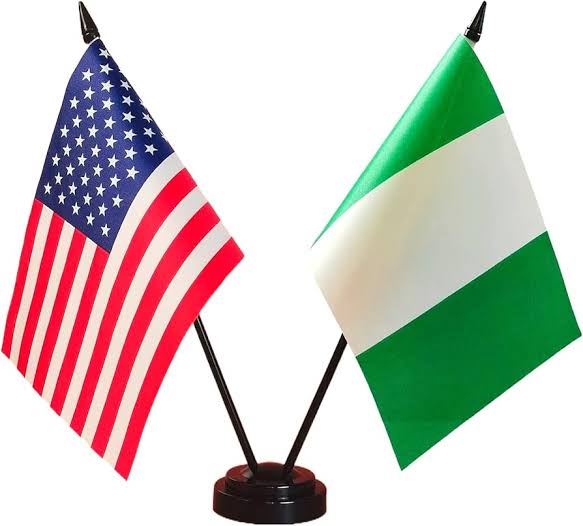
The Nigerian Government has commended Nigerians living in the United States for their resilience, patriotism, and sustained commitment to the country’s growth and development, as both sides pledged stronger collaboration to address national challenges.
The commendation was given during a joint virtual meeting organised by the Nigerians in Diaspora Commission, NiDCOM, and the Nigerian Centre, Washington.
The meeting brought together government officials and leaders of Nigerian diaspora organisations across the United States to discuss recent developments in Nigeria and the role of the diaspora in national affairs.
Speaking at the forum, the Chief of Staff to the President, Mr. Femi Gbajabiamila, urged Nigerians in the diaspora to continue drawing attention to national issues, particularly recent security challenges.
He acknowledged that the country is experiencing serious violence in some areas but stressed that “resolving the situation requires unity and focused, collective efforts rather than discord.”
Mr. Gbajabiamila emphasised that cooperation, not blame, is critical to overcoming the crisis.
Drawing lessons from how the United States responded to the September 11 attacks, he called on Nigerians to unite against insurgency and insecurity, irrespective of ethnic or religious differences.
Similarly, the Minister of Foreign Affairs, Ambassador Yusuf Tuggar, cautioned against what he described as misleading claims of “genocide,” noting that Nigeria’s challenges are rooted in complex regional conflicts.
He warned that misdiagnosing the problem would inevitably lead to ineffective solutions.
“Nigerians in the diaspora, you’re our first line of defense and it is important that they understand the conflict that we are facing for what it is. It is a regional conflict. It is happening in the Sahel region. It is happening in the Lake Chad region. So, when it is happening in certain parts of Nigeria and it is framed as a religions conflict, or religious persecution, or even genocide. It is completely framing it incorrectly. And when you frame something incorrectly, the solution you are going to apply is going to be wrong,” he said.
Ambassador Tuggar highlighted several contributing factors to the current security situation, including the collapse of Libya under Muammar Gaddafi, the failure of the European Union–Sahel strategy, and past restrictions on the sale of arms to Nigeria.
He reaffirmed the commitment of President Bola Tinubu’s administration to the 4D Foreign Policy Agenda—Democracy, Development, Demography, and Diaspora—underscoring the importance of diaspora engagement in national development.
The Chairman/CEO of NiDCOM and facilitator of the virtual conference, Dr. Abike Dabiri-Erewa, described the engagement “as essential, noting that sustained dialogue fosters deeper understanding.”
She thanked participants for their contributions and disclosed that all discussions and recommendations from the meeting would be compiled into a communiqué to be submitted to the President through the Minister of Foreign Affairs.
The event was moderated by Mr. Gbenga Ogunjimi of the Nigerian Centre, Washington, who stressed that the Nigerian diaspora represents the nation’s global communities.
He noted that diplomacy must extend beyond government-to-government relations and highlighted the strategic role Nigerians in the US can play, especially in the context of recent developments between Nigeria and the United States.
Representatives of key diaspora groups called for stronger collaboration between the global Nigerian community and the Federal Government to jointly address the country’s challenges.
They pledged their readiness to support Nigeria whenever called upon.
Stakeholders at the meeting also advocated the continuity of the forum, urging clear identification of issues and the adoption of strategic, Nigeria-focused lobbying mechanisms.
About 15 diaspora groups across the United States, represented by their leadership, participated in the virtual engagement.
The meeting reinforced the shared commitment of the Federal Government and Nigerians in the diaspora to work together in promoting national unity, stability, and development.
Lateefah Ibrahim