

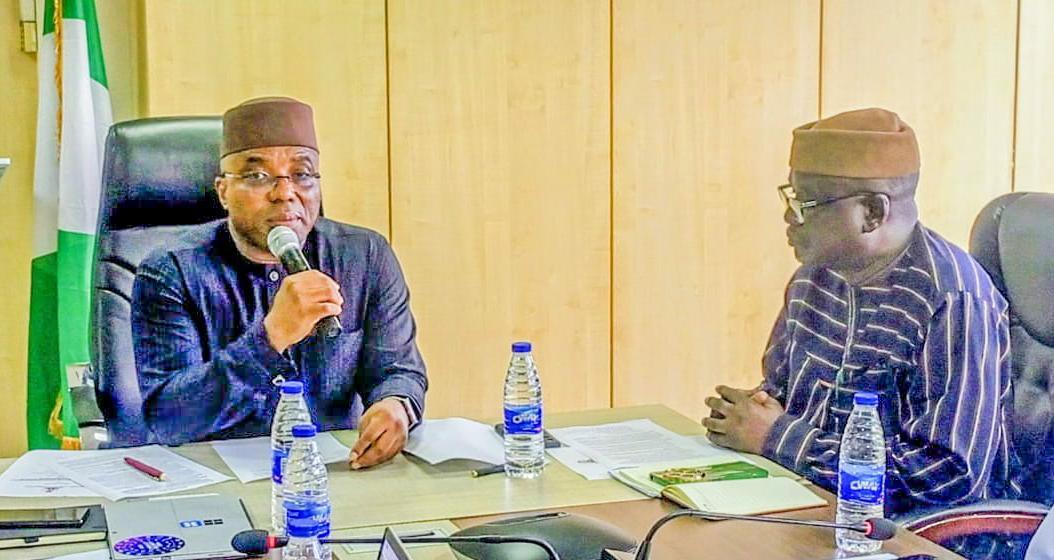
The Nigerian Government, through the Ministry of Petroleum Resources, has inaugurated a Technical and Steering Committee on the creation and management of the Nigeria Green Climate Fund and Sovereign Carbon Credits.
The move is aimed at positioning the country as a major player in global climate finance and energy transition.
Speaking at the inauguration in Abuja, the Permanent Secretary of the Ministry, Dr. Emeka Vitalis Obi, described the initiative as “a bold step towards integrating economic growth, energy security, and environmental responsibility.”
Dr. Obi noted that the Committee’s mandate is to design financial, institutional, and regulatory frameworks that will enable Nigeria to access global climate capital, monetize emission reductions, and reposition the Ministry as a transition-energy and climate-smart institution, in line with the Petroleum Industry Act (PIA) 2021.

He highlighted that the global voluntary carbon market is projected to exceed $50 billion by 2030 and reach $1 trillion by 2037, while Africa, despite contributing less than three percent of global emissions, receives under five percent of international climate finance.
He emphasised that Nigeria’s petroleum sector is strategically positioned to play a central role in global climate solutions due to its methane reduction potential.
The Permanent Secretary further explained that “under Nigeria’s updated Nationally Determined Contributions (NDCs), the country has pledged to cut emissions by 47 percent by 2030, equivalent to about 60 million metric tonnes—subject to international support.”
Dr Obi disclosed that gas flaring has reduced from 2.5 billion standard cubic feet per day in 2000 to about 700 million today, though it still emits over 25 million metric tonnes of CO₂ equivalent annually.
He said proper capture and trading of these emissions could earn Nigeria over $500 million each year.
Dr. Obi added that Nigeria’s Energy Transition Plan requires $1.9 trillion in investment by 2060, with about $410 billion expected from climate finance and carbon markets. He urged the Committee to deliver its report within 10 weeks, emphasising accuracy, patriotism, and institutional focus.
Earlier, the Director of Midstream and Downstream, Mr. Mohammed Mohammed Abubakar, described the inauguration as a milestone in aligning Nigeria’s petroleum sector with global transition priorities.
Mr Abubakar said the Ministry, in collaboration with Black River Switzerland and other government institutions, is developing a credible carbon credit trading framework for the oil and gas industry.
He noted that “the partnership brings technical expertise in carbon asset development, emissions accounting, and verification systems to ensure transparency and compliance with international standards.”
Members of the Committee were drawn from the Ministry of Petroleum Resources and relevant agencies including NMDPRA, NUPRC, and the National Council on Climate Change (NCCC), alongside private sector experts from Black River.