


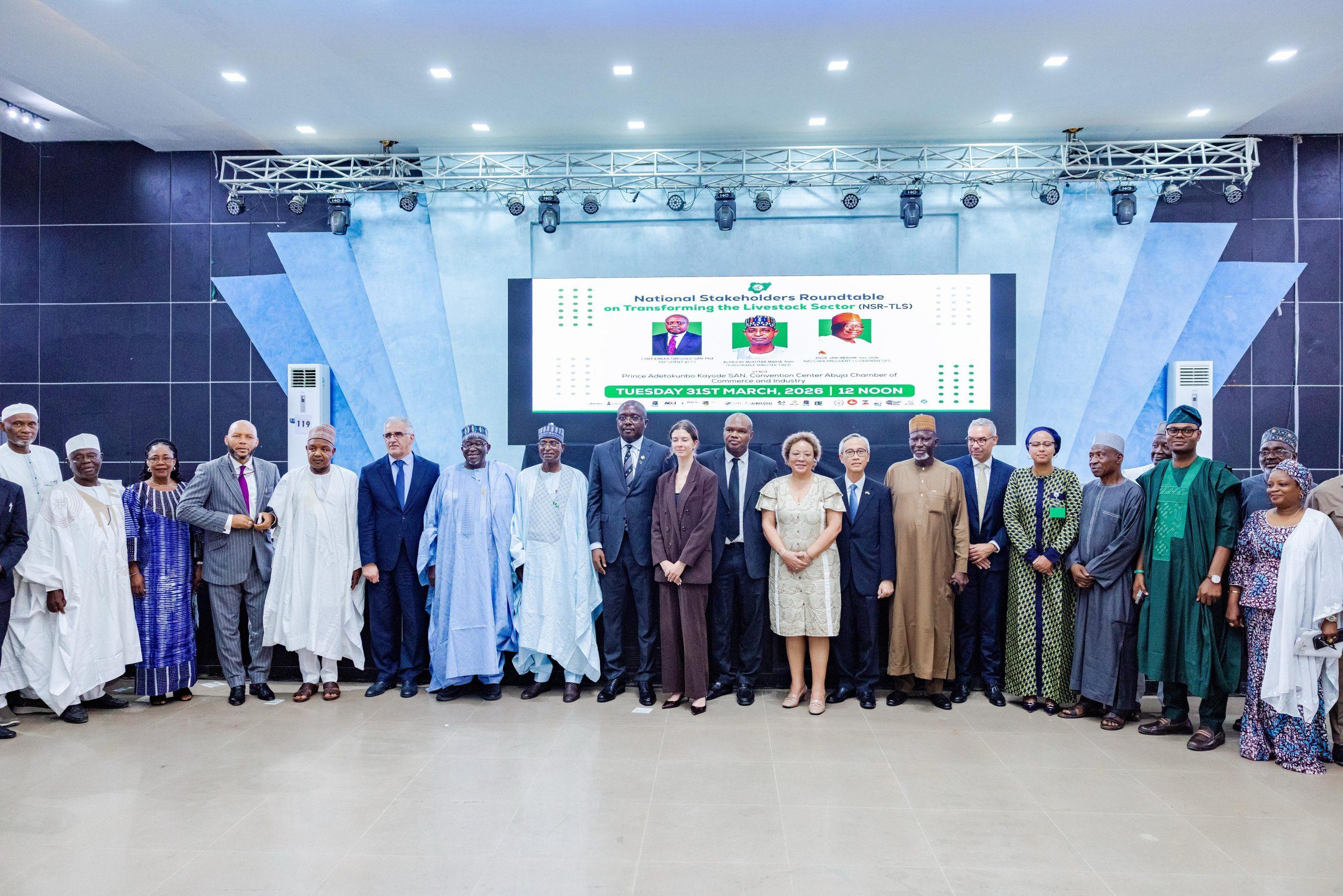
The Nigerian government has intensified efforts to unlock the full economic potential of the livestock sector, positioning it as a critical driver of inclusive growth, food security, and the nation’s ambition to build a $1 trillion economy.
The Minister of Budget and Economic Planning, Senator Abubakar Bagudu made this known at the National Stakeholders’ Roundtable on Transforming the Livestock Sector, convened by the Abuja Chamber of Commerce and Industry (ACCI) in Abuja.
Delivering a keynote address, the Minister outlined a coordinated, multi-level reform strategy anchored on policy alignment, institutional strengthening, and private sector-led investment.
He described the livestock sector as “one of Nigeria’s most inclusive and immediately scalable economic opportunities.”
He noted that the renewed national focus reflects the strategic vision of President Bola Tinubu, whose administration has prioritised structural reforms aimed at correcting historical inefficiencies and unlocking high-impact sectors across the economy
“The livestock sector is uniquely national in character, present in every state, every local government, and virtually every community. Yet, its contribution remains far below potential due to slow modernization and fragmented development efforts,” Bagudu stated.
READ ALSO:Jigawa Governor Leads Mission to Boost Forage, Livestock
Currently contributing about five percent to Nigeria’s Gross Domestic Product (GDP), the sector, according to the Minister, has the capacity for rapid expansion through improved productivity, value chain development, and targeted investments.
Bagudu disclosed that the National Economic Council (NEC), chaired by Vice President Kashim Shettima, is leading a whole-of-government approach to livestock reform. This includes harmonising federal, state, and local government interventions to ensure consistency, scale, and measurable impact nationwide.
He explained that the establishment of the Ministry of Livestock Development marks a decisive institutional shift designed to accelerate sectoral growth, attract investment, and drive modernization across production, processing, and distribution systems.
“Our objective is clear: to build a modern, competitive, and inclusive livestock economy that creates jobs, enhances livelihoods, and contributes significantly to national output,” he said.
The Minister emphasised that government’s role is to provide a transparent, rule-based framework that enables private sector participation, while strategically deploying public resources to de-risk investments and strengthen critical infrastructure.
He further revealed that coordinated budgetary support across all tiers of government is being mobilized to address structural gaps, enhance productivity, and support millions of smallholder producers who form the backbone of the sector.
Providing a deeper policy context, Bagudu highlighted that Nigeria’s demographic strength, being among the world’s most populous nations, offers a strong foundation for building a robust domestic market while scaling for exports, particularly when compared with peer economies such as Brazil and Indonesia.
“Countries with similar population dynamics have demonstrated that livestock development can significantly boost GDP. Nigeria has even greater potential, given the scale of participation and resource endowment,” he noted.
Addressing longstanding conflicts associated with livestock production, the Minister identified outdated production systems, land-use pressures, and slow adaptation to modern practices as key drivers.
He stressed that structured modernisation, supported by technology and improved resource management, will be central to resolving these challenges sustainably.
“Modernisation is the bridge between conflict and cooperation. By improving systems and supporting producers, we can transform historical tensions into economic partnerships that benefit all,” he said.
Bagudu commended the ACCI for its leadership in convening key actors across government, industry, and development partners, describing the initiative as a strategic complement to ongoing federal reforms.
Reaffirming the administration’s commitment, the Minister stressed that the livestock sector will play a defining role in Nigeria’s economic transformation journey.
“With the right coordination, investment, and policy discipline, the livestock sector will not only meet domestic demand but emerge as a major contributor to exports, jobs, and national prosperity. This is not just a reform agenda, it is an economic imperative,” he added.