


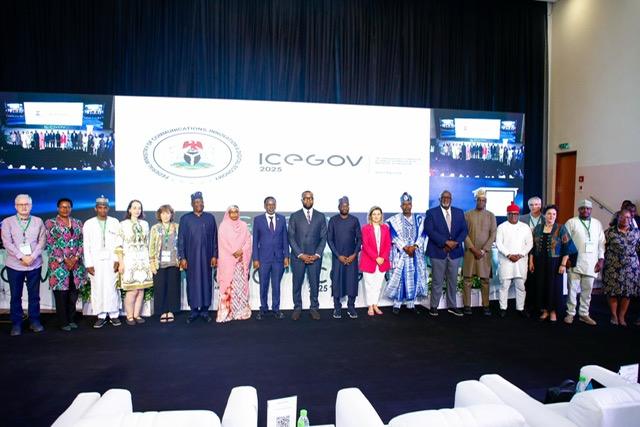
Nigeria’s Minister of Communications, Innovation and Digital Economy, Dr Bosun Tijani, has reiterated the country’s commitment to strengthening its digital economy by funding research projects nationwide.
The minister disclosed this at the opening ceremony of the International Conference on Theory and Practice of Electronic Governance (ICEGOV) 2025 in Abuja, Nigeria’s capital.
According to him, “The Nigerian government, after the last ICEGOV, funded over 55 research projects from the budget of NITDA. At the minute, we’re putting together about ₦12 billion to fund further research projects that are focused on the digital economy.”
“We are setting up three research clusters of six universities each, one focused on artificial intelligence, another focused on the biggest issue in our nation today, which is connectivity, where we’re investing significantly.
“And thirdly, because of our population, we are also funding another research cluster that is focused on digital skills and interests.”
In his remarks, the Director-General of the National Information Technology Development Agency (NITDA), Kashifu Inuwa Abdullahi, called for collaborations among countries to strengthen digital governance.
According to him, “Technology shows us we can do things in a different way and we can only do it when we are more intentional about it. The theme for this year’s conference is exciting, shaping digital governance through collaboration, innovation and inclusivity.
“It’s something we need to collaborate on, to work together to see how we can shape the future. Innovation also doesn’t happen in isolation, and it is not evenly distributed.
“Looking at the world, innovation happens in clusters, and what is so special about those clusters is collaboration, co-creation, bringing all the stakeholders together to design and shape the future.”

He added, “Digital governance is about government meeting people where they are. It is about delivering quality services to our citizens, making governance interactive, and getting feedback from citizens as well. To do that, we need to make sure our citizens are also digitally literate.
“So, we see ICEGOV as a platform we can leverage to do research, learn from what other countries are doing, share experiences with other African countries, and build our own digital nation.”
Similarly, the Chair of the ICEGOV Steering Committee, Elsa Estevez, highlighted the significance of cooperation in building capacities for better governance in the digital world.

“Given the latest developments on AI and the risk of increasing the divides that already exist between our societies, we need to cooperate at all levels.
“This entails cooperation between countries, but also within countries, across all levels of government. This cooperation must also be multistakeholder and multidisciplinary.
“Governments before and after digital transformation are key enablers for our society to pursue more equal, inclusive and productive futures. This is the vision that brought us, academics, policymakers and practitioners from different parts of the world together.
“Our core mission is working together to advance the state of the art and the state of practice in digital government, and ensure its contribution to development,” she concluded.
The 18th edition of the conference, with the theme “Shaping the Future of Digital Governance through Cooperation, Innovation, and Inclusion,” is jointly organised by the National Information Technology Development Agency (NITDA) and the United Nations University (UNU-EGOV).