


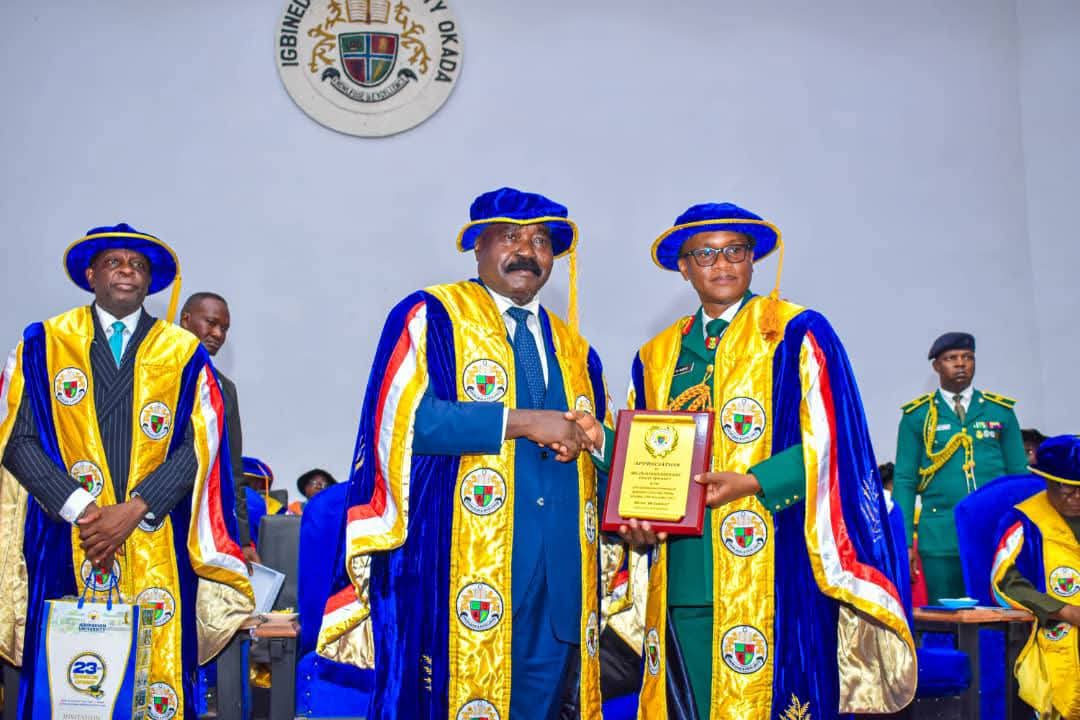
The Director-General (DG) of the National Youth Service Corps (NYSC), Brigadier General Olakunle Nafiu has called on Nigerian Universities to take decisive steps toward embracing Artificial Intelligence (AI) as a key driver of the nation’s future.
Speaking in a lecture delivered at the 23rd Convocation Ceremony of Igbinedion University, Okada, in Edo State, General Nafiu stressed that AI was already reshaping global education and that Nigeria must decide whether to guide this transformation or be overtaken by it.
He noted that Nigeria’s youthful population—60 percent of whom are under 25—places the country at a strategic crossroads.
General Nafiu said this “demographic advantage could become a national asset with the right investment in AI literacy and academic reforms.”
According to him, “estimates suggest that Nigeria’s AI market could grow by 27% annually and contribute as much as $15 billion to the country’s GDP by 2030.”

General Nafiu also highlighted groundbreaking learning experiments and AI-powered teaching tools that have produced outstanding student outcomes in various parts of the world and even within Edo State.
He said “the evidence shows that AI has the capacity to improve teaching quality, expand academic access, and elevate Nigeria’s competitiveness in the Fourth Industrial Revolution.”
Key Potentials
The DG outlined key potentials of AI in higher education, including personalised learning systems, accelerated research output, improved access to quality instruction, and streamlined administration across campuses.
General Nafiu stressed that universities must not remain passive consumers of foreign technology but should become active contributors to Africa-focused innovations.
“We must focus on AI solutions that address our unique challenges, such as predictive models for agriculture, diagnostic systems for local diseases, and educational platforms tailored to our multilingual, infrastructure-limited context,” he said.
General Nafiu asserted that the NYSC has the capacity to support this transformation, stating that its annual deployment of nearly 400,000 Corps Members presents an opportunity to promote digital literacy.
AI Literacy Ambassadors
Under this vision, he said, Corps Members could serve as AI literacy ambassadors in both urban and rural communities.
General Nafiuhowever, identified challenges such as infrastructural gaps, risks of digital colonialism, a shortage of AI-trained academic staff, ethical concerns, and funding constraints.
He emphasised the need for universities to adopt ethical guidelines for AI use and develop policies that would safeguard academic integrity.
General Nafiu recommended five strategic actions, including innovation in infrastructure, curriculum overhaul, capacity building for lecturers, strong institutional governance, and equitable access to AI tools.
He congratulated the graduands and advised them to embrace the digital future with responsibility.
“AI has already transformed your world; your task is to lead the transformation that comes next,” General Nafiu added.
Confidence Okwuchi