

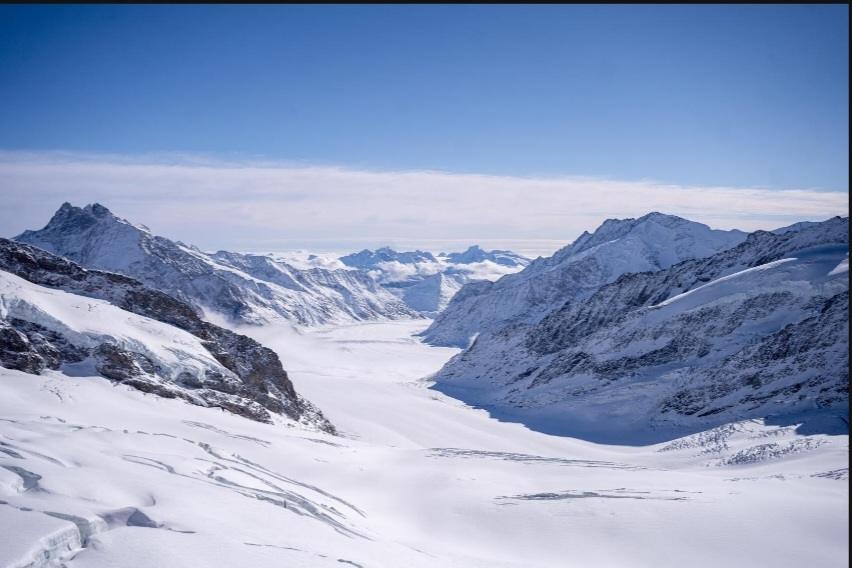
The International Ski and Snowboard Federation (FIS) and the World Meteorological Organization (WMO) have solidified their partnership with a scientific field meeting held atop Switzerland’s Great Aletsch Glacier, a UNESCO World Heritage Site.
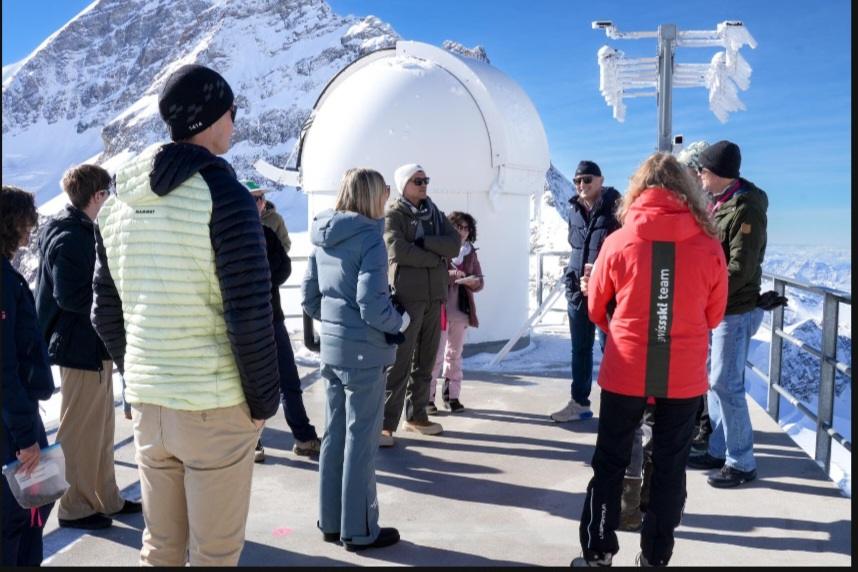
The event, convened at the Jungfraujoch observatory, brought together glaciologists, climate scientists, and winter sports professionals to highlight the accelerating impacts of climate change on snow and ice, and its consequences for both the environment and winter sports.
Speaking at the meeting, FIS CEO Urs Lehmann underscored the urgent need for action, warning that “the ripple effect of climate change on every aspect of society is truly terrifying.”
He noted that snow sports communities are among the first to feel the direct effects of global warming.
Lehmann added that the partnership between FIS and WMO represents a commitment to using science and knowledge to promote real change, emphasizing that credible climate action must be guided by data.
Dr. Stefan Uhlenbrook, WMO Director of Hydrology, Water Resources and Cryosphere, presented data showing a marked increase in global glacier retreat since the 1990s, driven by rising temperatures.
He explained that “melting glaciers lead to short-term hazards such as floods and landslides, and long-term challenges like water insecurity.”
Climate data from Switzerland indicates a significant decline in snow cover, particularly at lower altitudes, making winter sports increasingly uncertain in these areas.
Professor Matthias Huss, a glaciologist at ETH Zurich and head of Glacier Monitoring in Switzerland, said that “Swiss glaciers have lost one-quarter of their ice volume in the past decade, including a three percent reduction in 2025 alone, due to limited snowfall and record heatwaves.”
The discussions explored how both the sports and scientific communities can collaborate to promote awareness, mitigation, and adaptation to climate change.
Two-time Alpine Ski World Champion Alexandra Meissnitzer, now serving with the FIS President’s Office, emphasised the role of athletes in climate advocacy.
“As athletes, we may not have the scientific expertise to solve the crisis, but we can be powerful voices for awareness and action,” Meissnitzer said, stressing the value of bridging the gap between snow sports and science.
The partnership between FIS and WMO, formally signed in October 2024, marks the first collaboration between the UN’s World Meteorological Organization and an international sports federation.
It seeks to raise global awareness of the existential threat climate change poses to winter sports, tourism, and mountain ecosystems, while encouraging sustainable practices within the sports industry.
The Jungfraujoch meeting stands as a symbol of a shared mission uniting science, sport, and sustainability to confront the realities of a warming planet.
Olusola Akintonde