


Nigeria’s Minister of Power, Adebayo Adelabu, has commended the Nigerian Electricity Regulatory Commission (NERC) for its two decades of exemplary service in steering Nigeria’s power sector transformation.
Adelabu made the remarks while delivering a keynote address at the technical session themed “The Political Economy of the Power Sector Reforms under Bifurcated Constitutional Responsibilities” to mark NERC’s 20th Anniversary, held in Abuja, the nation’s capital.
The minister’s address traced the historical evolution of Nigeria’s electricity sector, highlighting milestones achieved through the Electricity Act 2023 and the Nigerian government’s vision for a cooperative and sustainable power market.
Adelabu praised NERC’s pivotal role since the enactment of the Electric Power Sector Reform Act (EPSRA) in 2005, which liberalised the electricity industry and transitioned it from a state-owned utility to a private-sector-driven market.
He said, “Over the past two decades, NERC has laid the foundation for market stability through robust tariff frameworks, consumer protection mechanisms and regulatory guidelines that continue to shape our power sector.”
The minister described the Electricity Act 2023, signed into law by President Bola Ahmed Tinubu on 6 June 2023, as “the most profound change in the history of Nigeria’s power sector.”
He explained that the Act, along with recent constitutional amendments, now empowers state governments to generate, transmit, distribute and regulate electricity within their territories.
“This shift from a single national electricity market to multiple sub-national markets marks a new era of decentralised power governance, unlocking the immense potential of states to pursue energy independence and tailored solutions,” Adelabu stated.

Unlocking Opportunities Across the States
The minister outlined three key benefits of the new framework:
- Unlocking Sub-National Potential: States can harness local resources such as solar, hydro and wind to meet their energy needs.
- Driving Competition and Investment: Decentralisation encourages private-sector participation, improved services, and innovative pricing.
- Incremental Electrification: A city-by-city model—beginning with state capitals by 2030—offers a pragmatic path to reliable power nationwide.
Addressing Challenges Through Collaboration
Adelabu cautioned that the emerging sub-national markets must be carefully managed to avoid fragmentation and conflicting regulations that could undermine investor confidence.
He called for a collaborative federal framework built on four key pillars:
- Policy and Regulatory Harmonisation:
Through the National Integrated Electricity Policy and Strategic Implementation Plan (NIEPSIP), the Ministry is aligning federal and state energy policies.
2. Addressing Liquidity Challenges:
The minister revealed that President Tinubu has approved a ₦4 trillion bond to clear verified debts owed to Generation Companies (GenCos) and gas suppliers.
“Additionally, a targeted subsidy framework is being developed to protect vulnerable households and support market sustainability.”
3. Strengthening the Entire Value Chain:
Ongoing reforms include tighter financial oversight of Distribution Companies (DisCos), the Presidential Power Initiative (Siemens Project), and stabilisation of generation capacity — which rose to 5,300 MW in 2024, up from 4,200 MW in 2023.
4. Prioritising Citizen-Centred Reforms:
Adelabu reaffirmed the government’s commitment to transparent tariff setting, enhanced metering through the Presidential Metering Initiative, and greater accountability.
“States are now empowered to hold DisCos and the Transmission Company of Nigeria (TCN) accountable for service quality. The people must be at the centre of our power reforms.”
He urged stakeholders to allow the new Electricity Act to mature before seeking amendments, stressing patience and policy consistency.
“The Federal Government has provided the framework, the States now have the autonomy to act, and the private sector has the capital and innovation to invest. Let us give this model time to mature,” he said.

Celebrating NERC @ 20
In his closing remarks, Adelabu praised NERC’s professionalism and resilience over the past 20 years.
“As NERC celebrates twenty years, we celebrate an institution that has embodied integrity, innovation, and foresight. Let this anniversary renew our shared commitment to collaboration between the federal and state governments, regulators and operators, and public and private investors,” he said.
He reaffirmed the Ministry’s vision for a cooperative federal electricity framework that guarantees reliable supply, industrial growth and improved living standards for all Nigerians.

NERC’s Legacy and Future Vision
Earlier in his opening address, NERC’s Vice Chairman, Musiliu Oseni, welcomed dignitaries and stakeholders to what he described as an “epoch-making event” celebrating the Commission’s journey since its establishment in 2005 under the EPSRA.
Oseni expressed gratitude to all who contributed to the evolution of Nigeria’s electricity market, acknowledging the reform-driven leadership of Ransome Owan, Sam Amadi, James Momoh and Sanusi Garba — all former NERC chairmen.
He stated that, despite challenges, the Commission had achieved significant milestones, from overseeing privatisation and unbundling to strengthening the electricity market and consumer protection.
According to him, NERC’s regulatory interventions have improved electricity delivery for at least 30% of Nigerian consumers compared with two decades ago, while saving the Nigerian government trillions of naira in subsidies through effective oversight.
Looking ahead, Dr Oseni reaffirmed NERC’s commitment to deepening reforms and attracting private investment, particularly in transmission infrastructure, noting that the newly established Transmission Infrastructure Fund (TIF) would play a pivotal role.
“Our transmission networks require significant investment. Government alone cannot fund them. With the right regulatory frameworks, we can unlock private sector participation to drive efficiency and reliability,” he said.
Oseni also urged a rethink of industrial power policy, proposing that part of the USD $2 billion available to the Rural Electrification Agency (REA) be directed toward powering industrial hubs.
Commending the 15 states that have received transfer orders to establish State Electricity Regulatory Commissions (SERCs), Oseni urged the new regulators to maintain independence and integrity.
“Regulation is not populism, activism, or politics. It requires objectivity, analytical depth, and independence. Always remember — there must be a utility before you can be called a regulator.”
As his tenure draws to a close, he thanked NERC staff, commissioners, and partners for their dedication to “Keeping the Lights On.”
Calls for Policy Stability
In his remarks, the Group Managing Director of Sahara Power Group, Kola Adesina, urged Nigeria’s power stakeholders to embrace policy consistency, regulatory stability, and national alignment to attract investment and ensure sustainable supply.
Adesina noted that with Nigeria’s population expanding by over 20,000 births daily, reliable electricity is crucial to the nation’s future.
“If our population is increasing geometrically and our electricity infrastructure is not, what do we do to make it happen?” he asked.
“For the influx of investment to come, one thing is required — the policy setting must be consistent. There must be stability in the system.”
Reflecting on Sahara Power’s journey since 2013, he said investors had faced obstacles stemming from inconsistent policies and weak commercial structures.
“It is not for lack of ambition or desire,” he said. “Somehow, we’ve not gotten it right yet. The momentum we have today must not be lost.”
Adesina commended President Tinubu’s ₦4 trillion debt clearance initiative for GenCos and gas suppliers, describing it as a “bold step that could unlock possibilities across the electricity value chain.”
He emphasised the need to prioritise local investors, arguing that Nigeria’s growth must be Nigerian-led.
“The people that built America are Americans. The people that built Korea are Koreans. If we treat our own with levity and dignify foreigners, we are destroying our own future.”
Adesina also decried widespread power theft and meter bypassing by wealthy customers, calling for honesty and accountability throughout the value chain.
“If those that are metered are bypassing meters, what incentive is there for universal metering? We must restore honesty and accountability in our electricity value chain,” he warned.
He concluded by urging all sector stakeholders—regulators, government, investors, and partners—to align under a single, disciplined national power plan.
The Nigerian Electricity Regulatory Commission (NERC) was established in 2005 under the Electric Power Sector Reform Act to regulate and oversee the Nigerian Electricity Supply Industry (NESI).
Its mandate includes promoting transparency, efficiency, and fairness in generation, transmission, distribution, and consumer protection.
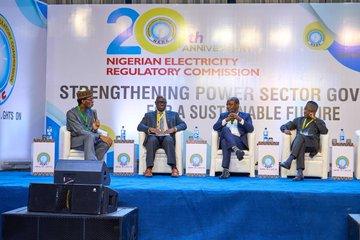
The 20th Anniversary event was attended by key stakeholders, including Senator Enyinnaya Abaribe, Chair of the Senate Committee on Power; Hon. Victor Nwokolo, Chair of the House Committee on Power; ministers, former permanent secretaries, power utility heads, development partners, and members of the National Assembly.