

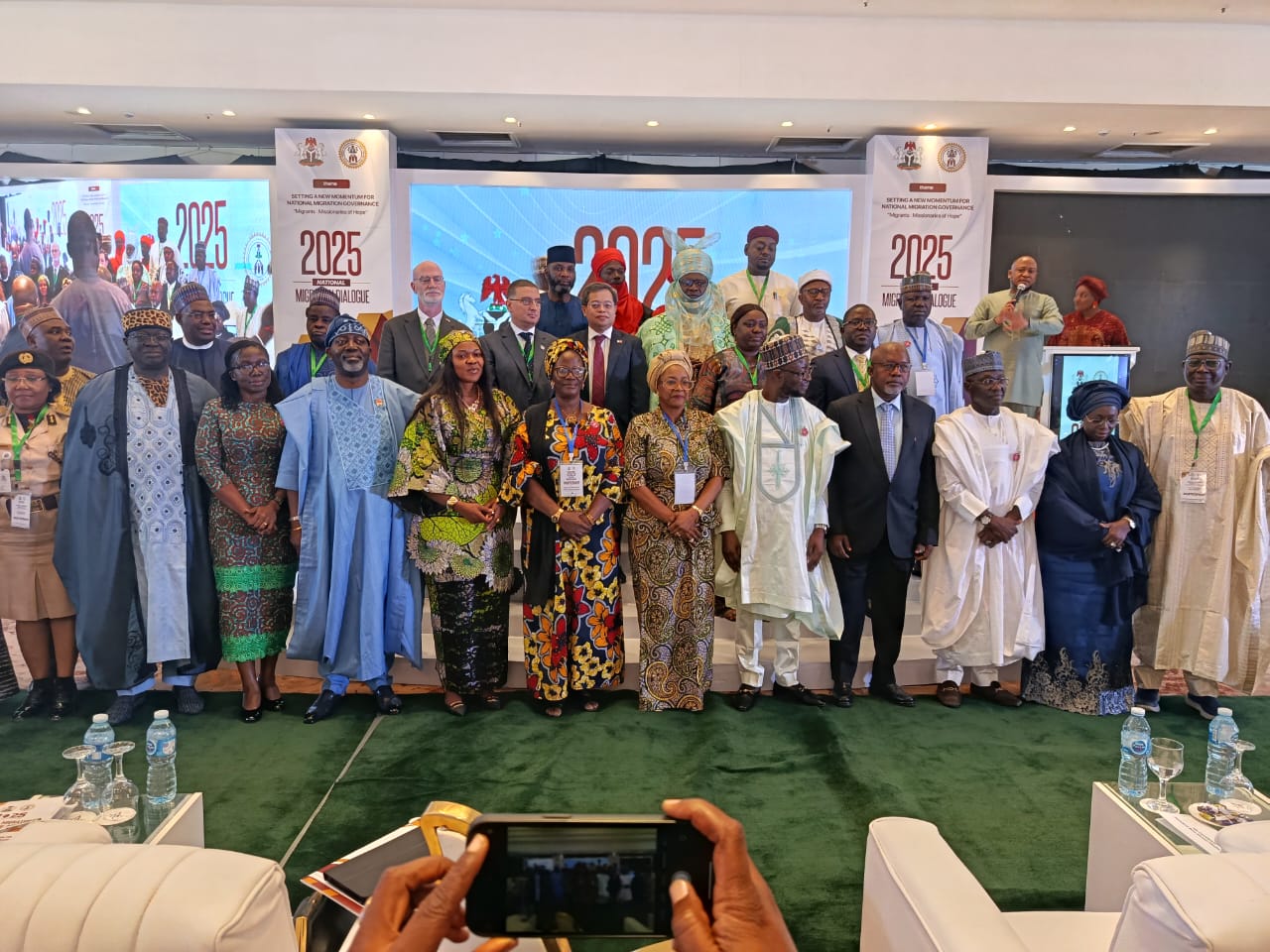
Nigerian President, Bola Ahmed Tinubu has presented the revised National Migration Policy.
President Tinubu presented the revised copy at the 2025 National Migration Dialogue organised by the National Commission for Refugees, Migrants and Internally Displaced Persons in Abuja, Nigeria.
Represented by the Minister for Humanitarian Affairs and Poverty Reduction, Dr. Doro Bernad, President Tinubu said the policy which serves as a guide for the nation’s migration governance architecture, reflects the evolving realities of migration and aligns with the administration’s Renewed Hope Agenda, while ensuring coherence with regional and global instruments, including the Global Compact for Migration, the Global Compact on Refugees, the AU Migration Governance Framework, and Agenda 2030.
He said as Nigeria reflect on national priorities, it is important to acknowledge the dynamics of labour mobility.
“Nigeria recently adopted the National Policy on Health Workers’ Migration, which complements the revised National Migration Policy. This strategic step ensures balanced, ethical, and beneficial migration in the health sector while protecting national interests. The implementation of this policy aligns with our broader national vision for sustainable human capital development”.
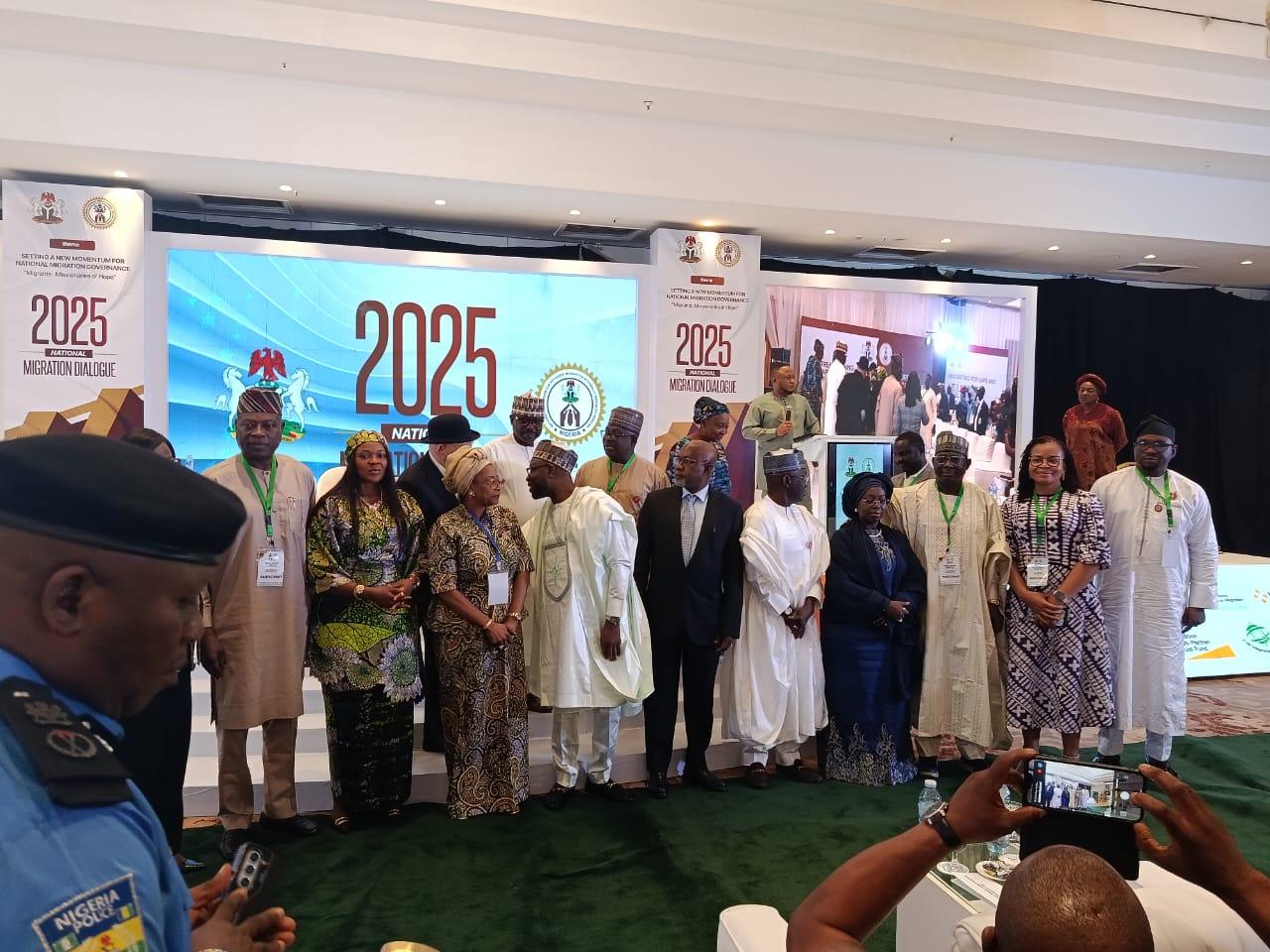
The President further noted that migration being a defining issue of the time, affects economic growth, national security, diaspora engagement, labour mobility, climate resilience, and sustainable development.
“With over 20 million Nigerians living abroad, remittances exceeding 20 billion USD annually, and increasing internal mobility shaped by climate-induced pressures, we must adopt a governance model that is evidence-based, people-centred, and development-oriented”.
He emphasised that the Revised National Migration Policy also introduces innovations, strengthens institutional coordination, and provides a clear Implementation Plan and Monitoring Framework.
“The Federal Government is fully committed to its operationalization and we will work tirelessly with all stakeholders to ensure its effective implementation at national and sub-national levels”.
Full Operationalization
President Tinubu who urged all stakeholders to focus on innovative solutions, collaborative approaches and the full operationalization of the National Migration Policy, also commended partners for their continued support.
“We deeply appreciate the continued support of the International Organization for Migration (IOM), the International Centre for Migration Policy Development (ICMPD), the German Development Corporation (GIZ), International Return and Reintegration Assistance (IRARA) and other international development partners within the Migration Network whose critical contributions have strengthened Nigeria’s migration governance strides”.
The Nigerian President also acknowledged the strong role of civil society organisations, the academia and the private sector for their meaningful contributions to shaping our national processes.
Read Also: Migration Policy: Stakeholders Strategise on Public Awareness
Nigeria unveils revised National Policy on Migration 2020
For his part, the Minister for Humanitarian Affairs and Poverty Reduction, Dr. Doro Bernad said migration governance must be firmly grounded in the humanitarian development-peace nexus.
“It is a lived reality for millions of Nigerians across our communities. It is shaped by conflict, climate stress, economic inequality, insecurity, and the search for dignity and opportunity” he said.
He disclosed that Nigeria currently hosts over 6 million internally displaced persons (IDPs), a reality that reinforces the need for policies that go beyond emergency response and focus on durable solutions, community stabilisation, and social cohesion.
Dr Bernad added that the revised policy rightly strengthens provisions on internal displacement, return, reintegration, and community-based recovery.
Extensive Consultative Process
The Federal Commissioner, National Commission for Refugees, Migrants and Internally Displaced Persons, Tijjani Aliyu said the review process went through an extensive and consultative process with the support of the International Organization for Migration (IOM), within the framework of the Migration Multi-Partner Trust Fund MMPTF, as well as regional and zonal engagements across the six geopolitical zones critically capturing state-level realities, diverse migration experiences and community perspectives, thereby ensuring that the revised Policy reflects Nigerian priorities and lived realities.
The Chief of Mission, International Organisation for Migration, Nigeria, Sharon Dimanche said the policy aligns Nigeria with the global and regional framework which strengthens collaboration and coordination.
She emphasised the need for stakeholders to move decisively from policy to practice, from coordination to results, from momentum to measurable impact.
“If we succeed, the young Nigerian can see that displacement can give way to recovery, movement can lead to skills, livelihood and stability and governance at every level can restore hope.
“When migration is well governed, it’s not a challenge to be feared, it’s a strength to be harnessed and Nigeria has shown the vision, leadership and unity of purpose to do just that”.
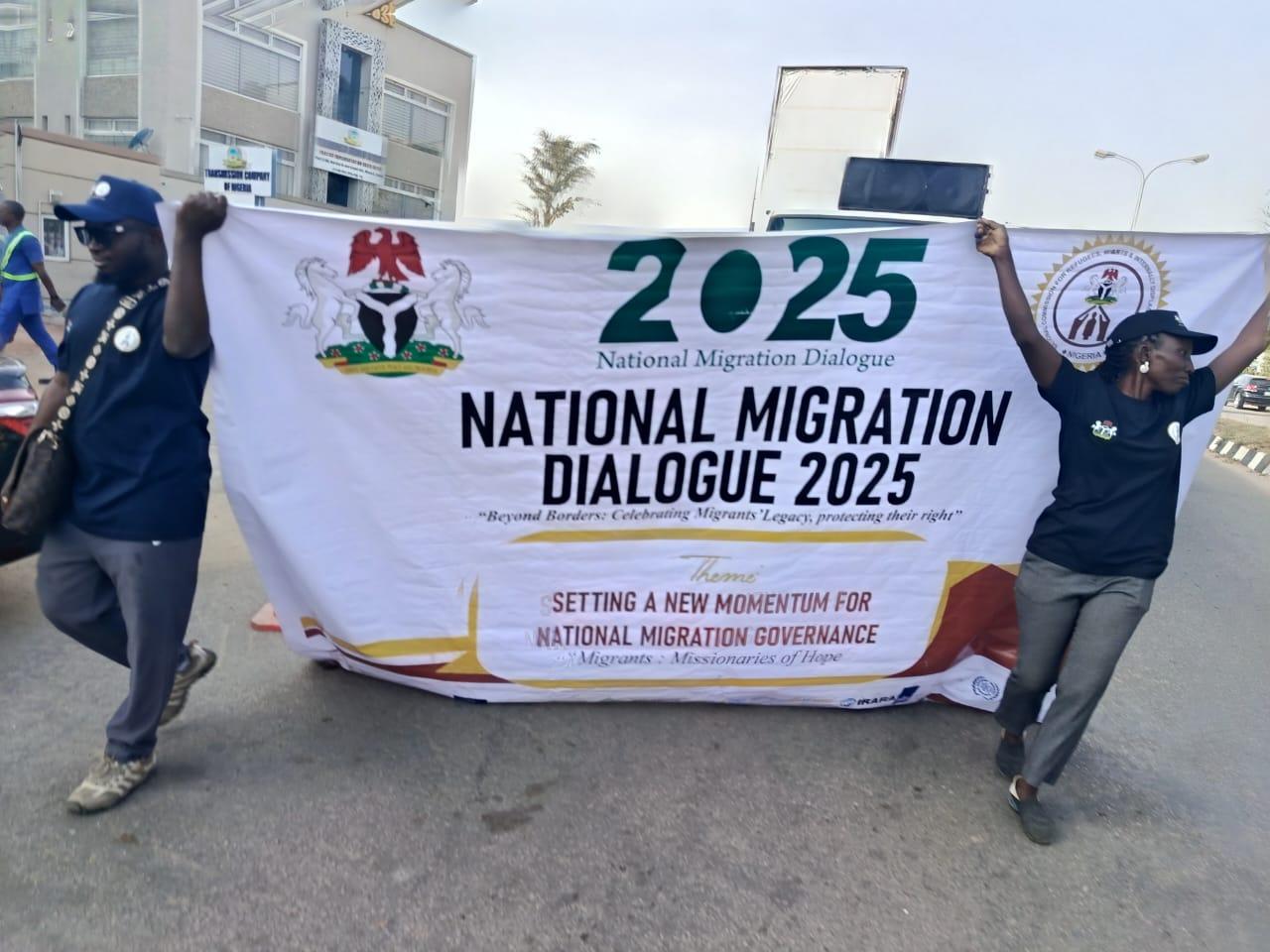
Earlier in the day, the National Commission for Refugees Migrants and Internally Displaced Persons, organised a road walk to sensitise Nigerians on the dangers of irregular migration.
The Director, Migration Affairs in the Commission, Mrs Katherine Udida who represented the Federal Commissioner, Tijjani Aliyu emphasised that although migration is a human right, there is a need to always follow the right pathways.
“Our emphasis is always that if you must migrate, do so the right way. And so, we’ll continue with the sensitisation. Some will heed, some may not, our duty is to continue sensitising. Awareness creation is what we’ve done today and will continue to do”.
Mrs Udida added that the Commission is partnering with other stakeholders at the grassroots to ensure that the people at sub-national level understand the characteristics of migration.
The theme for the 2025 Migration Dialogue is The Revised National Migration Policy: “Setting a New Momentum for National Migration Governance.”