

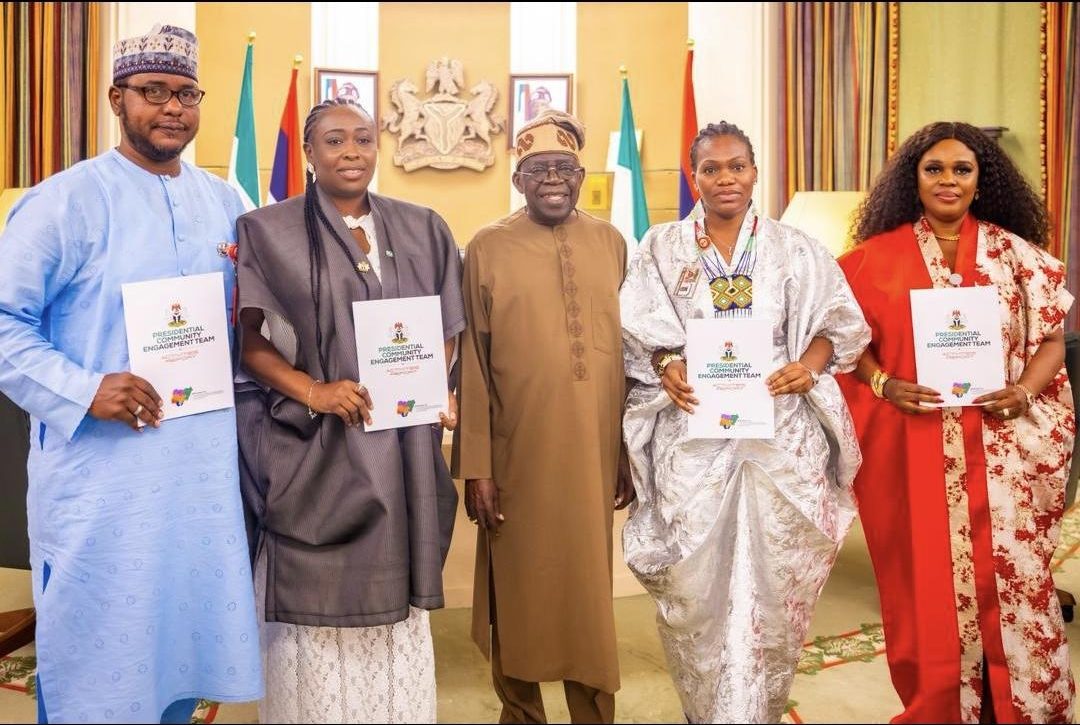
Nigeria’s President, Bola Ahmed Tinubu, has received briefings on zonal security, infrastructure, and grassroots development.
The Senior Special Assistant to the President on Community Engagement (North-Central), Dr. Abiodun Essiet, made this known on Monday while briefing State House correspondents in Abuja, alongside her counterparts from the North-West, South-East, and South-West zones.
Dr. Essiet identified historical mistrust, land-grabbing, banditry, and illegal mining as major factors causing insecurity and communal bloodshed in the North-Central region.
Essiet said the violence ravaging the region was “deeply rooted in unresolved historical tensions and resource conflicts,” which had been worsened by the activities of armed groups exploiting governance and development gaps.
“Our briefing focused heavily on insecurity, and we identified historical mistrust, land-grabbing, banditry, and illegal mining as major triggers of violence. The President has promised to strengthen peace structures and ensure our communities are safe,” she said.
She disclosed that community peace structures have been established across 121 local government areas including 32 in Niger, 21 in Kogi, and 23 in Benue States with deployment set to commence this week across all 17 LGAs of Plateau State.
According to her, the peace structures are designed to integrate traditional rulers, farmers’ associations, Fulani communities, youth, and women groups in fostering dialogue, conflict resolution, and social reconciliation at the grassroots level.
She added that President Tinubu has directed the relevant ministries and agencies to take immediate measures toward rehabilitating critical road infrastructure in the affected areas.
Read Also: Regional Development Commissions to Partner States on Security, Infrastructure
Nigeria Adopts Advanced Technologies to Boost Infrastructure Development
Speaking on developments in the North-West, the Senior Special Assistant to the President on Community Engagement for the zone, Abdullahi Tanko-Yakasai, noted that his office is prioritising interventions aimed at reducing the number of out-of-school children across the region.
He said vulnerable children were being enrolled in primary schools and provided with uniforms, books, and learning materials. While acknowledging improved agricultural output this season, Yakassai noted that fertiliser access remained a challenge and that the President had promised intervention.
Tanko-Yakasai further highlighted efforts to mobilise voter registration and create awareness about the new student loan scheme and ongoing tax reforms.
“We are the bridge between the Federal Government and the grassroots,” he said.
For the Southeast, the Senior Special Assistant Chioma Nweze said the region had launched a Citizens’ Assembly to deepen engagement and understanding of government policies.
She noted that renewed federal presence through ministerial appointments and major road projects had begun to restore public confidence. “It’s been long since we saw federal presence in the Southeast. But now, we are seeing a lot of road construction courtesy of this administration,” she said.
Nweze added that the Monday sit-at-home directive was losing traction in the region, while the President had pledged support for youth skills acquisition and agricultural programmes across the region’s 95 local government areas.
Nationwide Enrolment of NIN
Also briefing Journalists, the representative for the Southwest, Moremi Ojudu, described the discussions with the President as “insightful,” noting that President Tinubu emphasised the need to expand National Identification Number (NIN) enrolment nationwide to strengthen identity management.
She added that her team would scale up grassroots sensitisation to deepen understanding of the Renewed Hope Agenda and promote peacebuilding.
“We owe it to ourselves to safeguard this country. We have nowhere else to go,” she said, adding that the President directed collaboration with key stakeholders on livestock reforms in the North-Central.
Representatives for the South-South and North-East zones were absent due to official engagements.
The Presidential Community Engagement Team was established to enhance grassroots mobilisation and provide real-time feedback to the Presidency on policy implementation and citizen response.
Olusola Akintonde