

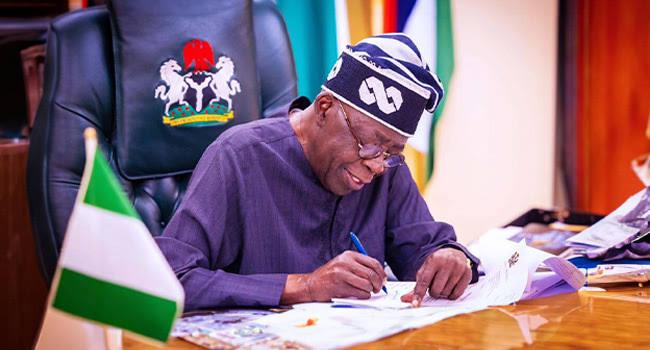
President Bola Ahmed Tinubu has signed four landmark tax reform bills into law, unifying Nigeria’s fragmented tax system, remove redundant overlaps, boost investor confidence, enhance transparency, and promote coordinated efforts across all levels.
President Tinubu described the legislation as a clear departure from previous policies, emphasising that the reforms are designed to ease the burden on working families, small businesses, and low-income earners while eliminating inefficiencies that have long plagued Nigeria’s fiscal structure.
The President on Thursday said in a post on his verified X handle @officialABAT, that the new tax limit. forms the groundwork for the Nigeria of tomorrow, focused on unlocking opportunities for all.
“We are also building a framework for the Nigeria of tomorrow-leaner, fairer and laser focused on unlocking opportunities for all.”
The Nigerian Leader explained that with the new tax reform laws, the Bola Tinubu led Administration is now laying the foundation for a tax regime that is fair, transparent and fit for a modern, ambitious Nigeria.
“These reforms go beyond streamlining tax codes. They deliver the first major, pro-people tax cuts in a generation, targeted relief for low-income earners, small businesses, and families working hard to make ends meet.
“For too long, our tax system has been a patchwork-complex, inequitable, and burdensome. It has weighed down the vulnerable and shielded inefficiency. That era ends today.
“We are laying a foundation for a tax regime that is fair,transparent and fit for a modern, ambitious Nigeria. A tax regime that rewards enterprise, protects the vulnerable,and mobilises revenue without punishing productivity.
The four bills are ; the Nigeria Tax Bill (Fair Taxation), Nigeria Tax Administration Bill, Nigeria Revenue Service (Establishment) Bill, and the Joint Revenue Board (Establishment) Bill”.
President Tinubu also commended the Presidential Fiscal Policy and Tax Reform Committee for its tireless work,the National Assembly for its rigorous review, the subnational partners for their critical contributions and Nigerians for keeping faith with the tax reform vision.
He added that the newly signed tax reform act indicates the beginning of another era re-echoing Nigeria’s commitment to fair and most open business.
Concluding his message, President Tinubu made a nationwide appeal for collective action, “This is our rallying cry : Simplify. Reform.Grow.
“Let the World know that Nigeria is open for business ,and this time,everyone has a fair shot.
“We are betting on a new Nigeria and building it block by block” The President added
The historic presidential assent ceremony was witnessed by the Senate President, Godswill Akpabio, Speaker of the House of Representatives, Tajudeen Abbas, Senate Majority Leader, Jibrin Barau, House Majority Leader, Prof. Julius Ihonvbere , chairman of the Senate Committee on Finance, Mohammed Sani Musa and his House counterpart, James Faleke.
Also present to witness the event were the Chairman of the Governors Forum, Abdulrazaq Abdulrahman, the Chairman of the Progressive Governors Forum, Hope Uzodinma, the Minister of Finance and Coordination of the Economy, Wale Edun and the Attorney General of the Federation,Lateef Fagbemi.
Newly Signed Four Tax Reform Bills
The Nigeria Tax Bill (Ease of Doing Business), aims to consolidate Nigeria’s fragmented tax laws into a harmonised statute.
The second bill, the Nigeria Tax Administration Bill, will establish a uniform legal and operational framework for tax administration across federal, state, and local governments.
The Nigeria Revenue Service (Establishment) Bill, the third bill, repeals the current Federal Inland Revenue Service Act and creates a more autonomous and performance-driven national revenue agency— the Nigeria Revenue Service (NRS). It defines the NRS’s expanded mandate, including non-tax revenue collection, and lays out transparency, accountability, and efficiency mechanisms.
The last of the four is the Joint Revenue Board (Establishment) Bill. It provides for a formal governance structure to facilitate cooperation between revenue authorities at all levels of government.
It introduces essential oversight mechanisms, including establishing a Tax Appeal Tribunal and an Office of the Tax Ombudsman.
Olusola Akintonde