


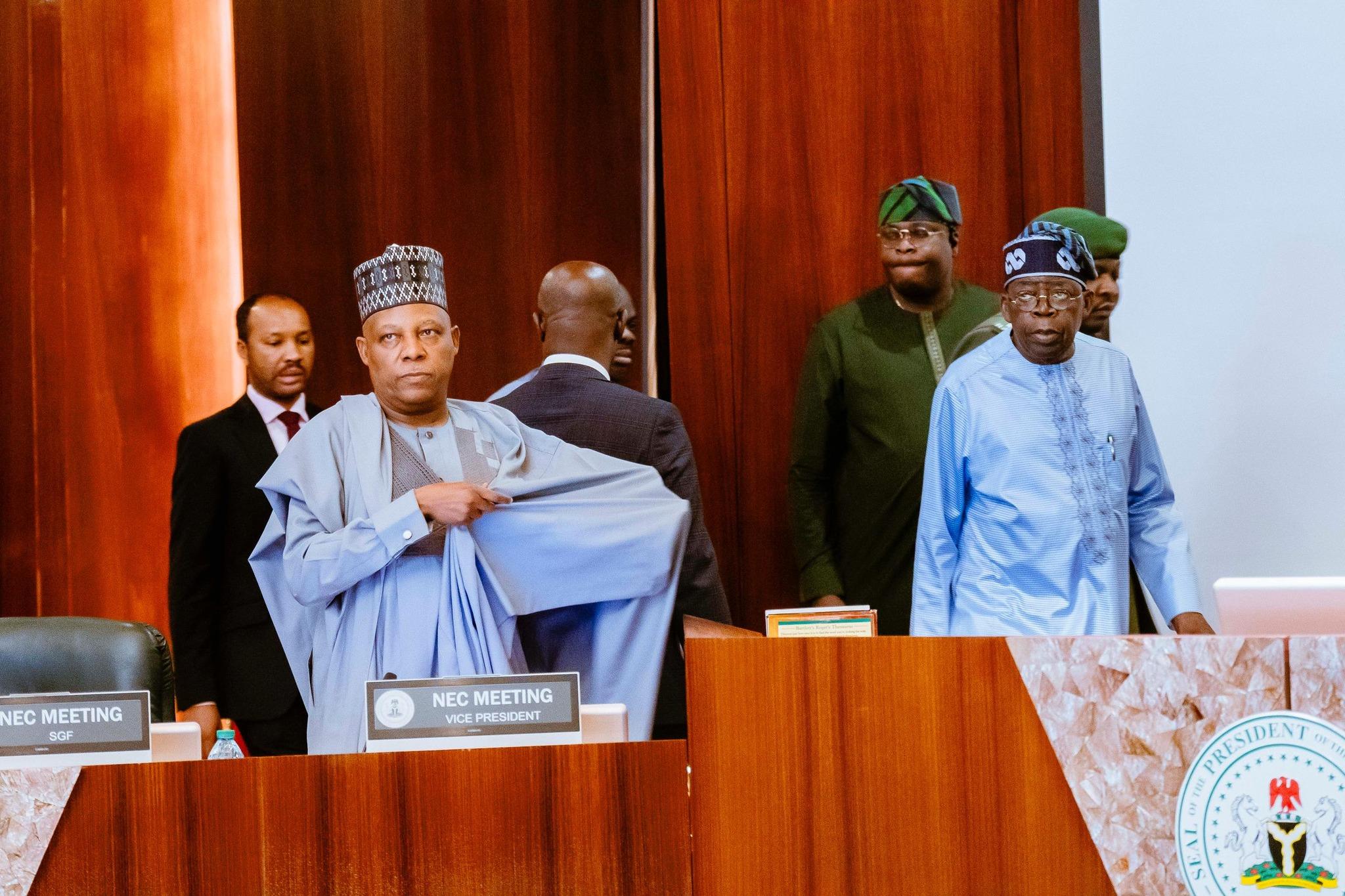
President Bola Tinubu has charged state governors to prioritise the welfare of Nigerians by investing more in their future, focusing on rural electrification, agricultural mechanisation, poverty eradication, and improved infrastructure investment.
President Tinubu’s charge to the governors followed a presentation on the Renewed Hope Ward Development Programme by the Minister of Budget and Economic Planning, Atiku Bagudu, at the 150th meeting of the National Economic Council (NEC) held at the State House Council Chambers, Abuja.
STATE HOUSE PRESS RELEASE
President Tinubu To Governors: Invest More In Poverty Eradication, Power, Agriculture
*As NEC endorses ward development programme to hasten social protection at grassroots*
*Orders transfer of Surveyor-General’s office to presidency for seamless… pic.twitter.com/X8Zd8VhGCE
— Bayo Onanuga (@aonanuga1956) July 31, 2025
The new Renewed Hope Ward Development Programme (RHWDP) is aimed at actualising double-digit economic growth through direct intervention in Nigeria’s 8,809 administrative wards across all 36 states of the country.
The president implored the governors to do more to positively impact the lives of Nigerians in the grassroots, saying, “I want to appeal to you; let us change the story of our people in the rural areas.
“The economy is working. We are on the path of recovery, but we need to stimulate growth in the rural areas. We know the situation in the rural areas; let us collaborate and do what will benefit the people.”
President @officialABAT on Monday charged state governors to prioritise the welfare of Nigerians by investing more in their future, putting more money into rural electrification, agricultural mechanisation, poverty eradication, and improved investment in infrastructure.
This is… pic.twitter.com/LKqjw9BoDB
— Senator Kashim Shettima (@officialSKSM) July 31, 2025
More Collaboration
President Tinubu urged state governors to collaborate with the federal government to drive economic development in rural areas across the country. “We have to embrace mechanisation in agriculture, fight insecurity and improve school enrolment through school feeding,” the president said.
Accordingly, he directed NEC to set up a committee to enhance the actualisation of legacy projects, especially the Lagos-Calabar and the Sokoto-Badagry Super Highways.
He also ordered the transfer of the Office of the Surveyor-General of the Federation to the presidency to enhance the seamless actualisation of his administration’s legacy projects across the country.
The programme is anchored on President Tinubu’s Renewed Hope Agenda, which seeks to achieve a $1 trillion economy by 2030, requiring a growth rate of 15%, while the current rate sits below 4%.
Legality
The RHWDP draws its legal framework from the 1999 Constitution and the Fifth Alteration Act, which mandates state policy toward ensuring food security and improved production methods.
Its key targets include sustainable support for economic activities with minimum thresholds of 1,000 economically active individuals for smaller wards and 2,000 for larger ones.
Steering Committee
A National Steering Committee comprising representatives from all six geopolitical zones will oversee implementation, with the Ministry of Budget and Economic Planning as secretariat.