

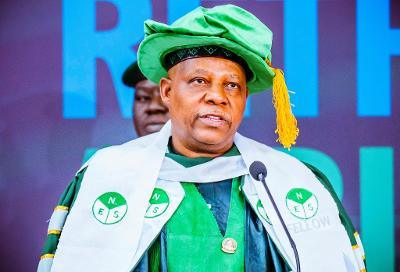
Vice President Kashim Shettima says the courageous reforms being undertaken by President Bola Ahmed Tinubu’s administration to fix Nigeria’s structural weaknesses demonstrate the power of political will in economic policy.
He urged African nations to embrace the knowledge economy as a bridge to transform the continent’s growth and productivity beyond outdated economic models.
Speaking on Tuesday in Abuja at the opening of the 66th Annual Conference of the Nigerian Economic Society (NES), Shettima said Nigeria faces the same economic headwinds as other African nations, but the country’s hope lies in having a president who listens.
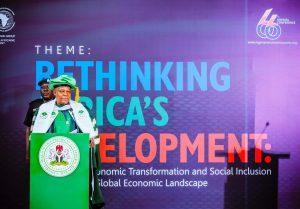
“Nigeria is, of course, not exempt from Africa’s economic tragedies. But our silver lining is the listening ear of His Excellency, President Bola Ahmed Tinubu. Under his leadership, this administration has embarked on bold and inevitable reforms to address structural weaknesses that others before us only paid lip service to. These reforms testify to the power of political will in economic policy. Their painful but necessary consequences remind us that a malignant disease can only be cured by painful surgery. The wounds are temporary, but the recovery is permanent,” Shettima said.
The Vice President stressed the urgency for Africa to shed old-fashioned approaches and embrace structural transformation to reverse unemployment and strengthen human capital.
“We live in a world where a random citizen in Daura can outsource his services to a corporation in Dallas without seeing the inside of a plane or leaving his bedroom. But to catch up with this changing world, Africa must embrace a structural transformation that reinvents its human capital and reverses unemployment. Poverty must be confronted head-on for the promise of this continent to be realised in the lives of our people. There is no justification for the low per capita income that afflicts our nations amidst the resources at our disposal,” he added.
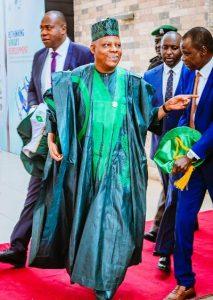
Shettima said global disruptions such as trade protectionism, geopolitical conflicts, supply-chain shocks, the energy transition, and the rise of artificial intelligence should be seen as opportunities rather than just threats, and he reaffirmed the administration’s focus on investment-friendly measures and social protection.
“Policies in transportation, healthcare, and education have been deliberately targeted at reducing inequality because these are the sectors that affect the weakest among us,” he said.
He also urged conference participants to treat their work as a continental and national assignment.

“I urge all participants to take their role in this conference not as a scholarly exercise but as a continental and national assignment—one expected to salvage Africa’s economies from their fragile status,” Shettima said.
Minister of Budget and Economic Planning, Atiku Bagudu, praised the Vice President’s role in advancing the reforms and pledged full integration of the NES into development planning, including the Renewed Hope Ward Development Programme.
Minister of Livestock Development, Alhaji Idi Mukhtar Maiha, highlighted the sector’s multi-billion-dollar potential and expressed readiness to partner with the NES, describing the livestock sector as “the next crude oil,” Maiha said.
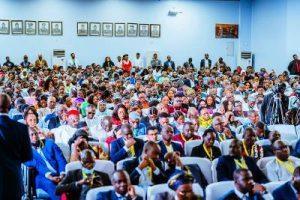
NES President, Prof. Adeola Adenikinju, reiterated the society’s commitment to partnering with the Tinubu administration to drive genuine economic transformation and national development, noting the NES’s reforms to widen reach and inclusivity through state chapters, a Women’s Wing and a Students’ Wing.
Director of the African Development Institute, Dr. Eric Kehinde Ogunleye, said “Nigeria occupies a strategic position in moving the African continent forward,” Ogunleye said, and commended the Tinubu administration for reforms aimed at structural transformation and inclusive growth.
The high point of the event was the investiture of Vice President Kashim Shettima as a Fellow of the Nigerian Economic Society.