

Gloria Essien Abuja
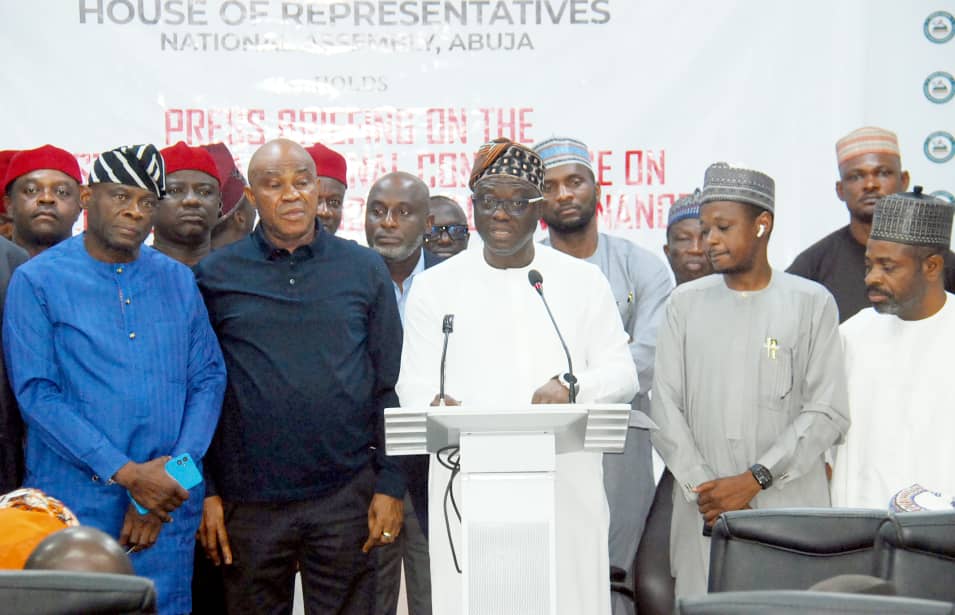
The House of Representatives Committee on Public Accounts is set to host National Conference On Public Accounts And Fiscal Governance (NCPAFG), in Abuja.
The Chairman, Public Accounts Committee (PAC), House of Representatives Mr. Bamidele Salam made the disclosure at a Media briefing in Abuja.
He said that the high-level national conference is convened as a key component of the 10th People’s House Legislative Agenda, which is firmly committed to strengthening good governance as a foundation for sustainable national development.
” Anchored on the theme “Fiscal Governance in Nigeria: Charting a New Course for Transparency and Sustainable Development,” the conference represents a bold, deliberate, and strategic initiative by the Public Accounts Committee and the House of Representatives at large to reposition Nigeria’s fiscal governance and public accounts management systems towards greater integrity, enhanced efficiency, and robust accountability. It will also serve as a veritable platform to mainstream the Renewed Hope Agenda into global fiscal governance transparency structures to firmly reestablish Nigeria’s leadership both regionally and at a continental level.
” As a crucial stakeholder charged with the constitutional mandate to oversight public financial management activities and review reports of audit and accounting institutions, we note that Nigeria stands today at a critical juncture in its journey toward fiscal governance reforms. While some progress has been made over the years and particularly the notable reforms under the current administration, entrenched systemic challenges remain. These challenges include limited full-cycle audit implementation, high-level institutional financial leakages, a skewed and opaque public financial reporting system, and widespread non-enforcement of financial protocols across MDAs at all levels of government”. Mr. Salami said.
He said that available records from 2020/2021 Auditor Generals reports reveal that over a quarter-trillion Naira in public expenditures remain unaccounted for, with high incidents of unauthorized virements, growing numbers of audit queries each fiscal year, and the reported cases of more than 60% of MDAs persistently failing to comply with financial regulations.
“These trends, if left unchecked, will continue to erode public trust, undermine sustainable national development, and weaken our democratic institutions.
” Therefore, if Nigeria is to reap optimally the full benefits of the ongoing fiscal governance reforms initiated by the Tinubu-led administration, then we must seize the opportunity of this conference as a platform for high-level national policy dialogue for galvanization of stakeholders’ commitment.
We strongly believe as important stakeholders, that t is imperative for us to leverage the opportunity of this unique conference to deepen collaboration among Public Accounts Committees, especially at the sub-national levels, Audit Institutions, Regulatory Bodies, and Anti-Corruption Agencies”. He said.
Mr. Salam also said that the NCPAFG which would serve as a prelude to the Annual Conference of the West African Association of Public Accounts Committees (WAPAC) later in year following Nigeria’s emergence as the winner of the hosting rights for 2025 edition has been deliberately structured to deliver strong institutional value.
He noted that the conference would hold with special focus on the following objectives:
” 1. Build Institutional and Human Capacity: it aims deliver targeted capacity development and skill-building sessions for Public Accounts Committees, Auditors, Financial Managers and Regulatory Officers across all tiers of government, with an emphasis on contemporary tools and practices for audit efficiency and oversight.
2. Facilitate Knowledge Exchange and Co-learning: Create a participatory environment for dialogue and experience-sharing among national and international stakeholders on public sector audit reforms, accountability practices, and digital innovations in fiscal governance.
3. Strengthen Audit Implementation Frameworks: Examine the current institutional frameworks and technical bottlenecks limiting the implementation of audit recommendations, and recommend specific mechanisms for reform, enforcement, and institutional compliance.
4. Harmonize National and Sub-National laws and PAC’s practice direction: To align and standardize the laws, procedures, and operational guidelines of Public Accounts Committees (PACs) and other stakeholders in fiscal governance space across the national and sub-national levels for greater consistency and effectiveness in public financial oversight.
5. Foster Broad Stakeholder Commitment to Transparency and Accountability: Build consensus and shared responsibility among all actors in the fiscal governance space to uphold accountability, reduce leakages, and institutionalize sound public financial management practices.
6. Promote Post-Legislative Scrutiny and Enhanced Sub-national Accountability: Deepen the capacity of sub-national legislatures and PACs in post-legislative audit and oversight to bridge the accountability gap between budget appropriations and actual service delivery.
7. Explore Global Best Practices in Digital Governance and Anti-Corruption: Introduce proven international models in audit automation, fiscal tracking, and anti-corruption technologies in line with the evolving demands of a digital economy and 21st-century governance”.
The Chairman added that ” At the end of the conference, we expect tangible outcomes, including but not limited to achieving:
1. A significant reduction in unaccounted expenditures from over ₦300 Billion to less than ₦1Billion in the next fiscal year 2026,
2. A drop in the number of audit queries and rate of non-compliance with financial regulations from over 60% to less than double digit at 9% through rigorous capacity building development.
3. A measurable significant improvement in Nigeria’s Fiscal Governance Health Index (FGHI) across all levels of government through enhanced transparency measures using digital technology tools for sustainable national development.
4. Issue a High-Level Broad Stakeholders’ Communique that will outline actionable policy, legislative and institutional recommendations required to chart a new course for fiscal transparency and sustainable development. Among the expected legacy outcomes are:
5. The development of a National Blueprint for Digital Audit and Financial Management, and
6. Establish Nigeria’s National Fiscal Governance Working Group, a multi-stakeholder body that would be tasked with sustaining reforms and institutionalizing good fiscal governance practices nationwide”, he added.
The theme of the conference is Fiscal Governance in Nigeria: Charting a New Course for Transparency and Sustainable Development.