

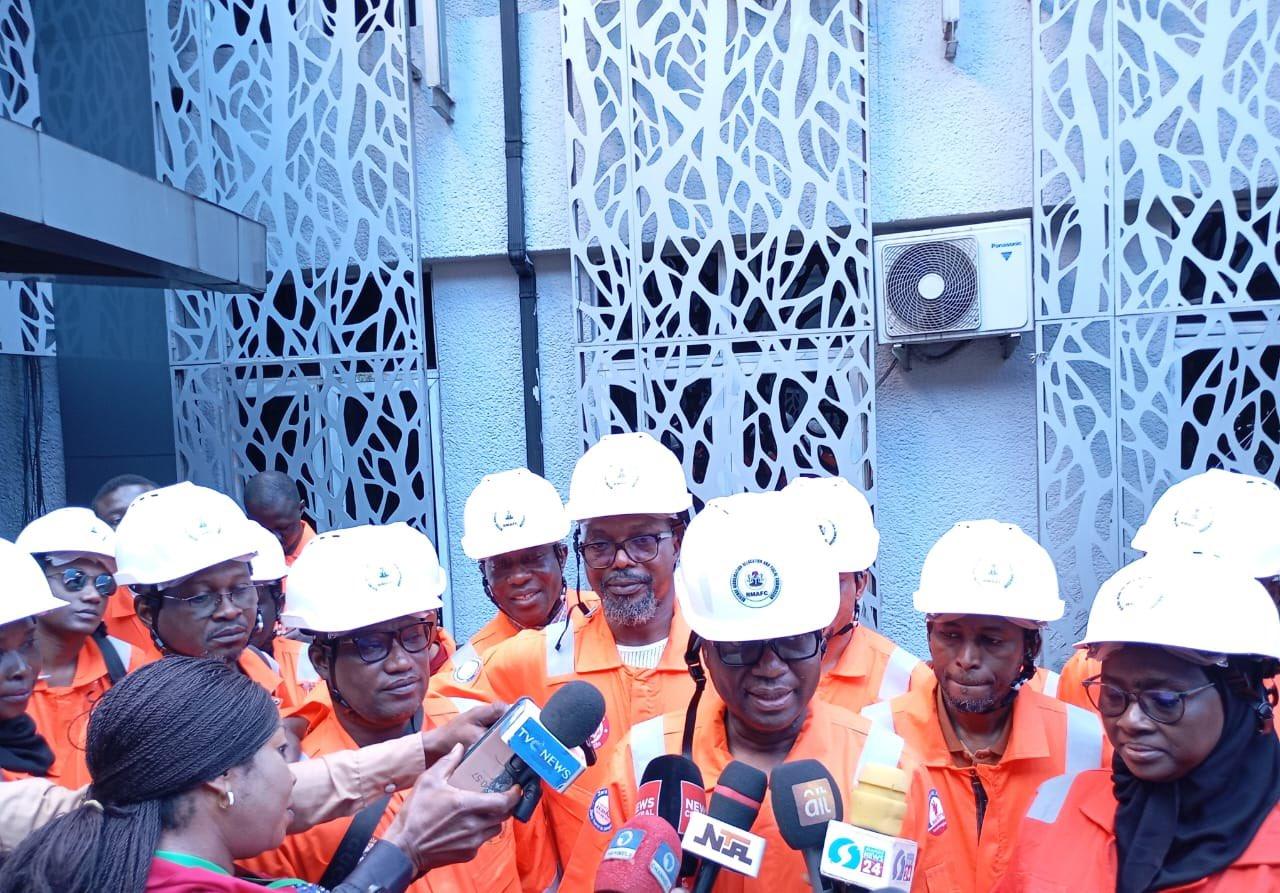
The Revenue Mobilisation Allocation and Fiscal Commission (RMAFC) has launched a verification exercise to promote fairness and accountability in newly drilled and disputed crude oil and gas fields across the Niger Delta, Southern Nigeria.
The move aims to resolve longstanding resource ownership disputes and ensure fair revenue allocation in the Niger Delta region.
The verification exercise kicked off in Asaba, Delta State, and is expected to extend to six oil-producing states.
(RMAFC) has commenced the verification of disputed and newly drilled crude oil, gas fields and wells in the Niger Delta region.
The exercise, which began on Monday 22nd September in Asaba Delta State, is being carried out by a technical team with officers drawn from the pic.twitter.com/Sbd502va5q
— RMAFC (@ng_rmafc) September 22, 2025
A statement by the Head of Information & Public Relations, RMAFC, Maryam Umar Yusuf, revealed that the verification is being carried out by a technical team comprising officers drawn from the Office of the Surveyor General of the Federation, the Nigerian Upstream Petroleum Regulatory Commission, and the National Boundary Commission, under the leadership of RMAFC.
While addressing journalists in Asaba, the capital of Delta State, the Chairman of RMAFC, Dr Muhammed Bello Shehu, said:
“We announce the inauguration of the Inter-Agency Technical Committee and reaffirm our unwavering commitment to accurately identify the locations of crude oil and gas fields and wells within the disputed areas and the newly drilled crude oil and gas wells.”
He said the Commission was determined to deploy precise geospatial data and constitutional authority to settle state boundary disputes that have stoked tension and hindered equitable revenue distribution.
“This is about justice, transparency, and national unity,” Dr Shehu stated. “We are here to ensure that every oil-producing state gets its rightful share based on verifiable data.”
The verification exercise follows formal petitions by the governors of Anambra, Delta, Imo, Edo, Ondo, and Rivers, each claiming territorial rights to oil and gas fields whose ownership remains disputed.
Among the assets under review are the Aneize oil field within OML 143, as well as the Eyine and Ameshi fields, alongside a range of newly drilled wells across the region dating from 2017 to the present.
Dr Shehu stated that the exercise aligns with the provisions of Paragraph 32(a), Part I of the Third Schedule of the 1999 Constitution of the Federal Republic of Nigeria (as amended), which mandates the Commission to monitor and verify revenue accruals and ensure equitable disbursement from the Federation Account.
“The 1999 Constitution, as amended, empowers the RMAFC, among other functions, to monitor accruals into and disbursement of revenue from the Federation Account.
“We are tasked with the plotting of coordinates of newly drilled and identified crude oil and gas fields and wells across recognised oil-rich regions.
“This initiative is essential to ensure that every oil and gas-producing state receives its rightful share of the resources, to reduce tension and safeguard the integrity of the Federation Account,” he said.
Dr Shehu explained that the Commission would rely on geospatial data provided by the Nigerian Upstream Petroleum Regulatory Commission, which would be validated and plotted, while the Surveyor-Generals of the affected states would observe the entire process.
He further said: “This decision reflects our unwavering commitment to support the Commission in obtaining precise location data for these assets, ensuring that the 13 per cent derivation fund is equitably disbursed to the rightful boundary states among the oil-producing areas.”
Dr Shehu noted that the exercise aims to resolve long-standing disputes among the affected states.
“By promoting transparency and fairness, we are laying the groundwork for a more stable and conducive environment for continued exploration and development across the region,” he noted.
He emphasised that the initiative is essential to ensure that every oil and gas-producing state receives its rightful share of the resources, to reduce tension and protect the integrity of the Federation Account.
“We want to assure all stakeholders that this process is not just technical; it is transparent, participatory, and constitutionally backed,” Dr Shehu said.