

The Russian government has promised to address the prevailing trade imbalance between the country and Nigeria.
As part of this effort, plans are underway to establish direct trade routes and encourage greater participation of Nigerian producers and exporters in the Russian market.
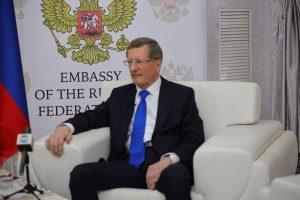
In an exclusive interview with the Voice of Nigeria in Abuja, Russia’s Ambassador to Nigeria, Andrey Podelyshev, said; “Moscow is keen on boosting investments in Nigeria’s energy, mining, and agriculture sectors.”
“The Russian side is strongly interested in reducing the current trade imbalance. The Russian Trade Mission in Nigeria, established a little over a year and a half ago, is actively working to promote Nigerian exports to the Russian market, which could help mitigate the existing asymmetry.
“One of the key challenges remains logistics. Nigerian-origin goods, such as cocoa beans, do reach Russia, but often through third countries, which significantly increases costs and undermines competitiveness.
“Efforts are therefore being made to establish direct trade routes and to encourage Nigerian producers and exporters to engage more actively with the Russian market,” he said.
Trade deficit
As of August 2025, Russia exported far more to Nigeria than it imports.
In 2023, Nigeria imported $1.51 billion worth of goods from Russia, primarily wheat, fertilizers, and fish, while exporting only $10.02 million, mainly cocoa products, according to the United Nations COMTRADE.
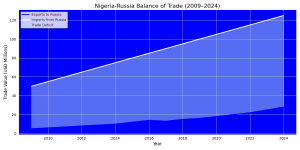 Source: United Nations COMTRADE
In 2020, these accounted for the $39.1 million export value, dropping to $10.02 million by 2023, indicating decline.
Ambassador Podelyshev gave an insight into how this trade imbalance is being addressed.
“A positive example is the activity of one of Russia’s largest fat-and-oil industry companies, which has already registered a legal entity in Nigeria and leased two warehouses for the supply of shea and shea butter to Russia. This year, exports are expected to reach 6,000 tonnes, with the potential to grow to 40,000 tonnes by 2028. It should also be noted that Russian participants are seldom invited to exhibitions and trade fairs held in Nigeria, and when invitations are extended, they often arrive belatedly.
“We believe that the regular participation of Russian business structures in such events would raise awareness among Russian importers of the opportunities offered by Nigerian suppliers, which would ultimately contribute to increasing Nigerian exports to Russia,” the Ambassador said.
Supporting Industrialization
One of Russia’s key cardinal foreign policy objectives is to support the rapid industrialisation of countries in the global South through concepts like “partnership for development”, “mutual benefit”, or “anti-neocolonial cooperation”.
In this quest, the Russian Ambassador said Moscow has consolidated its support for Nigeria’s industrialisation through the revival of the Ajaokuta Steel Complex in Kogi State.
He said; “In 2024, a team of Russian experts visited the Ajaokuta Steel Plant in order to assess its current condition. An agreement was reached to conduct a comprehensive audit, which will provide a complete picture of the scale of tasks required for the plant’s revitalisation. At this stage, however, it would be premature to speak of concrete timelines, prospects, or the scope of the work until the audit has been completed.
“With regard to ALSCON, the Russian company RUSAL — Russia’s largest aluminium producer and the owner of this asset — has expressed its readiness to resume the plant’s operations. The company continues to take measures to maintain the facility in working condition.”
“According to the plant’s management, production was suspended due to problems with gas supply, and we hope that a solution to this issue will be found in the near future. I would also like to draw attention to the promotional materials published in The Nation newspaper on 17 July 2025.
“According to the information presented there, between 2007 and 2013 more than 800 people were employed at the plant, and output exceeded 76,000 tonnes of aluminium.
“It is important to underline that the enterprise not only ensured aluminium production, but also contributed to the social development of the surrounding areas. For example, a medical clinic provides services to about 600 employees and their family members, training centres are operational, and a local computer literacy programme is being implemented. I am confident that once the plant resumes full-scale operations, these social programmes will continue to develop further,” he added.
Prospects
A World Bank report in 2024 indicates that Nigeria’s economy, valued at $187.76 billion (nominal) and $630 billion (PPP) in 2024, is Africa’s largest.
Russia’s $2.17 trillion (nominal) and $6.91 trillion (PPP) economy is significantly larger, driven by hydrocarbons, technology and defense.
Both nations have growth potential through trade diversification and industrial cooperation, but Nigeria’s smaller scale and Russia’s geopolitical constraints shape their economic trajectories.
Analysts point out that Nigeria’s growing engagement with Russia presents enormous opportunities, coming on the heels of the West African nation’s acceptance as a partner state in emerging BRICS International order.
Also, the Nigeria-Russia Chamber of Commerce and Industry (NRCCI), is another economic vehicle that helps promote commerce and facilitate market access.
Russia’s interest in increasing bilateral trade beyond the $600 million mark (2018 figures) to billions in the coming years offers a pathway for Nigerian SMEs to tap into Russian markets.