

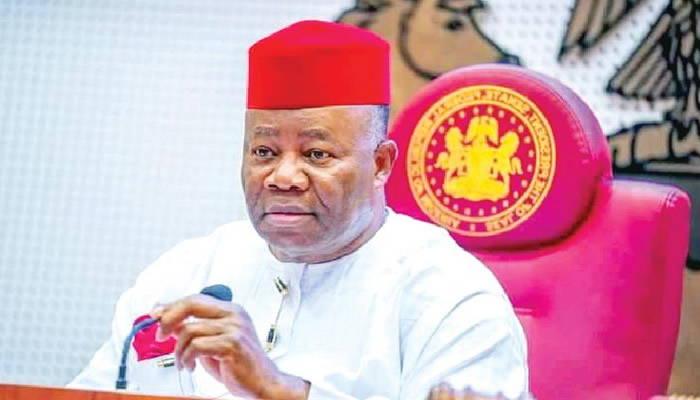
President of the Nigerian Senate, Senator Godswill Akpabio, has emphasised the need for greater investment in human capital development.
Senator Akpabio made the call in Abuja during a public hearing organised by the Senate Committee on Tertiary Institutions and TETFund, chaired by Senator Muntari Dandutse.
The hearing was on six bills namely; “Federal University of Education (Special), Oyo (Establishment) Bill, 2024; Federal University of Health Sciences, Funtua, Katsina State (Establishment) Bill, 2024.
“Federal University of Technology, Ikot Abasi, Akwa Ibom State (Establishment) Bill, 2024; Federal University of Geomatics, Oyo, Oyo State (Establishment) Bill, 2025.
“Federal University of Technology and Vocational Studies, Yaba, Lagos State (Establishment) Bill, 2025 and Federal University of Technology, Omoku, Rivers State (Amendment) Bill, 2025”.
senator Akpabio who was represented by the Deputy Senate President, Senator Jibrin Barau said Nigeria was at a pivotal point in its development journey and such more investments were needed in the sector.
“Our population continues to grow, and so must our investments in human capital,”he said.
He said that the universities of technology, health sciences, education, and vocational studies were instrumental in preparing a workforce that was capable of driving innovation and delivering essential services.
“And transforming the nation’s economic fortunes.
“The inclusion of specialised institutions like the proposed University of Education (Special), Oyo and the University of Geomatics highlights our intention to cater to specific educational and developmental needs”.
Senator Akpabio added that the task before the Senate was to ensure that these institutions, once established, are not only sustainable but also adequately funded.
“And also effectively governed, and tailored to meet the dynamic needs of the 21st-century learner”.
Chairman of the Committee, Senator Muntari Dandutse (APC-Katsina), sponsored the Federal University of Health Sciences, Funtua, Katsina State (Establishment) Bill, 2024.
Senator Dandutse said that it was instructive to note that the conventional or mainstream medical practice was gradually being passed out with the advancement in science and technology.
“And also, the advent of Artificial Intelligence and the use of robotics are predominantly being deployed to handle sophisticated medical practices and procedures limiting the chances of medical practitioners.
“This is no doubt will invariably give rise to job losses in the near future”.
He said that it was imperative that urgent and necessary steps were taken for Nigeria to align with this current global phenomena.
Senator Yunus Akintunde (APC-Oyo) sponsored the Federal University of Education (Special), Oyo Establishment Bill 2024 and Federal University of Geomatics, Oyo Establishment Bill 2024.
He said that the proposed establishment of the two universities constituted upgrades rather than establishments from the scratch.
Senator Akintunde said that the Federal University of Education (Special), Oyo aims to provide a just, sound and robust educational system for all Nigerians, including those with disabilities.
“It is predicated on the availability of qualified and well-trained teachers to impart the required knowledge on the students.
“Federal College of Education (Special), Oyo is the only one of its kind in sub-Saharan Africa.
“Thus, the need to have a university in our educational sector that can cater for people with disabilities and continuously produce well-qualified and trained teachers as it is obtainable in other developed countries cannot be over emphasised”.
He added that there was an unbridled quest for special need education in Nigeria.
“The current administration in Nigeria has shown sufficient determination to submit adequate funds to critical sectors in nation building including education.
“The enactment of this bill will help not only to provide education access, but also reduce difficulties faced by people with disabilities in seeking university education in non-conducive conventional institutions”.