

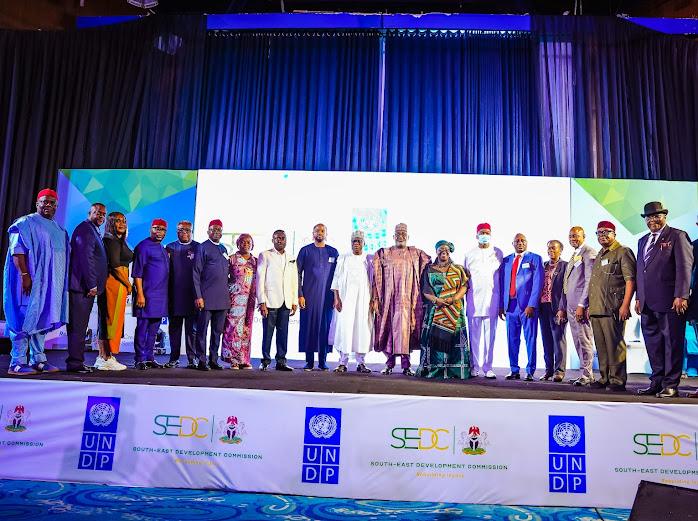
The South-East Development Commission (SEDC), in collaboration with the United Nations Development Programme (UNDP), has convened a strategic high-level roundtable.
The meeting involved key development partners, government stakeholders, and institutional leaders.
It was to formally discuss SEDC’s vision, mission, and operational roadmap, while also highlighting key areas of intervention across sectors such as infrastructure, innovation, youth empowerment, agriculture, and regional integration.
Addressing the roundtable, the Minister of Regional Development Abubakar Momoh assured the South East Development Commission of the unwavering support of the government in creating a future that truly reflects the aspirations of SEDC and the entire region, adding that the roundtable was not just a conversation but a shared opportunity to deliver real, measurable change, urging for collective support.
“We must work together to address issues such as industrialisation, infrastructural deficits, youth unemployment, and social cohesion. Our proposal must retain inclusivity, ensuring that women, youth, and vulnerable groups are not left behind in a process of shared prosperity,” he said.
The Deputy Speaker of the House of Representatives Benjamin Okezie Kalu, in a goodwill message, pledged the commitment of the Legislature in supporting SEDC’s objectives.
Represented by the Chairperson, House Committee on SEDC Chris Nkwonta, Kalu reaffirmed support for a new era of growth in the South East, calling for a legacy of leadership marked by bold decisions and shared commitments that unite strengths, harmonise vision, and deliver positive results for future generations.
“We will continue to advocate for adequate funding, legislative backing, and oversight mechanisms that ensure transparency and measurable impact… As we move forward, let us transition from one-time interventions to long-term investments, move from one-time interventions to coordinated strategies.”
UNDP Commitment
In a keynote address, UNDP Resident Representative Elsie Attafuah said “Mobilising Development Finance for Regional Transformation” is pivotal to recalibrating economic pathways to respond to climate shocks, digital distractions and the growing demands for equity and inclusion.
She said the Southeast of Nigeria is a strategic hub for enterprise development and investment, created through indigenous informal venture incubation apprenticeship system, deeply rooted in community structures emphasising innovation, creativity, mentorship, reinvestment, and apprenticeship, which presents a compelling opportunity to reimagine development financing by blending traditional wealth-generating systems, with formal capital markets and impact investment models.
“Each of the five states within the Southeast contributes distinct strengths to the region’s value proposition. These are opportunities waiting for the right kind of investment, especially through structured public-private partnerships to become powerful engines of growth and impact.
“Our role is to be the bridge connecting these powerful financial players with the transformative projects that Nigeria’s regions offer, ensuring their resources find a home where they can make the biggest difference.”
She pledged the commitment of the UNDP to partnering with SEDC to design strategies that bring together smart public policy, private sector co-investment and clever ways of attracting significant capital investments with reduced investment risks.
SEDC Roadmap
Presenting the SEDC roadmap titled “Co-creating a New Era for South East Nigeria”, Managing Director/CEO, SEDC, Mark Okoye stated that one of the strategic objectives of SEDC was to grow the South East economy from $40 billion to $200 billion in 10 years.
Okoye added that it would be attained in collaboration with development partners, State Governments, the organised private sectors, CSOs and the academic, through interventions in agriculture, industrialisation, economy and tourism, to drive and develop high-impact major region-wide bankable infrastructure projects.
” For us at the Southeast Government Commission, the question is how can we have systems and resources that come in to ensure we can plan properly. We want to set up an investment portfolio that targets to reach an audacious amount of $1 billion in 10 years through the Southeast Investment Fund,” he stated.
Chairman of SEDC Board, Emeka Wogu in his remark said the strategic framework presented by SEDC reflects the distinct human capital, entrepreneurial spirit, needs, aspirations, realities and opportunities of the South East fully and aligns with the national priorities of the Renewed Hope agenda.
“As a newly established Federal Government Commission, we understand that many of you our distinguished development institutions, private sector partners, and government stakeholders—may still be assessing how best to engage with us. This roundtable is precisely designed to open those doors and provide the clarity and confidence needed to move forward.”
SEDC Development Initiatives
The SEDC Development Initiatives embody regional transformation and inclusive development through the South-East Regional Economic and Industrial Program, the South-East Agro-Development Program targeting 50,000 hectares for food security and the South-East Security Intervention Programme.
Others are the South-East Investment Company (SEIC), a $50 million Southeast Venture Capital Fund to bridge capital and ecosystem gaps for startups and MSMES, and the South-East Grassroots Recreational Infrastructure Development (SEGRID) initiative to invest in sports and recreational infrastructure, amongst other laudable initiatives.
The presentation of the SEDC Strategic Roadmap sets the stage for coordination, implementation, institutionalisation and clear pathways to the economic transformation of the region to a hub of innovation and magnet for inclusive investment.
The convergence with the theme “Rebuilding Legacy: Co-Creating a New Era of Growth in the South East”, was a platform to formally discuss the SEDC’s vision, mission, and operational roadmap with the development community, while also highlighting key areas of intervention across sectors such as infrastructure, innovation, youth empowerment, agriculture, and regional integration.
It also created an avenue for co-creation and co-investment in the transformation of the South East, in alignment with the vision of the commission to drive sustainable development, economic growth and unity through strategic investments and empowerment initiatives, thus positioning the South East.