

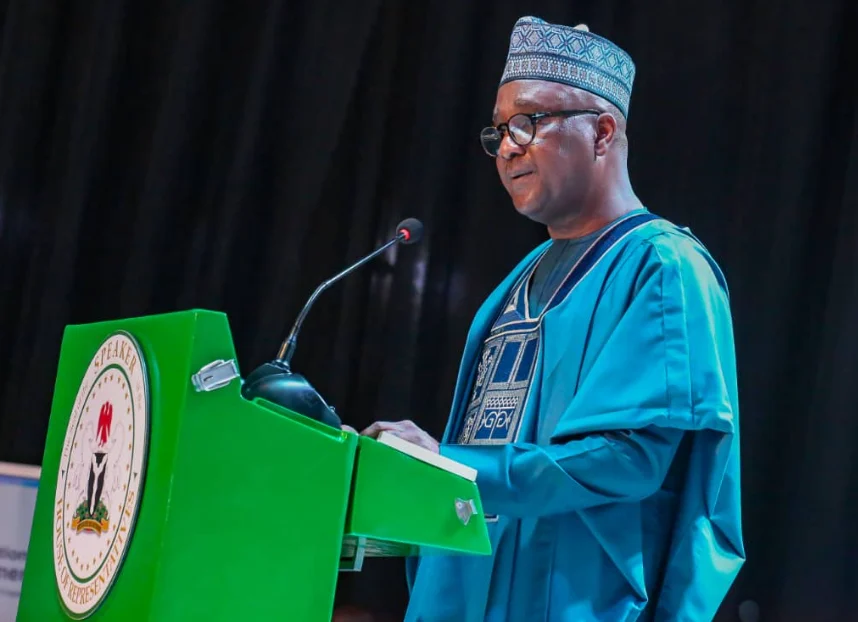
The Speaker of Nigeria’s House of Representatives, Mr. Abbas Tajudeen has emphasised the need for Africa to speak with one voice and respond with unity to the changing dynamics in global politics.
Speaker Abbas also stated the critical role of African parliaments in advancing the continent’s interests and priorities in the changing world order.
The Speaker made this known over the weekend at the 3rd General Assembly of the Conference of Speakers and Presidents of African Legislatures (CoSPAL) in Rabat, Kingdom of Morocco.
While noting that the global order is “at an inflexion point,” Speaker Abbas said power is diffusing across old and emerging centres, while economic competition has intensified.
Speaker Abbas also noted that new technologies are reshaping production, security, and social life, just as conflicts within and between states continue to displace communities and disrupt fragile regions.
He stressed that supply chains are shifting, climate pressures are increasing, non-state actors have become more agile, and institutions once considered stable are now under strain.
Speaker Abbas said: “Africa stands within this shifting architecture, facing both risks and possibilities. Our continent is young, resource-rich, and strategically positioned. Yet we also face threats that exploit institutional fragility, weak regional coordination, and uneven global influence.
“For Africa to secure its interests, our parliaments must understand the changing order and respond with foresight. Legislative leadership must become a tool for resilience. Parliamentary diplomacy must evolve into a strategic instrument for advancing African priorities.”
Speaker Abbas said: “This changing global landscape affects Africa in many ways. It shapes food systems, energy markets, and access to technology. It influences security cooperation, migration flows, and the ability of states to tackle terrorism and organised crime. It determines the extent to which African voices are heard in global debates on trade, health, and climate.
“More than ever, Africa must speak with coherence and act with unity. Our parliaments cannot be observers. We must be active participants in shaping outcomes.”
Speaker Abbas explained that legislative leadership in this context demands “strong institutions that hold the executive accountable, protect public finances, and drive inclusive growth.”
He also said it requires laws that give confidence to investors and create opportunities for youth, stressing that it calls for parliaments that reflect the aspirations of citizens and defend constitutional values.
He said; “The Nigerian Parliament has placed these obligations at the centre of its work and continues to strengthen the tools that enable oversight and reform.
“Parliamentary diplomacy has also become essential. It allows legislatures to engage peers, build alliances, and project national positions with credibility. It supports conflict prevention and regional stability. It enhances mutual understanding. It deepens economic and security partnerships.
“For Africa, parliamentary diplomacy is not optional. It is a strategic necessity. Nigeria’s approach reflects this conviction. Under President Bola Ahmed Tinubu, our government has pursued reforms intended to stabilise the economy, attract investments, and strengthen national security. These reforms require legislative backing and sustained cooperation with partners.
“Nigeria continues to work with ECOWAS, the African Union, and neighbouring countries to tackle security threats. We also support the strengthening of continental institutions so that Africa can negotiate from a position of clarity and unity.”
Within the House of Representatives, Speaker Abbas noted that the Nigerian parliament has taken deliberate steps to deepen legislative leadership and expand parliamentary diplomacy.
He also stated that Nigeria strongly supports CoSPAL and has worked with the secretariat to ensure its effective take-off, including the provision of office space and initial staffing.
While expressing appreciation to his predecessor, Femi Gbajabiamila for spearheading CoSPAL as its pioneer chairman, Speaker Abbas stressed that Nigeria considers the body as an essential platform for African parliamentary cooperation and a vehicle for strengthening collective voice.
The Speaker added: “Nigeria has also expanded its network of parliamentary friendship groups to promote engagement with strategic partners. These groups have enabled sustained dialogue with parliaments in Africa, Asia, Europe, and the America.”