


Former Executive Secretary of the National Universities Commission (NUC), Prof Peter Okebukola, has called for the creation of a joint National Quantum and AI Education Fund by the NUC and the Tertiary Education Trust Fund (TETFund), saying Nigeria must urgently prepare a workforce capable of leveraging next-generation computing technologies.
Prof Okebukola made the comment while delivering a convocation lecture at Kwara State University (KWASU), Malete, Kwara State,
He said the fund should provide competitive grants to universities that demonstrate a clear commitment to artificial intelligence and quantum research, as global technological shifts are expected to reshape nearly one billion jobs within the next decade.
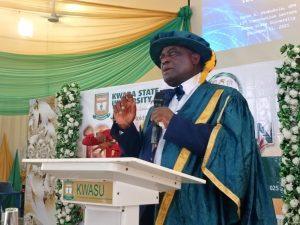
He pushed for Nigerian universities to establish a Quantum Futures Institute (QFI), an interdisciplinary hub where experts from engineering, sciences, humanities, and social sciences can jointly tackle national challenges using quantum-thinking approaches.
Expressing concern over Nigeria’s low research investment, Okebukola noted the country spends about 0.2% of its GDP on research, below the African average of 0.5% and far behind nations that commit 3% to 4%. He urged federal and state governments to increase R&D funding and introduce tax incentives for private companies that sponsor university research or establish endowed research chairs.
Okebukola also recommended that the NUC design a dedicated accreditation framework for emerging technology programmes, arguing that these fields evolve too quickly for traditional evaluation methods. He suggested universities have more flexibility under the 30 percent institutional addition permissible in the CCMAS.
For the private sector, he advocated the creation of industry–university collaboration hubs in all geopolitical zones, where companies can present real-world challenges and universities can produce research-based solutions for commercialisation. He also urged companies to support digital infrastructure on campuses and deepen curriculum, internship, and sabbatical partnerships.
Stressing the need for active knowledge creation, Okebukola said universities must train students and staff to move away from passive learning, highlighting that the quantum era demands comfort with uncertainty, creativity, and interdisciplinary thinking. He called on KWASU and other universities to roll out AI literacy programmes for all students and establish at least three global partnerships with leading universities in quantum computing and AI.
In his remarks, Vice Chancellor Prof Shaykh-Luqman Jimoh said KWASU places a high priority on transformative ideas and collaborations that produce societal value, describing Okebukola as a scholar whose work continues to shape the evolution of higher education.
PIAK