

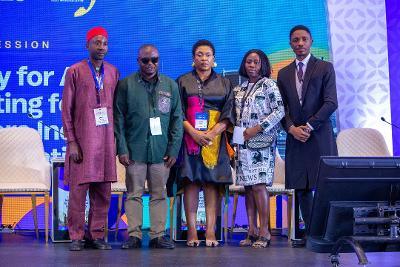
Persons with Disabilities (PWDs), market women and private transport operators have called for holistic reforms in Nigeria’s transport system to guarantee safety, affordability, and inclusive access for all commuters across the country.
The demand was made during a two-part plenary on “Mobility for All: Innovating for Safer and More Inclusive Transportation” at the Gender and Inclusion Summit (GS-25) organised by the Policy Innovation Centre in Abuja.
PWDs: Barriers Create the Disability
Representing the Joint National Association of Persons with Disabilities (JONAPWD), Kenneth Echiche advocated for systemic inclusion in transport planning.
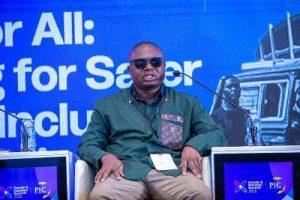
“When you remove the barriers, the disability disappears. Impairment plus barriers equals disability! Look at the Abuja master plan—there is no provision for persons with disability. Even the CNG buses being rolled out have no ramps,” he said.
He also highlighted discriminatory behaviour by some drivers:
“Sometimes drivers zoom off when they see a person with disability because they do not want the stress of folding a wheelchair. That is not inclusiveness,” Echiche added.
Women Inclusion Imperative
Mary Ogwu, a trader, appealed for measures to ease the struggles of women traders, stressing that rising fares affect both pricing and profit.
“We want our voices to be heard as market women. Sometimes I trek two poles with my goods to find cheaper fares… Where I paid ₦400 before, I now pay ₦1,500. At the end of the day, there is no gain,” Ogwu said.
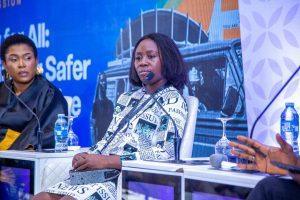
From the ride-hailing sector, Glory Ejeje, MD of SREE Services and Logistics, lamented gender gaps in transportation.
“Women are not included. Even the few who participate are abused and disrespected. At airports where you’d expect civility, women drivers are not welcomed by men. We need more advocacy for women in transportation,” Ejeje said.
Weyinmi Aghadiuno, policy and regulation lead at Bolt Africa, said technology can enhance safety, but deep-rooted stereotypes persist.
“At Bolt, we’ve deployed safety features like panic buttons and trip monitoring to protect riders and drivers, but the real challenge is cultural. When we introduced women-for-women rides, many women refused female drivers, saying, ‘women can’t drive.’ That bias is a major obstacle to true inclusion,” Aghadiuno said.
Safety, Technology and Formalisation
Transport scholar Julius Ajayi said exclusion in mobility translates into “missed opportunities and lost dignity,” warning that “up to 54% of people do not have access to transit stops within 10 minutes walking distance,” thereby exposing commuters to safety risks.
He insisted that “those most affected must be at the roundtable if transport reforms are to succeed… We must plan not so that government looks good, but so that the people will be good,” Ajayi said.
Enahoro Okhae, CEO of GIG Mobility, urged technology-driven solutions.
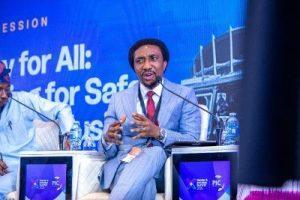
“We must use technology to solve structural challenges—from cashless ticketing to GPS tracking and passenger safety systems. Technology allows us to standardise, collect data, and make transport safer and more predictable,” Okhae said.
He added that scaling such solutions could “ease daily barriers for women, children, and persons with disabilities who rely on public transport the most. Our terminals have CCTV, security and trained staff. Informality cannot protect women, children or persons with disabilities,” he added.
Enforcement and Infrastructure
The Federal Road Safety Corps (FRSC), represented by DCC Okpe Omadachi, stressed the importance of compliance.
“Verbal harassment at motor parks can be worse than physical abuse… We do audits, safety checks and sensitisation, but enforcement is key for compliance. Any vehicle without a plate number should not be entered,” Omadachi said.
Daniel Clement, representing the FCT Secretary of the National Union of Road Transport Workers (NURTW), said the union had introduced reforms to enhance commuter safety.
“We partner with the Road Safety Corps, NEMA, and emergency agencies to train our marshals. Commuters must feel safe in our parks,” Clement said.
Government Intervention
Responding, Mrs. Florence Okonkwo, Permanent Secretary of the FCTA Transportation Secretariat, reaffirmed President Bola Ahmed Tinubu’s commitment to a safer, world-class, and inclusive transport system.
“The Tinubu administration is determined to end ‘one chance’ and deliver a safe, modern, inclusive system for Abuja. This administration has built two bus terminals—one in Kubwa and one in Mabushi—and there is another one at the central business district. These are terminals that can be compared to anywhere in the world. They have CCTV cameras, escalators, and elevators. When the President commissioned the Mabushi terminal, he said these terminals are built for safety, they are built for comfort, and they are built to help solve the problem of one chance,” Okonkwo said.
She announced new safety and enforcement measures, assuring that plans are underway to expand the terminals across Abuja’s satellite towns to reduce reliance on unsafe roadside pick-ups.
“This present FCT Minister is very serious and determined not to leave any stone unturned in seeing to it that the Bola Ahmed Tinubu vision of making FCT very safe is achieved in the shortest possible time. We want to profile our drivers. If you don’t see a registration number on any taxi you want to board, you don’t board. We’re also looking forward to situations where you can book on your phone, and that app is to have a panic button you can just press when you feel unsafe,” she reaffirmed.