

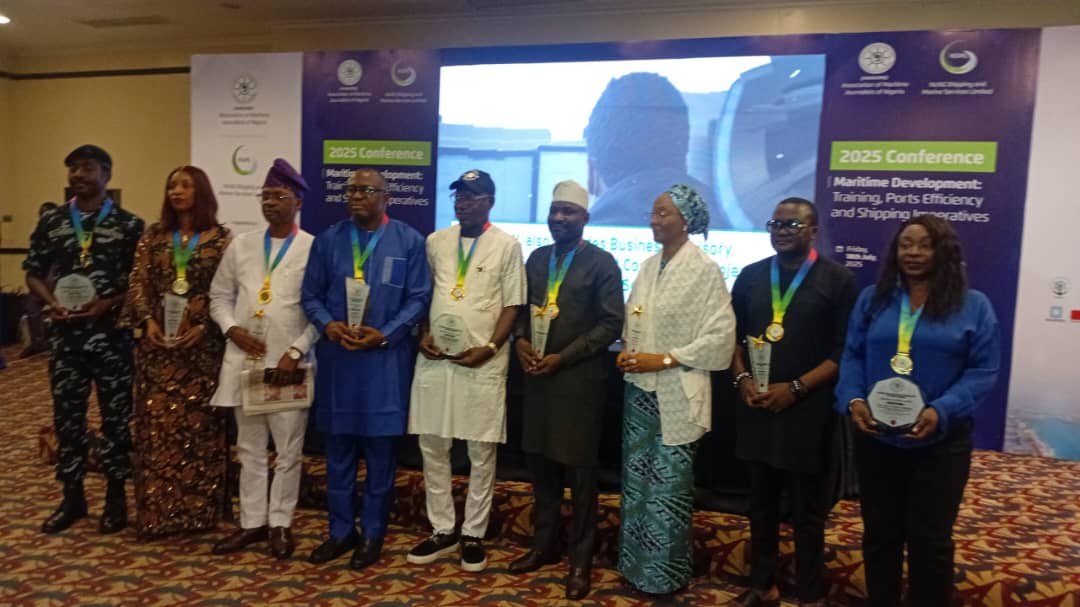
Stakeholders in the Nigerian Maritime Sector have advocated urgent reforms on sustaining innovative narrative and build human capital development and overhaul regulatory functions to enhance Ports efficiency in the nation’s seaports.
NLNG Shipping and Marine Services Limited (NSML), and the Nigerian Shippers’ Council (NSC), identified strategies to bridge training gaps and streamline port operations to boost efficiency and global competitiveness at the 2025 Annual Conference of the Association of Maritime Journalists of Nigeria (AMJON) held in Lagos Southwest Nigeria.
The Managing Director, NLNG Shipping and Marine Services Limited,(NSML), Mr.Abdulkadir Ahmed in his paper presentation ,titled: “The Evolving Global Maritime Regulatory Environment – The Role of Maritime Training and Capacity Development,” said the maritime sector is now at a critical juncture where “investment in human capital is indispensable.
He warned that new international regulations, from climate mandates to cybersecurity rules and crew welfare standards, require a workforce that is agile, educated, and globally competitive.
Mr. Abdulkadir cited transformative policies like the IMO’s Sulphur Cap, EEXI, and CII as game changers that compel shipowners to adopt cleaner, more efficient technologies.
According to him; “With increased reliance on digital systems onboard, the threat landscape has broadened. It’s no longer enough to train for traditional operations—we must build competence in cyber defence, automation, and sustainable energy use.”
“NSML is investing heavily in maritime training through its Maritime Centre of Excellence (MCOE) in Bonny, Rivers State, where over 200 cadets have already been trained with many absorbed into NSML’s operations. The centre, he said, delivers UK-accredited, STCW 2010-compliant programmes with one of Africa’s most advanced maritime simulation systems for bridge operations, crisis response, and cargo handling.”
Abdulkadir said NSML’s contributions include fleet renewal with dual-fuel vessels, investment in LPG carriers, support for the Deep Blue security project, and strategic collaborations with NIMASA and global bodies to advance maritime sustainability and compliance.
He noted that, while NSML tackles the human capital challenge, the Nigerian Shippers’ Council (NSC) is moving to fix fragmented port governance through a Standard Regulatory Framework that prioritises transparency, efficiency, and stakeholder inclusiveness.
Delivering his paper titled :”Ensuring standard Regulatory Framework: what strategies and Options?” Executive Secretary, Nigerian Shippers’ Council, NSC, Dr Pius Akutah decried Nigeria’s 130th place out of 139 countries in the 2023 World Bank Logistics Performance Index.
Akutah while quoting UNCTAD stated: “A standard regulatory framework is not just a technical necessity it is an economic imperative, Where regulation is smart and efficient, trade flows. Where it is not, trade chokes.”
The Shippers Council boss who was represented by the Deputy Director,Ibrahim Mohammed noted that 49 per cent of port delays stem from overlapping inspections by more than eight federal agencies operating within the ports, leading to high logistics costs and reduced investor confidence.
While speaking on the need to address impediments on port efficiency, the NSC helmsman proposed: legislative reform via the Nigerian Ports Economic Regulatory Authority (NPERA) Bill to clarify mandates and enhance NSC’s enforcement powers ;
Others included; digital integration through a Port Community System (PCS) linking all port users; codified and transparent regulations, updated tariffs and sanctions; performance monitoring using monthly KPIs such as turnaround time and dwell time; creation of a Maritime Economic Tribunal for fast dispute resolution within a 21-day target; and stakeholder engagement, including Quarterly Regulatory Roundtables to ensure inclusivity in policymaking.
He added that similar reforms in countries like Ghana and Singapore have shown tangible results, including 60 per cent reduction in clearance time and 34 per cent increase in revenue through digital harmonisation and agency integration.
Hauwa Abu