


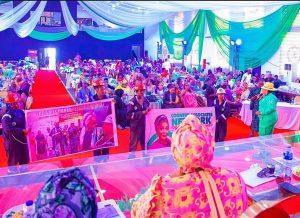
Stakeholders at the 25th National Council on Women Affairs and Child Development (NCWACD) have called for stronger institutional systems and deeper social impact across Nigeria, to enhance national equity.
Responding to questions after her keynote presentation on “Agenda for Women, Children, the Family and Vulnerable Groups”, gender expert and former Director, Centre for Gender Studies, University of Benin, Professor Uwa Edosomwan, said education, health, and gender-responsive budgeting remain the pillars of empowerment.
“I think we need to strengthen the educational sector because education is so important in terms of empowerment for women, children, and the vulnerable,” she said. “Fifteen percent should be allocated to women’s issues, and I don’t think this is being adhered to.”
She explained that a restructured system would have ripple effects across all sectors. “When these sectors are strengthened, you will see change, transformation, more prosperity for all, more health for all, and everyone will benefit,” she said.
Political inclusion
Professor Edosomwan also called for increased political inclusion and the passage of the gender and reserved-seat bills.
“Those gender bills that were thrown out should be brought back. It is not something that should be debated—it is necessary. We can’t stand on one leg; men and women together make a better society,” she maintained.
In her submission, the founder of the Arieli Foundation, Dr. Natasha Oyibo, presented a locally driven model that tackles maternal deaths through a three-way collaboration among trained midwives, the National Union of Road Transport Workers (NURTW), and Primary Health Care Centres (PHCs).
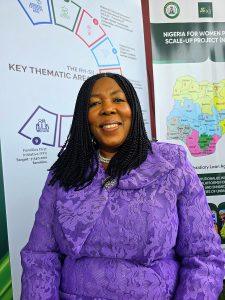
“We’re running a project that connects the trained midwives in communities, the NURTW control centres, and PHCs… At the first sign of maternal or child risk, the midwife calls the local transport control centre, and a driver with a trained first aider is dispatched immediately. No woman in distress should be miles away from help — help should be minutes away” she said.
She emphasised that maternal and child health must be repositioned as a national emergency priority.
“We are partnering with community birth attendants, traditional midwives, and even local transport operators as first responders so that help can be minutes away, not miles away.Every minute counts in maternal emergencies,” she stated.
Dr. Oyibo noted that the initiative, currently piloting in the FCT, is designed for nationwide scalability. “Everywhere in the country we have union drivers, midwives, and PHCs- so the system can work anywhere,” she explained.
People-centered governance
Meanwhile the Founder of Oaks of Righteousness Global Foundation, Mrs. Mary Abimbola Ajikobi urged for people-centered governance that integrates compassion with sustainability.
“Government must work with community structures to ensure that widows, orphans, and the vulnerable are consistently supported. When compassion is institutionalised, development becomes sustainable,” she said.
Also speaking, the Managing Director of Smart Energies, Yinka Opeke, called for stronger partnerships to accelerate the adoption of clean energy and sustainable mobility solutions at the grassroots to safeguard the health and cushion environmental risks associated with traditional cooking methods.
She explained that Smart Energies is already working with the Federal Ministry of Women Affairs and other stakeholders to promote clean cooking and e-mobility across all 774 local government areas.
Interventions
Highlighting the company’s interventions, Opeke stated that Smart Energies has donated over 70,000 gas cylinders, reaching 350,000 individuals, and distributed subsidy cards, mobile kitchens, solar lanterns, and electric motorcycles.
“Our Memorandum of Understanding with the Federal Ministry of Women Affairs covers solar panel installations for off-grid areas, mobile kitchens for MSMEs, and clean energy alternatives for roadside vendors who rely on firewood and charcoal,” she said.
She emphasised that Smart Energies’ operations are “ESG-centric” and aligned with the Sustainable Development Goals (SDGs) 3, 5, 7, 9, 11, and 13—covering health, gender equality, clean energy, innovation, sustainable cities, and climate action.
According to her, affordability remains a major barrier to energy transition.
“Based on our research, the major barrier to transition is the initial cost of the cylinders,” she said, noting that Smart Energies addresses this through data-backed subsidy systems.
“To ensure accountability and transparency, we use data-enabled cards that can also distribute other palliatives like rice or fertilizer. It helps partners plan and strategize while promoting transparency, which donor agencies appreciate,” she said.
Opeke called on development partners and private actors to “come together to co-create solutions that are sustainable, accessible, affordable, and reliable.”
They stressed the need for sustained collaboration between government, civil society, and development partners to advance the wellbeing of women, children, and vulnerable groups.
Stakeholders stressed that inclusive governance, accessible healthcare, and social protection are central to advancing the Renewed Hope Agenda of President Bola Ahmed Tinubu, aimed at ensuring prosperity, dignity, and opportunity for every Nigerian.
Lateefah Ibrahim