

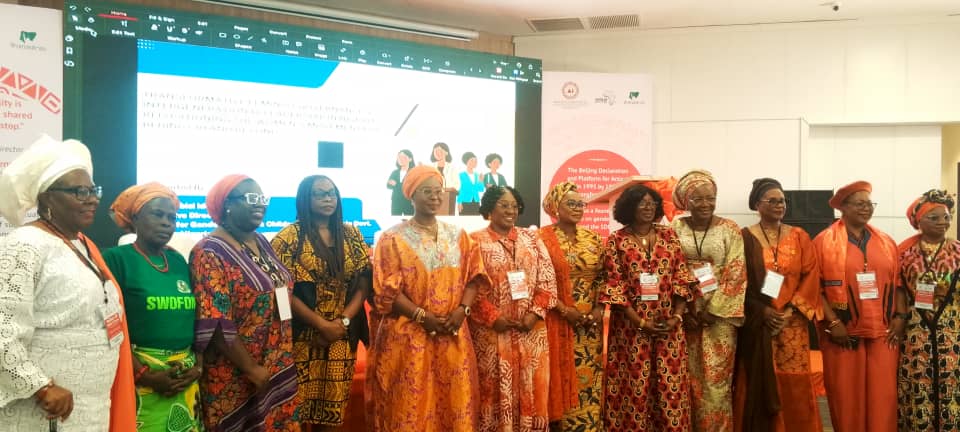
Stakeholders have reiterated call for stronger policies, sustained funding and collective action to advance the rights of women and girls in Nigeria.
The stakeholders made the call at the Beijing +30 Women’s Summit, in Abuja, as the world marks the 30th anniversary of the Beijing Declaration and Platform for Action.
The Beijing Declaration and Platform for action, adopted in 1995 focus on women’s empowerment, gender equality and sustainable development, with a call to action for global progress.
The stakeholders said that systemic barriers, policies and underfunding had slowed progress toward gender equity.
They said that urgent reform was needed to ensure that women can fully participate in national decision-making.
Minister of Women Affairs and Social Development, Hajiya Imaan Sulaiman-Ibrahim, said that Nigerian women possessed enormous potential but were held back by disunity, under-investment, and structural barriers.
Economic Empowerment
Sulaiman-Ibrahim said that economic empowerment was a critical pathway to financially stable women, reducing vulnerability, enabling participation in decision-making and supporting children’s education.
“When women have money, they can achieve anything. Financially empowered women are better positioned to resist domestic abuse, support their families, and engage meaningfully in politics,” she said.
On legislative reforms, the Minister expressed concern about the proposed reserved-seats bill for women, warning that poor design could put women against one another and undermine progress.
She, therefore called for strategic consensus-building and Intentional negotiation.
Drawing on lessons from China, she highlighted how intentional investment in women transformed outcomes for millions.
She also decried Nigeria’s absence in major continental and global gender platforms, urging women to show up and work collectively to secure representation.
She said that Nigeria could not solve gender challenges without unity, honesty and shared ownership of reforms.
“The power of teamwork makes the dream work,” she said.
She therefore called for intentional coalition-building, informed advocacy, and strategic negotiations to secure sustainable political representation for women.
A Professor of Sociology and Gender Studies at Obafemi Awolowo University, Professor Olabisi Aina in her keynote address, said that Nigeria’s gender-equity efforts remained trapped in fragmented coordination, underfunding and data poverty.
Gender Responsive Policies
She emphasised the need for the Ministry of Women Affairs to drive gender-responsive policies across health, education, agriculture and planning, ensuring that government action advances women’s rights and inclusion.
Aina called for a transformative feminist governance model, driven by collaboration, justice, accountability and data.
“Feminist leadership is not about filling seats but reshaping the table and ensuring that women who enter governance understand the issues and can negotiate effectively.
“When a nation is directed only by the brains of men, can you say it is thinking in totality?,” she said.
She said: “Nigeria is lagging behind its African peers on women’s political epresentation, and this is a shame for a country considered the giant
of Africa.”
She identified key pillars for progress, including intergenerational mentorship, gender-responsive budgeting, stronger GBV interventions, feminist data governance, and investment in knowledge production.
“How can you change the situation of women when you do not have data? Data is the engine of transformation,” she said.
The Chairperson, Nigeria Governors Spouses’ Forum and first Lady of Kwara State, Professor Olufolake AbdulRazaq, reaffirmed commitment towards ending GBV, improving women’s rights, economic empowerment and participation in governance.
Earlier, Mrs Bisi Adeleye-Fayemi, Co-founder, Amandla Institute, highlighted the need to tackle Gender-Based Violence (GBV), noting progress in some states but highlighting the need for nationwide
accountability.
“The progress of African women since Beijing has been one of five steps forward and ten steps back.
“We have had to say the same thing over again to different audiences, or we make gains and our losses keep increasing,” she said.
She, therefore, stressed the need for conscientious efforts towards gender equality, women’s rights, ending GBV and shaping the post-Beijing gender agenda.
Other activities include panel discussion on “Recalling Beijing 1995 (Looking Back)” and “Intergenerational Dialogue (Marching Forward).
The summit was organised by the Amandla Institute for Policy and Leadership Advancement in collaboration with the African Women Leaders Network (AWLN-Nigeria) and Womanifesto.
The summit, ended with a shared call for transformative feminist governance to address persistent inequality and accelerate meaningful change for Nigerian women.
Lateefah Ibrahim