

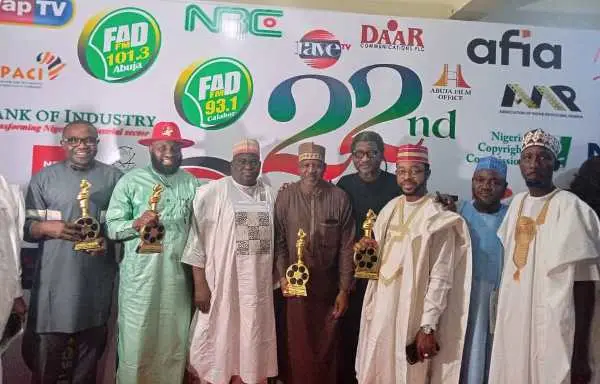
Stakeholders in the creative economy sector have called for infrastructural support, increased funding and investment in the Nigerian film industry to unlock its economic growth and job creation potential.
The stakeholders made the call at the closing ceremony of the just concluded 22nd Abuja International Film Festival (AIFF).
This year’s AIFF with the theme, ”From Script to Nation: The Role of Film in Shaping National Identity”, was held from Nov. 6 to 10.
The festival brought together filmmakers, actors, government functionaries and other cinematic stakeholders from around the world.
According to the stakeholders, the nation’s film industry ecosystem has the potential to engage teeming employed youths and contribute significantly to the nation’s GDP, if properly harnessed.
They therefore called for increased investment and support to boost the industry’s potential through government policies, infrastructure development, and private sector financing.
READ ALSO: Plateau Governor to Deliver Lecture at 2025 Zuma Film Festival
The National President, Association of Movie Producers (AMP), Blessing Ebigieson, said that in spite of the sector’s contribution to the economy, industry players continue to face significant challenges including funding, piracy, inadequate infrastructure, and distribution issues.
”I think that the government should do more because in every country of the world the government is supporting their creative industry.
”For example, filmmakers in Canada, UK, US, India and even in South Africa have the opportunity to apply for grants and get it, so it makes things so easy for them.
”But in Nigeria, we have built this industry with our sweat and we continue to struggle as the government keeps saying there are grants, but you can’t access them.
”Of course we appreciate the steps taken recently by the Federal Ministry of Art, Culture, Tourism and the Creative Economy for announcing the Creative Economy Development Fund.
”However, we are hoping they have the goodwill to ensure this fund is disbursed to those that really need it when the time comes,” she said.
Appointing Credible Leaders
Similarly, the National President, Directors’ Guild of Nigeria (DGN), Uche Agbo, lauded the Federal Government for appointing the right people to lead the creative sector.
He however said more needed to be done, especially in providing the right policies and infrastructure.
”We need policies around insurance; this is because filmmakers in Nigeria are finding it difficult to access insurance for productions due to the peculiarities of the industry.
”We are also battling with an infrastructure deficit, and the government needs to partner with private sectors to be able to invest more in that area” he said.
Veteran actor and singer, Sani Danja said governments at all levels needed to do more to get the best from the industry in terms of job creation.
”It is only in the movie industry that a day-old baby can be in a movie and get paid, there is no other industry that can provide this opportunity.
”Even a very old person can still be in a movie, based on the expected role, and get paid. It is only our industry that doesn’t need you to be educated, because you can be in a movie whether you are educated or not, even a deaf person can be in a movie,” he said.
Earlier in his speech, the AIFF founder, Fidelis Duker, said the 22nd edition was a milestone as the festival had stood the test of time to become the film fiesta that thespians look forward to every year.
”This whole journey started 22 years ago and several times I had wanted to stop it, but filmmakers will always call me around March and April to ask when is the next AIFF.,” he said.
The annual Abuja International Film Festival has continued to evolve as a platform that connects filmmakers, audiences, and investors, spotlighting Nigerian cinema on the global stage.
It features film screenings, panel discussions, workshops, master-classes and awards.
NAN/Wumi