

Stakeholders in Nigeria’s maritime sector have urged enhanced public–private collaboration to unlock new wealth, boost exports, and expand multimodal cargo transport.
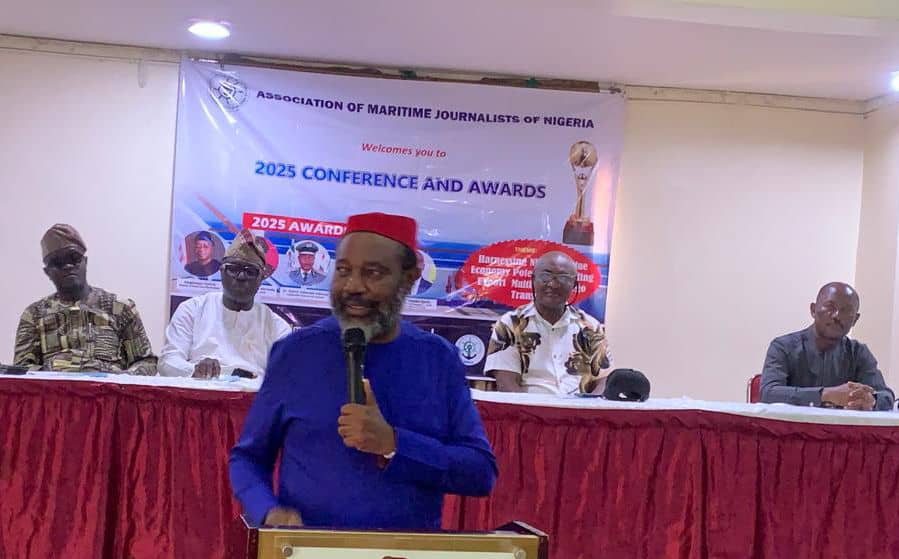
The call came during the 2025 Annual Conference of the Association of Maritime Journalists of Nigeria (AMJON) held in Lagos, Southwest Nigeria, as the country seeks to harness its vast Blue Economy potential.
At the high-level gathering, Maritime expert and Head of Research at the Sea Empowerment & Research Centre (SEREC), Dr. Eugene Nweke, highlighted the gap between potential and performance, emphasising that “Nigeria has the resources but needs stronger implementation to achieve results.”
Nweke warned that despite its 853 km coastline, 3,000 km of inland waterways, and a 200-nautical-mile Exclusive Economic Zone, Nigeria contributes less than 1.5% to regional maritime GDP. For him, the gap between potential and prosperity can only be bridged through a structured public–private synergy (PPS) that transforms policy intentions into measurable economic outcomes.

He said; “Public–Private Synergy goes beyond traditional partnerships.
“It is about uniting government, investors, academia, and host communities to co-create and co-monitor marine development.”
Nweke outlined five pillars capable of driving exponential growth in the Blue Economy—fisheries, shipping and logistics, tourism, marine energy, and data governance. With the right investment climate, he argued, these sectors could create millions of jobs and position Nigeria as a maritime powerhouse.
He offered strong evidence: closing the nation’s 2.1 million-tonne fish deficit could create over 500,000 jobs, while an automated port system could save the economy ₦3 trillion annually.
Nweke also underscored the deep link between steel, mining, and maritime development, calling for ‘the revival of the Ajaokuta Steel Complex as a backbone for shipbuilding, coastal engineering, and automotive production.’
On infrastructure, the SEREC researcher advocated for improved intermodal transport and ICT-driven automation, including the National Single Window and the International Cargo Tracking Note (ICTN) — innovations expected to cut cargo clearance time by 40% and save another ₦500 billion yearly.
To streamline regulation, Nweke urged agencies such as the Nigerian Ports Authority (NPA), Nigerian Maritime Administration and Safety Agency (NIMASA), National Inland Waterways Authority (NIWA), and the Nigerian Shippers’ Council (NSC), to harmonise their mandates under a unified maritime policy implementation framework.
He further proposed the establishment of a National Blue Economy Council chaired by the Vice President, alongside a Public–Private Blue Economy Implementation Roundtable (PBBIR) to drive coordinated action.
Citing success stories from Mauritius, Ghana, and the Lekki Deep Sea Port, Nweke noted that “synergy, innovation, and transparency are the true anchors of a thriving maritime future. What matters most, is not the volume of policies but the “industries revived, jobs created, and prosperity sustained.”
Legislative Support for Reform
Also speaking, Senator Wasiu Eshilokun, representing Lagos Central District, echoed the call for integration and reform.
Eshilokun emphasised the urgent need to modernise Nigeria’s aging ports, expand deep-sea port infrastructure, and strengthen multimodal cargo transport systems.

He called for major investments in inland waterways, rail and road connectivity, and the deployment of digital tools like ICTN to enhance cargo transparency and security.
Eshilokun urged the development of a comprehensive National Blue Economy Policy aligned with the African Union’s Agenda 2063 and the UN SDGs. Strengthening the Ministry of Marine and Blue Economy, enhancing inter-agency cooperation, and improving the legal framework for maritime dispute resolution formed part of his recommendations.
In her welcome address, Acting President of AMJON, Vera Osokpo reminded participants that Nigeria’s blue economy holds the key to reducing its over-dependence on oil. She highlighted emerging opportunities in shipping, fishing, tourism, aquaculture, renewable energy, and marine biotechnology.
With the global blue economy projected to hit $2.5 trillion by 2030, Osokpo said Nigeria must urgently position itself to benefit from this rapidly expanding frontier.
She expressed optimism that with sustained reforms, investment, and collaboration, Nigeria could emerge as a global maritime force.
The AMJON conference ended with a renewed sense of urgency and unity, as stakeholders agreed that Nigeria stands at the threshold of a maritime-driven economic transformation but only if government and the private sector paddle in the same direction.