



Mnena Iyorkegh, Abuja
The Minister of Information and National Orientation, Mohammed Idris, has reaffirmed the commitment of President Bola Ahmed Tinubu’s administration to strengthening institutional frameworks to combat corruption across Nigeria.
Idris stated this in Abuja at a Roundtable Engagement on Agenda Setting for the Strategic Integration of State Commissioners of Information in the Fight Against Corruption.
He stressed that transparency and accountability remain strong pillars of democracy and are central to President Tinubu’s governance vision.
He noted that curbing corruption is a top priority for the administration and dismissed claims that anti-corruption agencies were being used against political opponents.
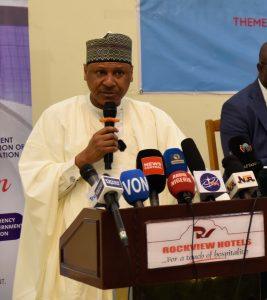
“Fighting corruption is indeed one of the 8-Point priorities of the Tinubu administration, and that is why the President is strengthening the institutional framework to fight corruption, especially through the ICPC and the EFCC.
“By its policy of non-interference, the Tinubu administration has made it clear that anti-corruption agencies are not instruments of political witch-hunt.
“They operate with independence and professionalism in line with the rule of law. However, the President has vowed that there will be no safe haven for corruption in Nigeria.”
The Minister added that President Tinubu is advancing far-reaching judicial reforms to curb delays in corruption trials and ensure that justice is delivered without compromise.
“He is also advancing far-reaching judicial reforms aimed at curbing unnecessary delays in corruption trials, ensuring that justice is neither denied nor endlessly deferred.”
Idris commended ICPC Chairman Musa Adamu Aliyu for his innovative approach to development communication and urged state governments to rise above partisanship and seize the opportunities presented by the Renewed Hope Agenda.

“I wish to implore you all, Honourable Commissioners, that irrespective of the political party you belong to, it is important you identify with the massive opportunities inherent in the Renewed Hope Agenda of President Tinubu, who is relentless in reshaping our economy to address years of neglect, and its limitations, and in turn achieve inclusion, diversification, growth and steady development.
“I also want to draw our attention to the need to leverage the vast and effective assets of the agencies under the Federal Ministry of Information and National Orientation, to achieve effective outreach across Nigeria.”
ICPC Chairman Dr. Musa Adamu Aliyu underscored the role of communication in building public trust and promoting accountability.
“When governance information is proactively disclosed, and the public is ethically re-oriented to demand accountability, positive narratives are created, which in turn foster trust in institutions and strengthen democratic culture,” he said.
He explained that the ICPC’s communication approach aligns with the pillars of the National Anti-Corruption Strategy (2022–2026) and is being advanced in partnership with professional associations, civil society, and development partners.
“Information alone may raise awareness, but only strategic communication—deliberate, consistent, and engaging—truly changes behaviour. This is why the National Anti-Corruption Strategy (2022–2026) provides a guiding framework through its pillars. ICPC has aligned its communication approach with these pillars.
“Through collaboration with NIPR, NUJ, CSOs, and development partners, we developed a Communication Strategy that builds on NACS to ensure that anti-corruption messages inspire trust and change behaviour.”
He added that the ICPC is implementing practical measures at the local level.
“Our approach calls for state and local governments to proactively disclose information—budgets, procurement, and projects should be open and accessible. This informed our Accountability and Corruption Prevention Programme for Local Governments (ACPP-LG); engage citizens in oversight through town halls, participatory budgeting, and e-governance platforms, reflecting NACS’ emphasis on public engagement’ promote ethical re-orientation by embedding values into governance, schools, and community structures, so that integrity becomes a culture, not just a law.; partner with media and civil society as allies in amplifying government efforts and providing independent assessments.”
The Director General of the Voice of Nigeria (VON), Mallam Jibrin Baba Ndace, pledged the platform’s support in advancing the anti-corruption agenda.
“I would like to inform you that the Voice of Nigeria will remain committed to being a strategic ally in this national effort. We believe that by working together with ICPC as state actors, other state actors, the media and civil society, we can build a united front against corruption and foster a culture of accountability that strengthens our democracy.
“I want to assure you, that the Voice of Nigeria is the only public media institution on the continent of Africa that broadcasts in eight languages. So if you speak to us in English, you are speaking eight other languages. And we are focused not just on building our perception in Nigeria, but how people see us globally. We are offering the Voice of Nigeria platform to further deepen this discussion.”
In a keynote address, Abdalla Adamu of Bayero University, Kano, stressed the importance of communication as a unifying tool in the fight against corruption.
“At the state and local levels, partnerships help align resources, harmonize strategies, and multiply voices in ways that make corruption harder to hide.
“Partnerships bring together the unique strengths of different actors: the investigative power of anti-corruption bodies, the convening ability of traditional and religious leaders, the reach of the media, the vigilance of civil society, and the everyday concerns of citizens themselves.
“But partnership without communication is like a drum without sound. You may have all the right actors in the room, but without a coherent communication strategy, their efforts remain fragmented.”
Participants at the roundtable resolved that accountability must extend beyond the federal government to sub-national governments, where corruption often undermines service delivery.
The Roundtable Engagement carried the theme: “Partnership for Strengthening Transparency and Accountability at State and Local Government Levels Through Strategic Communications.”
PIAK