

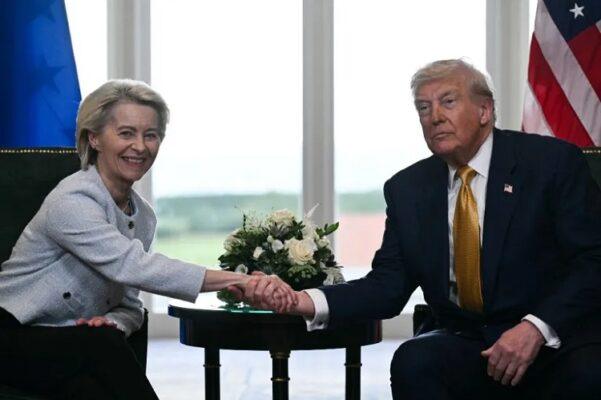
The United States and the European Union have reached a framework trade agreement, easing months of escalating tensions and averting a potential trade war between the two economic powerhouses, which together account for nearly a third of global trade.
Under the new deal, the U.S. will impose a 15% import tariff on most EU goods, a significant reduction from the previously threatened 30%, signalling a compromise aimed at restoring economic cooperation between the long-time allies.
The agreement was formally announced on Sunday by U.S. President Donald Trump and European Commission President Ursula von der Leyen during a joint appearance at Trump’s luxury golf resort in western Scotland, following a high-stakes, hour-long meeting that concluded months of intense negotiations.
Good to be in Scotland to meet @POTUS for discussions on transatlantic trade today.
The EU-US trade relationship is the world’s biggest.
I look forward to our talks ↓ https://t.co/pMWoCCwycn
— Ursula von der Leyen (@vonderleyen) July 27, 2025
“I think this is the biggest deal ever made,” Trump told reporters, lauding EU plans to invest some $600 billion in the United States and dramatically increase its purchases of U.S. energy and military equipment.
Trump said the deal, which tops a $550 billion deal signed with Japan last week, would expand ties between the trans-Atlantic powers after years of what he called unfair treatment of U.S. exporters.
Von der Leyen, describing Trump as a tough negotiator, said the 15% tariff applied “across the board.”
“We have a trade deal between the two largest economies in the world, and it’s a big deal. It’s a huge deal. It will bring stability. It will bring predictability,” she said.
The agreement mirrors key parts of the framework accord reached by the U.S. with Japan, but like that deal, it leaves many questions open, including tariff rates on spirits, a highly charged topic for many on both sides of the Atlantic.
The deal, which Trump said calls for $750 billion of EU purchases of U.S. energy in the coming years and “hundreds of billions of dollars” of arms purchases, likely spells good news for a host of EU companies, including Airbus, Mercedes-Benz, and Novo Nordisk, if all the details hold.
German Chancellor Friedrich Merz welcomed the deal, saying it averted a trade conflict that would have hit Germany’s export-driven economy and its large auto sector hard. German carmakers VW, Mercedes and BMW were some of the hardest hit by the 27.5% U.S. tariff on car and parts imports now in place.