

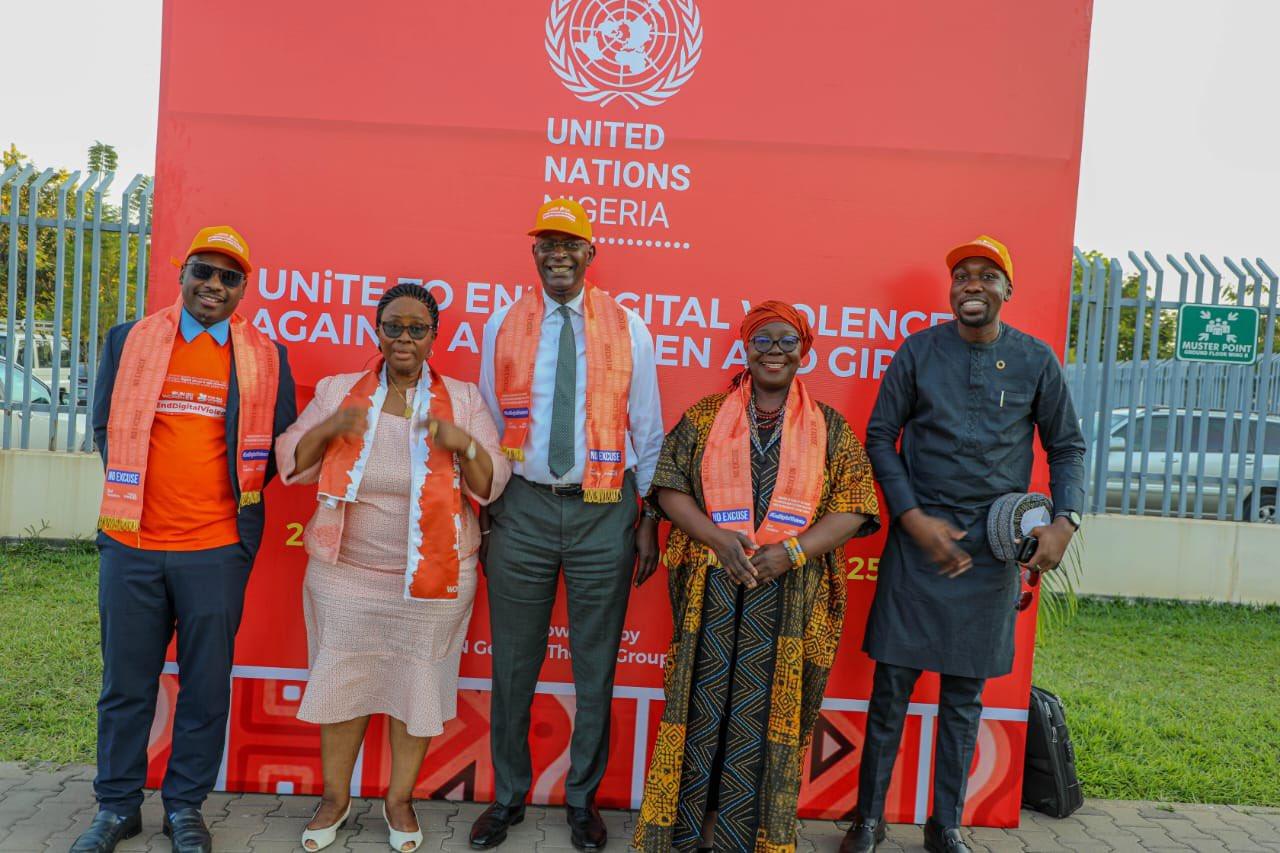
The United Nations system in Nigeria has called for urgent, collective action to address the rising wave of technology-facilitated gender-based violence.
The call was made at the flag-off of the 2025 16 Days of Activism Against Gender-Based Violence, during the UN House Orange Lighting and Digital Violence Awareness Event” in Abuja, with the global theme: “Unite to End Digital Violence Against All Women and Girls.”
Speaking at the ceremony, the UN Resident and Humanitarian Coordinator in Nigeria, Mr. Mohamed Fall, said the world must recognise that “the shape of violence is changing,” warning that abuse has now become part of daily digital interactions.

“Digital abuse is a reality. Cyber stalking, sextortion, impersonation, non-consensual image have become now part of our daily life.” he stated.
Mr. Fall stressed that online harms are silencing women in politics, schools, workplaces and communities.
“We, United Nations in Nigeria… we cannot tolerate that and we say enough is enough,” he said.
Citing the 2024 Nigeria Demographic and Health Survey, NDHS, he noted: “One in five women aged between 15 and 49 have faced physical or sexual violence… but as one door began to close, another one opened online.”
He called for a “safer digital space,” stronger law enforcement, investment in digital literacy, and responsible action from technology companies.
UN Women Country Representative to Nigeria and ECOWAS, Ms. Beatrice Eyong, said the launch “speaks to one of the most rapidly expanding and least understood forms of violence affecting women and girls today.”
Presenting national data, she said; “19% of women experience physical violence since age 15… 5% of women have experienced sexual violence… 2% of women aged 15 to 49 have experienced technology-facilitated gender-based violence,— approximately 1.2 million women.”

She emphasised that digital violence deepens inequality, noting that “women journalists, politicians and activists are disproportionately targeted with coordinated online attacks designed to silence them.”
Eyong said the UN would continue to support government and civil society “to ensure that technology becomes a tool for empowerment, not harm.”
Delivering remarks UNFPA, Ms. Muriel Mafico, highlighted severe exposure of adolescent girls.
She said UNFPA has “a particular focus on adolescent girls who are disproportionately impacted by gender-based violence”
Collective Action
While noting that protecting the citizenship is a collective effort, Mafico called for collective action, urging stakeholders to “speak openly and not judgementally.
United Nations Development Programme, UNDP Country Representative, Ms. Elsie Attafuah, described the nature of the digital violence challenge as alarming, citing a recent TikTok report where over 2 million videos that were not appropriate were brought down from Nigeria alone from April to June 2025.
“Online harassment, cyber stalking, non-consensual sharing of images, hate speech, digital exploitation… we must ensure that the right things are in place to end digital violence,” she said.
Director-General of National Agency for the Control of Aids, NACA, Dr. Temitope Ilori, spotlighted the links between GBV and HIV prevalence.
She said, “If we are curbing gender-based violence, we are indirectly reducing the prevalence of HIV… especially among younger women.”
A UN Women volunteer, Ms. Juliet Nweze, hightlighted online harassment of persons with disabilities:
“They have this way of approaching you… expecting you to accept their advances… it’s kind of discouraging,” she said.
Programme Manager, Women, Peace and Security with UN Women, Peter Mancha, called for technology use for protection.
“Maximise the use of digital technology to protect the rights of women and girls… ensure their security concerns are well addressed.” he said.
From the Muslim women’s perspective, Aisha Sani highlighted judgement and harassment online linked to religious identity, urging victims to use available reporting channels:
“There are laws and numbers you can call when you feel harassed… we must exercise all those avenues,” she said.

Lighting the UN Building Orange, the Minister of Women Affairs and Social Development, Hajiya Imaan Sulaiman-Ibrahim said she was committed to ending GBV online and offline.

The event featured a musical stage play depicting digital violence experiences by Nigerian youths from Girl child value support Initiative,and a performance by Nigerian artiste Alfred Atungu aka “Six Foot Plus”.
Atungu said Creatives have the currency of ideas, visibility, platforms and followership currency, adding that: “it needs to be spent properly by using it for the greater good to speak for the voiceless, defenceless and the silenced-majority. They should speak up and by so-doing stem the tide of Digital Gender-based violence.”
Confidence Okwuchi