


The United Nations Women has emphasized that ending Gender-Based Violence (GBV) is not only a moral imperative but also a shared responsibility and a pathway to peace and prosperity.
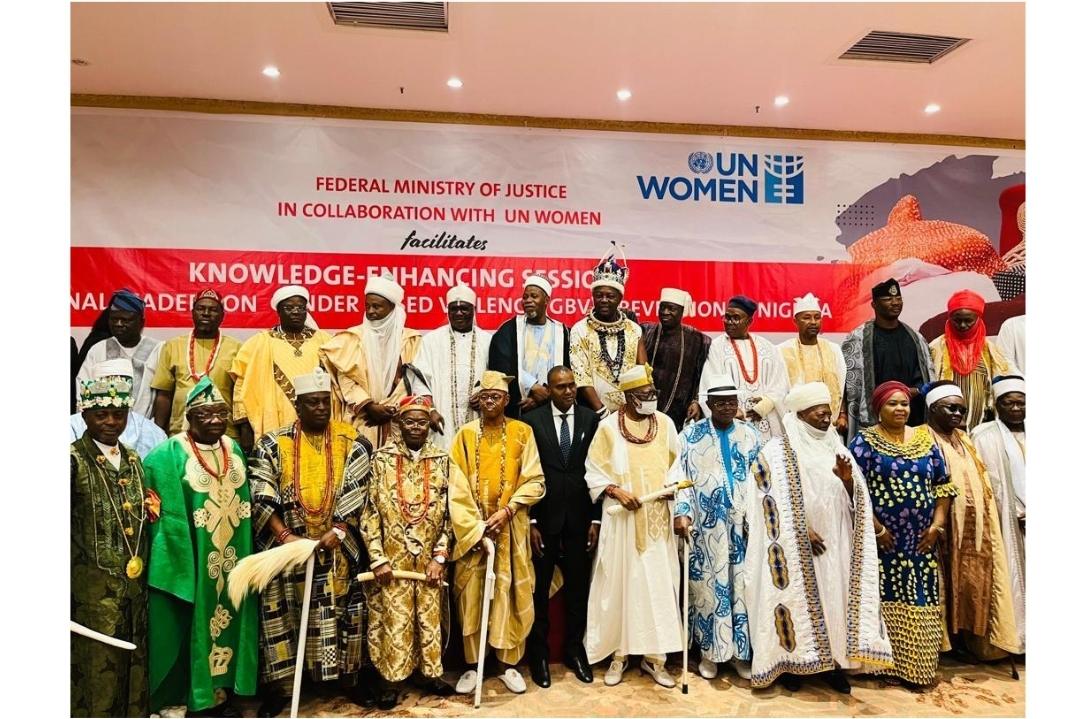
The UN Women Country Representative to Nigeria and ECOWAS, Ms. Beatrice Eyong, made this known in Abuja, Nigeria, during a knowledge-enhancing session for traditional rulers on gender-based violence, organized by the United Nations Women.
Ms. Eyong, who was represented by the Deputy Country Representative, Ms. Patience Ekeoba, stated that Gender-Based Violence (GBV) remains one of the most persistent and devastating human rights violations globally. She noted that recent evidence shows an increase in GBV cases due to violent conflict across the country, socio-economic downturns, and the slow recovery from COVID-19.

She reaffirmed UN Women’s commitment to supporting Nigeria in advancing gender equality, women’s empowerment, and a national response to GBV.
“Let me assure you, UN Women is with you on this journey. We are here to support, to learn, and to act together. Ending GBV is not only a moral imperative but also a shared responsibility and a pathway to peace and prosperity.
This is more than a workshop—it is a call to action. Over the next two days, we will reflect on the social, cultural, and legal dimensions of GBV; explore how traditional institutions can serve as early warning and prevention systems; and co-create strategies to enhance your role as protectors of justice and dignity in your communities.
Let today mark the beginning of a new chapter—one where traditional leadership becomes a beacon of hope, healing, and justice for women and girls, and all survivors of GBV across Nigeria,” she said.
According to the UN Women Country Representative, sustainable prevention begins in the community; hence, partnership with stakeholders, especially traditional rulers, is critical.
“While Nigeria has made significant progress with the passage of landmark laws like the Violence Against Persons Prohibition (VAPP) Act of 2015 and the Child Rights Act of 2003, we must confront a hard truth: laws alone are not enough.
The gap between legislation and local implementation, particularly in rural and traditional settings, remains wide. That is precisely why your presence here is so powerful. Traditional rulers are not only cultural custodians but trusted moral authorities. Your words shape perceptions. Your actions influence behavior. Your leadership can dismantle harmful norms and usher in new standards of dignity, safety, and equality, especially for women and girls,” she stressed.
Also speaking, Nigeria’s Minister of Women Affairs, Imaan Sulaiman-Ibrahim, who was represented by a Director in the Ministry, Ms. Sweet Okundaye, stressed that although the Violence Against Persons Prohibition (VAPP) Act of 2015 has been adopted in 35 states and the Child Rights Act of 2003 in all 36 states of the federation, the gap between legislation and implementation remains wide.
She also noted that despite years of national and subnational interventions, the statistics remain alarming.
“It is in this context that I emphasize the urgent need for nationwide enlightenment on the full implementation, funding, and monitoring of these critical legal frameworks.
This must include capacity-building for community actors, religious and traditional institutions, law enforcement agencies, and judicial officers. Laws must not only exist; they must work. Beyond legal tools, we must urgently strengthen our social protection ecosystem,” she said.
Sulaiman-Ibrahim added that the Ministry is advocating for the establishment of a National Social Protection Agency dedicated to addressing the multidimensional needs of survivors and other vulnerable groups.
“The Federal Ministry of Women Affairs stands at the forefront of advancing gender equality, protecting the rights and dignity of women, children, and vulnerable populations, and strengthening institutional responses to social injustice. We are resolutely committed to building systems that ensure safety, empowerment, and inclusion for all,” she added.
On his part, the Minister of Justice and Attorney General of the Federation (AGF), Lateef Fagbemi, called on traditional rulers across the nation to speak out against gender-based violence.
The AGF, who was represented by the Director of Public Prosecution at Nigeria’s Ministry of Justice, Mohammed Babadoko, noted that Nigeria, in line with both international and local obligations, has strong laws to tackle GBV crimes; however, laws alone are not enough.
“We recognize the authority of traditional and religious institutions, and we acknowledge the justice systems that already exist in our communities. Your active participation is key, especially at the grassroots. As traditional and religious leaders, you can help us break the culture of silence. Encourage your people to speak up. Work with the police and Ministries of Justice. Reject out-of-court settlements for serious crimes. Help your communities understand that GBV is not acceptable—not in our culture, not in our religion, not in our society,” he noted.
The Knowledge-Enhancing Session organized by the United Nations Women aims to equip leaders with the knowledge and tools to address SGBV within the framework of national laws, particularly the Violence Against Persons Prohibition (VAPP) Act.