


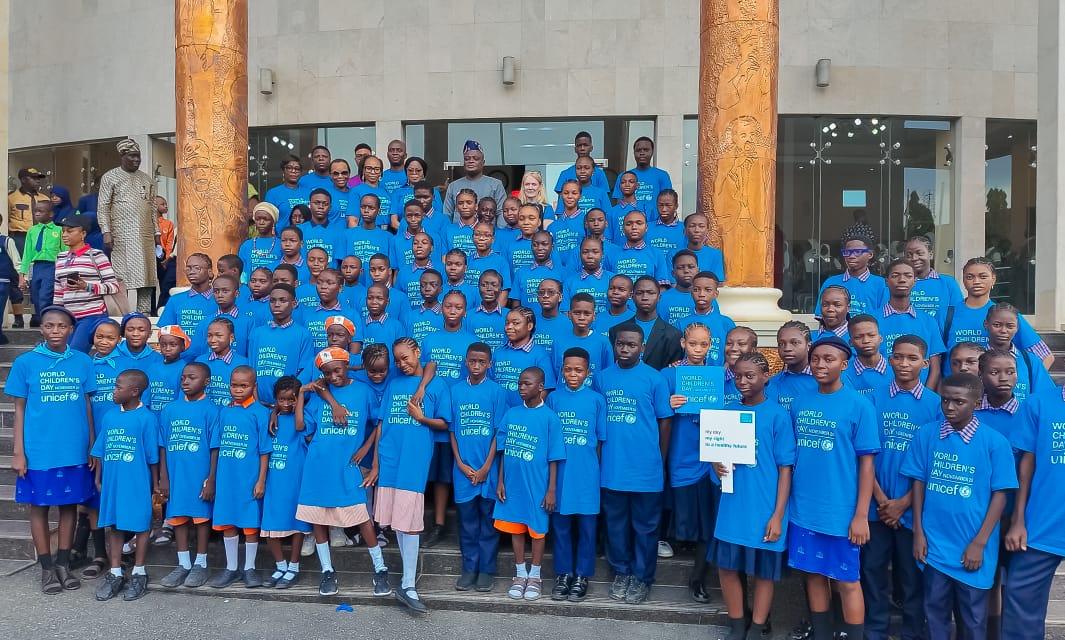
The United Nations Children’s Fund (UNICEF) has commemorated the 2025 World Children’s Day in Lagos with a policy dialogue that brought together pupils from schools across the state and lawmakers of the Lagos State House of Assembly.
The event, held at the Assembly Complex in Alausa and themed “My Day, My Right,” was organised in partnership with the Lagos State Ministry of Youth and Social Development.
Proceedings began with the pupils observing the Assembly’s plenary session, a moment many described as inspiring and empowering.


A central feature of the celebration was an interactive session between members of the newly inaugurated 7th Children’s Parliament and senior government officials, including Chairman, House Committee on Youth and Social Development, Abiodun Orekoya; Commissioner for Youth and Social Development, Bolaji Ogunlende; and the ministry’s Permanent Secretary, Pharm. (Mrs) Toyin Oke-Osanyintolu.
During the dialogue, the children presented demands for increased child-focused budgeting, improved healthcare services, accessible and quality education, expanded digital learning opportunities, upgraded school infrastructure, and enhanced safety in learning environments.
Their concerns reflect persistent national challenges.
UNICEF records show that “over 10 million Nigerian children remain out of school, while only about 25 per cent of children aged 7–14 can read and understand a simple sentence, solve basic arithmetic or access digital learning tools—a deficit that underscores the urgency of investment in child development.”
Lagos, despite its stronger performance indicators, continues to face pressure from rapid population growth and rising enrolment figures.

In their responses, lawmakers praised UNICEF and the ministry for convening the engagement and described the children’s submissions as timely.
Oke-Osanyintolu said “the push for greater child-rights budget allocation aligns with existing state priorities, including Lagos’ free basic education policy.
Legislators also referenced ongoing school rehabilitation projects and the development of new model classrooms across the state.
Orekoya reiterated “the Assembly’s commitment to child welfare and pledged increased legislative support to address the concerns raised.”
He also warned pupils against drug abuse. Nigeria has one of the highest substance-use prevalence rates in Africa, with about 14 per cent of the population aged 15–64 using drugs, according to UNODC figures a trend increasingly affecting adolescents.
Earlier, the Chief of the UNICEF Lagos Field Office, Celine Lafoucriere, commended Lagos for improvements in birth registration. UNICEF estimates that Lagos achieves over 80 per cent birth-registration coverage, compared to the national average of 57 per cent, owing to strengthened coordination between state agencies and healthcare facilities.
She, however, cautioned that global cuts to child-rights funding could undermine progress if governments fail to protect child-focused budget lines.
“Every child you invest in becomes a healthier, smarter, more productive adult. Every child you protect is one less person trapped in poverty or crime. Every child you empower becomes a leader who builds a better Lagos,” she said.
UNICEF reaffirmed its commitment to supporting Lagos State in strengthening child rights and expanding access to essential services across health, education and protection sectors.
The event also featured an art exhibition displaying children’s creative interpretations of their rights. The celebration ended with a reception, as participants commended UNICEF and the Lagos State Government for making the 2025 World Children’s Day both memorable and impactful.
Olusola Akintonde