

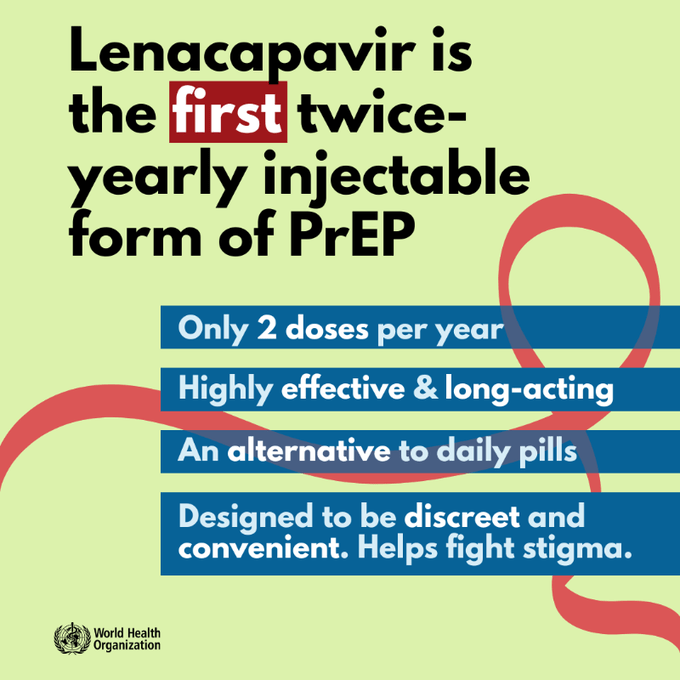
The World Health Organisation (WHO) on Monday released a landmark policy recommending injectable lenacapavir (LEN), administered twice a year, as an additional pre-exposure prophylaxis (PrEP) option for HIV prevention.
The guidelines were unveiled during the 13th International AIDS Society Conference (IAS 2025) on HIV Science, held in Kigali, Rwanda.
According to WHO, LEN—the first long-acting PrEP medication requiring only two doses annually—represents a transformative advancement for individuals at risk of HIV infection, particularly those facing challenges with daily adherence, stigma, or limited healthcare access.
“With just two doses per year, LEN is a transformative step forward in protecting people at risk of HIV,” the organisation stated.
“It provides a highly effective, long-acting alternative to daily oral pills and other shorter-acting options.”
A Crucial Step Amidst Stagnating HIV Prevention Efforts
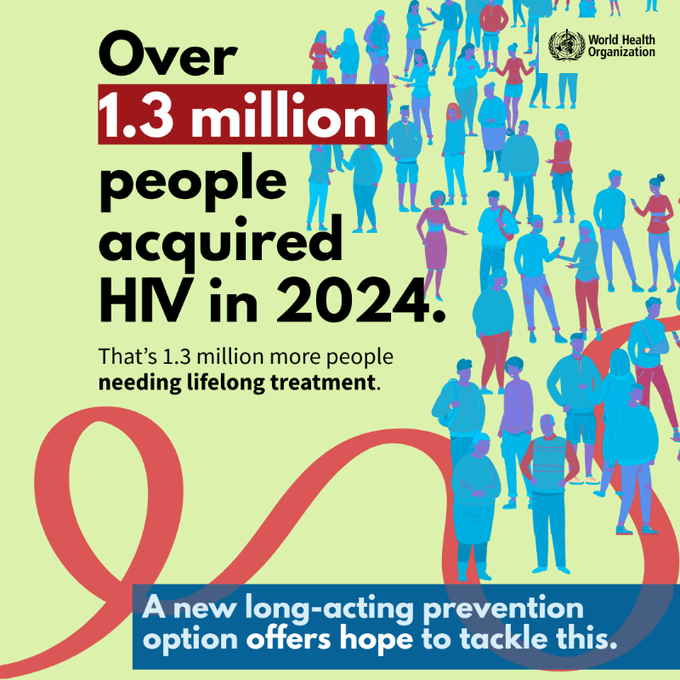
WHO Director-General Dr. Tedros Ghebreyesus described the approval of LEN as a critical step in addressing the 1.3 million new HIV infections reported in 2024, many of which affect key populations, such as sex workers, men who have sex with men, transgender people, people who inject drugs, and incarcerated individuals.
“While an HIV vaccine remains elusive, lenacapavir is the next best thing,” said Dr. Ghebreyesus.
“The launch of WHO’s new guidelines, alongside the FDA’s recent approval, marks a significant milestone in expanding access to this powerful tool.”
He emphasised WHO’s commitment to working with countries and development partners to ensure that LEN reaches communities quickly and equitably.
⚠️ 1.3 million people acquired HIV in 2024 alone, including thousands of adolescent girls and young women.
Today, in a landmark move towards HIV prevention, WHO recommends twice-yearly injectable lenacapavir as pre-exposure prophylaxis (PrEP) to protect people at risk of HIV.
— World Health Organization (WHO) (@WHO) July 14, 2025
Expanding the Arsenal: WHO Endorses a Range of HIV Prevention Tools
The new guidelines position LEN alongside other WHO-endorsed PrEP options, including:
- Daily oral PrEP
- Injectable cabotegravir (CAB-LA)
- Dapivirine vaginal ring
To support widespread delivery of long-acting PrEP, WHO also recommends a public health approach to HIV testing using rapid diagnostic tools, enabling community-level administration through clinics, pharmacies, and telehealth services—removing costly and complex testing procedures that often limit access.
Long-Acting ART for People Living with HIV
For the first time, WHO has formally recommended injectable cabotegravir and rilpivirine (CAB/RPV) as a switching option for antiretroviral therapy (ART) in people who have achieved viral suppression on oral ART and do not have active hepatitis B infection.
This long-acting regimen provides an alternative for individuals facing adherence challenges.

Guidelines on Integration, STIs, and Mpox
WHO also released updated service delivery recommendations to integrate HIV care with services for non-communicable diseases (NCDs) such as hypertension, diabetes, and mental health conditions like depression and alcohol use disorders.
The updated approach aims to streamline care and improve ART adherence.
Additional guidance includes:
- Routine screening for gonorrhoea and chlamydia among key populations
- Immediate ART initiation for people with HIV and suspected/confirmed mpox
- Expanded HIV and syphilis testing protocols for mpox patients
Read Also: Abuja Hospital Launches Free Maternal Health Project
Operational Guidance to Navigate Funding Challenges
In response to shrinking global HIV funding, WHO released a new operational framework to help countries sustain priority HIV services, adapt to resource limitations, and preserve public health gains.
“We have the tools and the knowledge to end AIDS as a public health threat,” said Dr. Meg Doherty, Director of WHO’s Global HIV, Hepatitis, and STI Programmes.
“What we need now is bold implementation, grounded in equity and powered by communities.”
Dr. Doherty noted that, as of the end of 2024:
- 40.8 million people were living with HIV globally
- 31.6 million were on antiretroviral therapy
- An estimated 630,000 people died from HIV-related causes
- 1.3 million new infections were recorded, including 120,000 children
She added that the new guidelines offer practical, evidence-based strategies to expand access, simplify services, and promote resilient health systems, especially in low-resource settings.
“Now is the time for bold implementation to ensure these gains translate into real-world impact,” she concluded.