

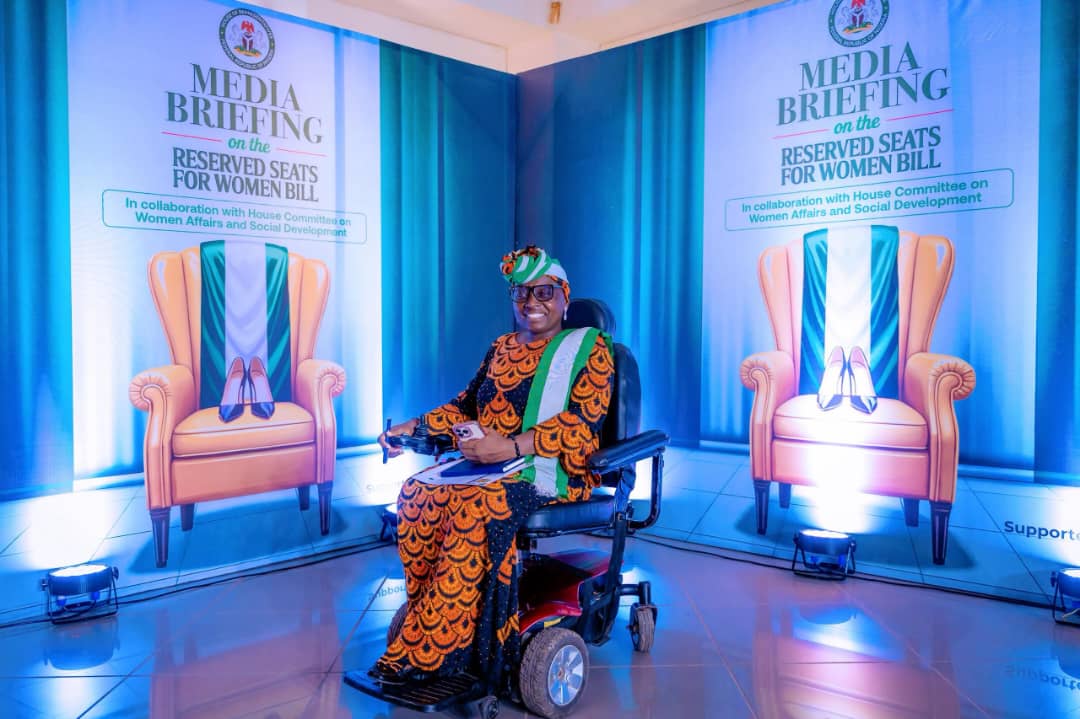
Advocates for women with disabilities have urged that the proposed Reserved Seats for Women Bill guarantee full inclusion.
They said that genuine representation must encompass all women, including those living with disabilities.
In an exclusive interview with Voice of Nigeria, respondents argue that true equity lies in the Reserved Seats Bill enshrining explicit provisions guaranteeing political representation for all categories of women, in line with national legislation.
Disability inclusion advocate, Lois Auta, Founder and President, Network of Women with Disabilities says the Reserved Seats Bill has the potential to strengthen democratic governance and accelerate socio-economic development.
“This will deepen democracy, it will increase the number of women in the political sphere. It will also contribute to the economic development of this country, when women with disabilities, young women, the elderly and every gender called woman, that is included,” she stated.
Auta urges lawmakers to align the bill with the Nigeria Disability Act, by allocating a minimum quota for women with disabilities.
“My recommendation is at least 5%… should be reserved for women with disabilities in these 182 seats we’re clamouring for,” she posits.
A visually impaired legal practitioner, Calista Ugwuaneke cautions that without deliberate measures to include vulnerable groups, the bill risks becoming symbolic rather than transformative, noting that Inclusion must go beyond gender.
“it will be more important if in future I see the inclusion we talk about because if we say that men have not really carried women along that we don’t have a place as women and then we come within ourselves as women maybe hoping that will correct what we perceive as not very favourable to women in the general term and we don’t find women including everyone like persons, women and girls with disabilities then it means that this bill is just a jamboree like many others in the past for us,” she said.
Ugwuaneke argues that once women safeguard political spaces from male dominance, they must avoid replicating exclusionary practices.
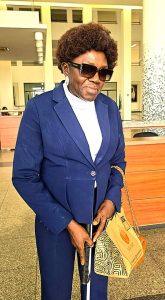
She also calls for visibility and platforms for women with disabilities, noting that only then, will the bill achieve its intended purpose.
“If we talk about inclusion if we safeguard our space from men then we should also know that we should not create that vacuum for the vulnerable within us as women and so it will make more meaning to me if I see persons with disabilities women with disabilities women and girls with disabilities very visible and a platform” she stressed
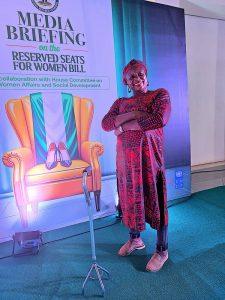
Juliana Yepwi, from the Network of Women with Disability, describes the struggle as a “double battle”; dealing with overcoming the challenges of being a woman while also confronting the obstacles faced by people with disabilities.
She says, “…first you know normally as women with disability we are faced with the barriers as a woman and also as a woman with disability. So for to achieve equity as a woman I think is an achievement.”
Yepwi noted that the bill, if implemented inclusively, could dismantle “cultural and societal barriers” that prevent women with disabilities from participating in politics.
Continuous Education
She emphasised the need for continuous education, advocacy, and political support to ensure that the reserved seats truly benefit all women, not just a select few.
“After achieving women equity, as a woman with disability, as a woman,… then it is now left for the organisation to educate, advocate for women with disability participation in politics, So that there would be total erasion of cultural and societal barriers that hinder women in participation,” she advocates.
Reserved Seats Bill
The Reserved Seats Bill seeks to create 74 new seats in the National Assembly and 108 in the State Houses of Assembly, reserved exclusively for women
It would run in the first instance for over a period of four election cycles of 16 years, and thereafter subject to a review.
The bill also seeks to amend Sections 48, 49, 71, 77, 91, and 117 of the 1999 Constitution as amended.
Statistical Overview
Nigeria’s National Assembly currently ranks 179 out of 183 in women’s representation with 4.05% seats occupied by women, with no representation by a person with disability.
The Reserved Seats Bill #HB1349 as proposed and advocated for, as part of ongoing Constitution Review, would reserve 74 Federal and 108 State seats for women in the nations legislature.
The Reserved Seats Bill possesses transformative potential to bridge the statistical deficit, by ensuring increased representation of women, including those with disabilities, in all tiers of governance.
Confidence Okwuchi