

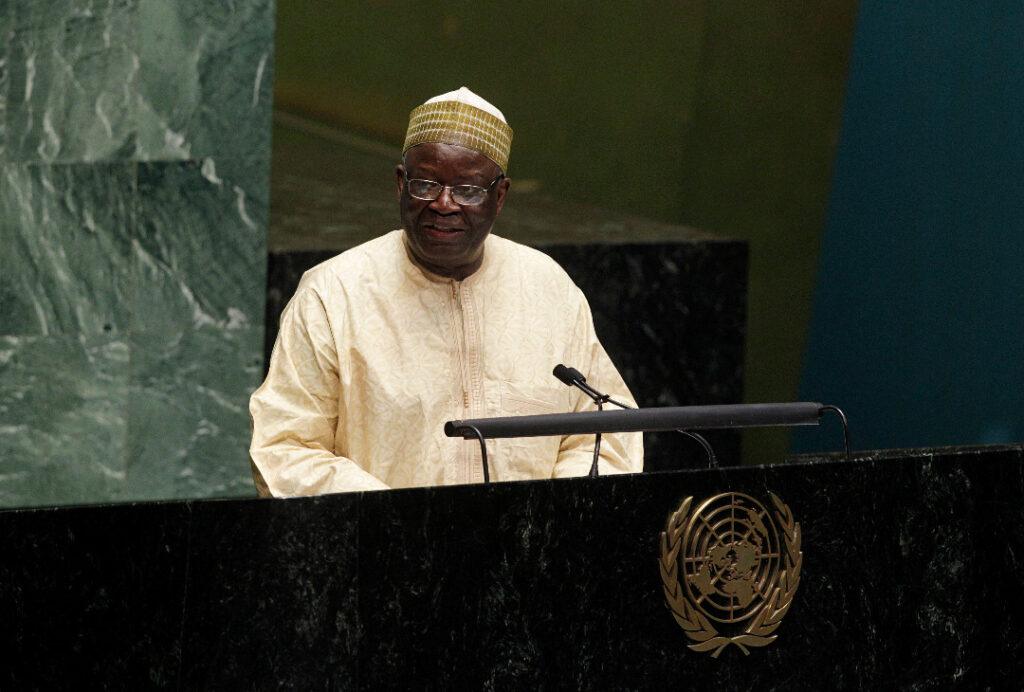
Nigeria’s Former Minister of External Affairs, Professor Ibrahim Gambari, has called on regional and international leaders to work together in addressing security concerns in the Gulf of Guinea.
He noted that enhanced stability would unlock the region’s immense economic opportunities.
Nigeria’s former permanent representative spoke on Thursday in New York during a high-level roundtable on the sidelines of the 80th United Nations General Assembly.
Professor Gambari said the Gulf of Guinea, endowed with abundant oil, gas, and critical minerals, holds vast potential for growth and investment.
By tackling challenges, the region can attract greater investor confidence, foster sustainable development, and strengthen community resilience.
The diplomat noted that despite the challenges, there was hope, pointing to the decline in piracy in some areas due to improved cooperation.
“We are not helpless. When states coordinate naval patrols and share intelligence, tangible results follow,” he said.
He highlighted Nigeria’s move to host a Combined Maritime Task Force, approved by the African Union in April 2025, as a sign of renewed political will.
To move from talk to action, Gambari laid down a five-point agenda for the region, which included Strengthening Security Frameworks, Merging Security with Development, bringing in the Private Sector, Embracing Technology, and forming a Business Council for the Gulf of Guinea to drive sustained cooperation.
Gambari insisted that for the region to become an economic hub, its natural wealth must be managed transparently to benefit local communities and avoid fueling grievances.
“Economic opportunity, when paired with inclusive governance, is itself a powerful deterrent to insecurity,” he argued.
He anchored the plan to broader continental goals like ECOWAS Vision 2050 and the AU’s Agenda 2063, warning that without decisive collective action, the Gulf of Guinea’s promise would remain unfulfilled.
“The future must be shaped by a shared commitment: to protect its waters, invest in its people, and transform its natural wealth into a driver of inclusive growth,” Gambari concluded.