


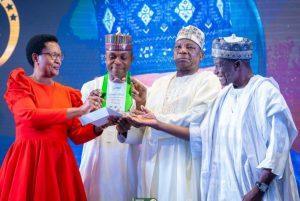
Yobe State has emerged as the overall best performing state in Nigeria’s 3rd edition of the Primary Health Care (PHC) Leadership Challenge Awards.
It received $700,000 in recognition of its leadership in quality of care, community engagement, PHC coordination, and commodity availability.
The ceremony was held under the auspices of the National Primary Health Care Development Agency (NPHCDA), the Nigeria Governors’ Forum (NGF) and development partners.
Speaking on behalf of the winning States at the PHC Challenge Fund event, Governor of Abia State, Alex Oti expressed appreciation to international partners, including the World Bank, UNDP, UNICEF, and other development organisations.
He said the achievements being celebrated would not have been possible without their sustained support.
Consistency and Purpose
Governor Oti reflected on the importance of consistency and purpose in public service, observing that meaningful progress is often driven by challenges that inspire excellence.
He noted that the introduction of healthy competition among states has significantly raised standards, encouraged innovation, accountability, and improved performance across the health sector.
He says, “When you know what you are doing and you keep doing it, someone will notice,” he said, adding that the Challenge Fund has helped states distinguish themselves through measurable results.”
Health Financing
Emphasising the importance of health financing, the Governor urged leaders to view spending on health not as a cost, but as a critical investment in human survival and national development.
He assured partners that States would continue to raise the bar in health outcomes and expressed gratitude on behalf of federal and states leaders.
Nigeria’s, Minister of Health and Social Welfare, Dr. Ali Pate, expressed deep gratitude for what he described as “years of dividends, achievements, and unwavering partnership” that have strengthened Nigeria’s health sector.
Reflecting on progress made over the past three years under the current administration, Pate noted that a critical sector-wide compact signed in 2002 outside the United States has grown into a cornerstone of Nigeria’s long-term health investment strategy.
“We have built a very strong sector. After 20 years of trading and collaboration, we are now seeing a total of 26% in earnings. These achievements reflect your leadership, the commitment of your teams, and the collective effort to improve the health and well-being of all Nigerians,” Pate said.
He emphasised that health must be understood as a serious and sustained investment, not an afterthought.
According to him, “A healthy person has a thousand wishes, but a sick person has only one to get well,” saying that health remains a universal aspiration and a foundation for national development and unity.
He argued that Nigeria cannot expect quality healthcare at minimal cost, urging all levels of government, civil society, and the private sector to join hands to deliver better outcomes.
On-going Initiatives
The Minister also highlighted ongoing initiatives set by the ECWC and partner agencies, including projects in biotechnology, food security, e-commerce, governance, and international services.

“These are tangible pillars that will support our journey toward a healthier population,” he said.
Dr. Pate acknowledged persistent challenges in affordability and access, particularly regarding the cost of drugs, medical treatment, and health insurance for children.
He noted that, “Although government intervention has helped reduce costs, it cannot succeed alone sustained investment is essential.”
National Investment
He announced a ₦3.6 billion national investment aimed at strengthening health systems and improving service delivery.
On resource allocation, Pate emphasised transparency saying, “We have seen improved revenue visibility not without gaps, but enough to show that a transparent system can extend services to more people.”
Looking ahead, Dr. Pate expressed optimism about Nigeria’s health trajectory for the next five years.
He called on the National Assembly to support increased allocations, targeting at least ₦3.5 million per state to improve university-based health initiatives.
He highlighted the role of university partnerships especially with the University of Java, which he described as crucial to expanding Nigeria’s skilled health workforce and reducing reliance on external assistance.
He also announced that Nigeria is set to receive its first world-class African-based accreditation for long-lasting health innovations, a milestone he said would position the country as a leader on the continent.
Pate commended international and local partners for fostering what he called a “perfect partnership” that will create jobs, expand industries, and bring sustainable growth to the Nigerian health sector.
“It is not just an investment, it is a foundation for generations,” he stressed.
Earlier, the Chairman of the Nigeria Governors’ Forum and governor of Kwara State, AbdulRazaq AbdulRahman representated by the Nasarawa State governor, Abdullahi Sule reaffirmed the collective commitment of State governments to strengthening Primary Health Care (PHC).
He described the PHC Leadership Challenge Awards as a growing national tradition that reflects measurable progress and accountable leadership.
He commended the Federal Government’s strong support for subnational health reforms, noting that the event has become an integral part of Nigeria’s annual observance of Universal Health Coverage Day.
Increased Investments
Highlighting key achievements over the past three years, the NGF Chairman stated that States governments have significantly increased investments in health, with combined State health budgets rising from ₦831 billion in 2022 to ₦2.36 trillion in 2025, with 30 percent consistently allocated to Primary Health Care.
He commended the States recognised for outstanding performance and urging continued collaboration with development partners to advance Universal Health Coverage nationwide.
The Gates Foundation deputy Director for Health, Dr. Nkata Chuku, said Nigeria’s ongoing efforts to revitalize primary health care (PHC) received strong endorsement from the Gates Foundation at the Nigeria PHC Challenge Fund event.
Dr. Chuku recalled the origins of the reform journey, which began in 2019 when twelve Nigerian Governors convened in Seattle and endorsed the Seattle Declaration.
That commitment, he noted, has since translated into tangible reforms aimed at prioritising, financing, and strengthening PHC systems across the country.
Drawing on national surveys, high-frequency monitoring, and administrative data, Dr. Chuku noted that Nigeria’s 2025 performance landscape shows steady progress.
Also speaking at the event, UNICEF Country Representative, Ms. Wafaa Saeed, emphasised that primary health care was the foundation upon which Nigeria’s journey toward Universal Health Coverage and the Sustainable Development Goals must be built.
She noted that for millions of Nigerians, primary health care centres are not just the first point of care but the only access to essential health services.
Ms Saeed commended the Federal Government’s bold reforms under the Nigeria Health Sector Renewal Investment Initiative launched in 2023.
She described the moment as pivotal, with renewed focus, clarity of direction, and ambition aligned to deliver measurable health outcomes.
Collaboration
Ms. Saeed reaffirmed UNICEF’s commitment to supporting Nigeria through close collaboration with the Federal Ministry of Health, the National Primary Health Care Development Agency, and partners under the Sector-Wide Approach.
The Executive Director of NPHCD, Dr. Muyi Aina, highlighted strong advances driven under the Nigeria Health Sector Renewal Investment Initiative (NHSRII) and the Sector-Wide Approach (SWAp).
Dr. Aina stated that 2,127 PHCs fully revitalised, with work ongoing in 1,671 more.
He said ₦52.5 billion has been disbursed to 8,309 PHCs through the reformed Basic Health Care Provision Fund (BHCPF 2.0).
“72,887 frontline health workers trained, with an ongoing target to train 120,000. A 22.5% rise in antenatal care attendance (ANC) in Q3 2025.
“7.4 million children reached under the Identify, Enumerate, Vaccinate (IEV) immunization strategy.”
Digital Dashboard
He disclosed that a live PHC Digital Functionality Dashboard has been launched nationwide.
Dr. Aina urged State governments to take ownership of PHC financing as donor support for the Challenge ends in 2026.
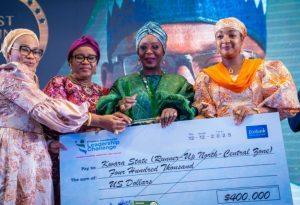
The event closed with renewed calls for States to increase PHC allocations to at least ₦3.5 trillion nationally by 2026, reduce dependency on external aid, and ensure that every Nigerian has access to quality primary healthcare through a system they trust.