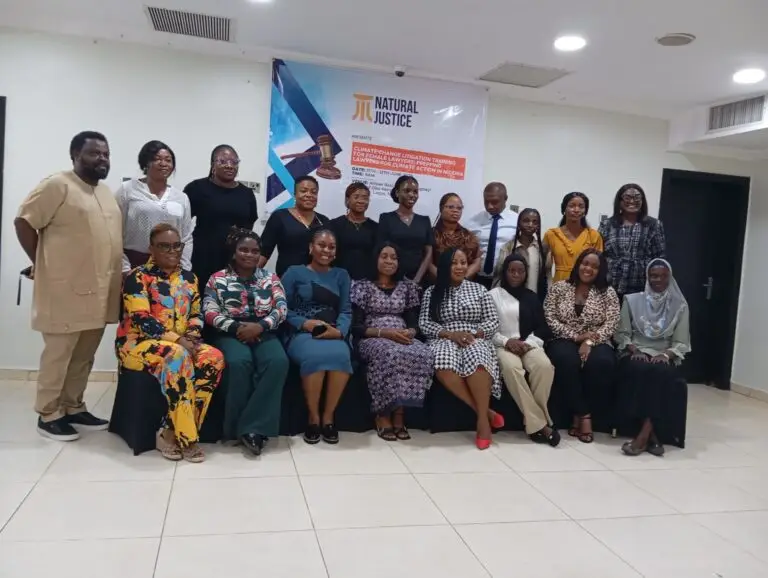
A Non-governmental organisation (NGO), Natural Justice, with support from African Activists for Climate Justice, has launched a two-day intensive training on climate change litigation for female lawyers across Nigeria.
The workshop aims to equip women in the legal profession with the knowledge and tools necessary to address climate justice through the courts.
The Country Manager of Natural Justice, Mr Michael Karikpo, at the training on Wednesday in Lagos emphasised the central role of women in climate activism.
Karikpo noted that women were disproportionately affected by the impacts of climate change.
“There are already legal frameworks like the Climate Change Act and Nigeria’s Nationally Determined Contributions that provide avenues for holding duty bearers accountable.
“Yet, the lack of preparedness and transparency, particularly in the management of Nigeria’s ecological fund, remains a significant concern,” Karikpo said.
He also called for the integration of climate change awareness and litigation into the legal education curriculum.
He said that empowering female lawyers was essential in amplifying vulnerable voices and advancing environmental justice.
In his presentation titled: “Climate Change Litigation in Nigeria: An Evolving Trend,” environmental lawyer and consultant Mr Ishaku Mshelia, discussed the critical connection between scientific exposure to climate risks and the legal responses needed.
Mshelia referenced the Paris Agreement and Nigeria’s commitment to reduce carbon emissions by 20 per cent.
He described the Climate Change Act as a foundation for legal engagement.
“There is a need to enhance the judiciary’s understanding of climate litigation while strengthening the capacity of lawyers to lead this charge,” Mshelia added.
Mr. Sulaimon Arigbabu, the Executive Secretary of the Human and Environmental Development Agenda (HEDA Resource Centre), elaborated on the science of climate change and its severe consequences for Nigeria.
“We are among the least contributors to climate change but face the most devastating effects.
“Science helps us understand the crisis; law helps us respond to it,” Arigbabu said.
He highlighted the role of gas flaring, inadequate policy responses, and weak enforcement mechanisms as urgent issues.
He urged participants to use their legal expertise to challenge injustice and protect the rights of the most affected populations—particularly women and children.
“Your role is not just to fight for laws, but to fight for lives,” Arigbabu added.
The training marks a significant step in promoting gender-inclusive climate justice and building a legal community capable of confronting the climate crisis through strategic litigation and advocacy.
NAN/Oyenike Oyeniyi