
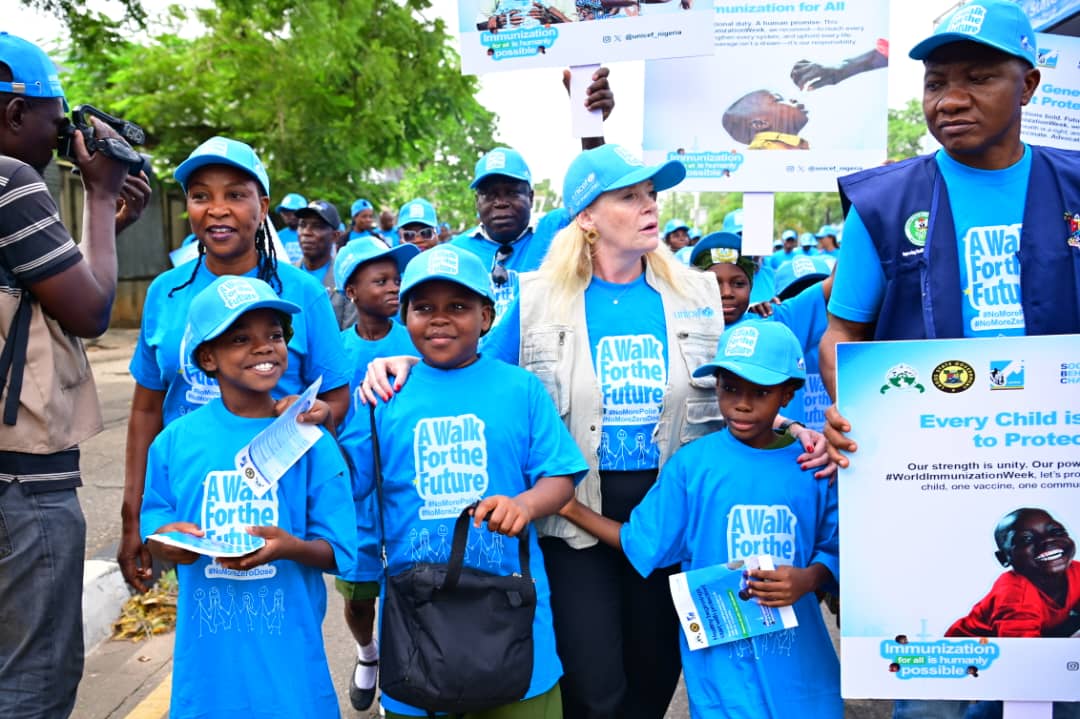
The United Nations Children’s Fund (UNICEF) has called on the Nigerian government to increase investment in child welfare, emphasising that such spending is not only a humanitarian imperative but also a catalyst for long-term economic growth.
UNICEF reports that over 100 Nigerian children die every hour from preventable causes such as malnutrition and lack of access to basic healthcare.
Despite the statistics, Nigerian government spends on early childhood development. A recent UNICEF report revealed that in sub-Saharan Africa, governments spend 16 times more on adolescents than on children aged 0 to 5.
In Nigeria, only 7 percent of the 2023 national budget was allocated to health well below the 15 percent benchmark set by the Abuja Declaration.
The Chief of UNICEF’s South West Nigeria Field Office,Celine Lafourcrier stressed that “poorly allocated or inadequately implemented budgets often have minimal impact on intended beneficiaries,” She added.
“Without data-driven planning, strong coordination, and accountability, public spending fails to improve children’s lives in any meaningful way,” Lafourcrier argued that budgeting must go beyond mere allocation, urging governments to prioritize investments that directly impact children’s wellbeing.
Supporting this call for strategic investment, Director of Budget at the Lagos State Ministry of Economic Planning and Budget Olufemi Orojimi, disclosed that the state had introduced a dedicated budget code to track every naira spent on children’s welfare.
“Funds are now more effectively channeled into essential services such as nutrition for vulnerable communities, expanded access to public education, and stronger child protection systems,” Orojimi said, noting that the initiative has brought greater transparency and accountability to child-focused budgeting.
Experts continue to stress that investing in child nutrition, healthcare, and education delivers high economic returns. The World Bank estimates that every dollar invested in reducing undernutrition yields $23 in economic benefits. Similarly, Nobel Laureate economist James Heckman has shown that early childhood education investments produce returns of $7 to $11 per dollar spent.
Currently, an estimated 10 million Nigerian children are out of school. UNICEF and other development partners are advocating for scaled up early learning programmes, especially in underserved communities, to close this gap and boost future productivity.
Government programmes such as the National Social Safety Nets Project (NASSP) have made strides reaching over 1.9 million vulnerable households with food, healthcare, and education support. However, UNICEF says these efforts must be significantly expanded to meet the country’s growing demographic and developmental challenges.
Countries like Canada and Bangladesh have demonstrated how prioritising child welfare can lead to measurable gains in both human development and economic performance.
“With one of the largest youth populations in the world, Nigeria stands at a critical juncture,” UNICEF said in a statement. “
The nation’s future prosperity depends on the choices made today. Every naira spent on children is a building block for a stronger, more inclusive economy.”
UNICEF is urging Nigerian policymakers to adopt evidence based strategies in the allocation and utilisation of funds for children’s programmes, stressing that the returns are socially and economically undeniable.

