
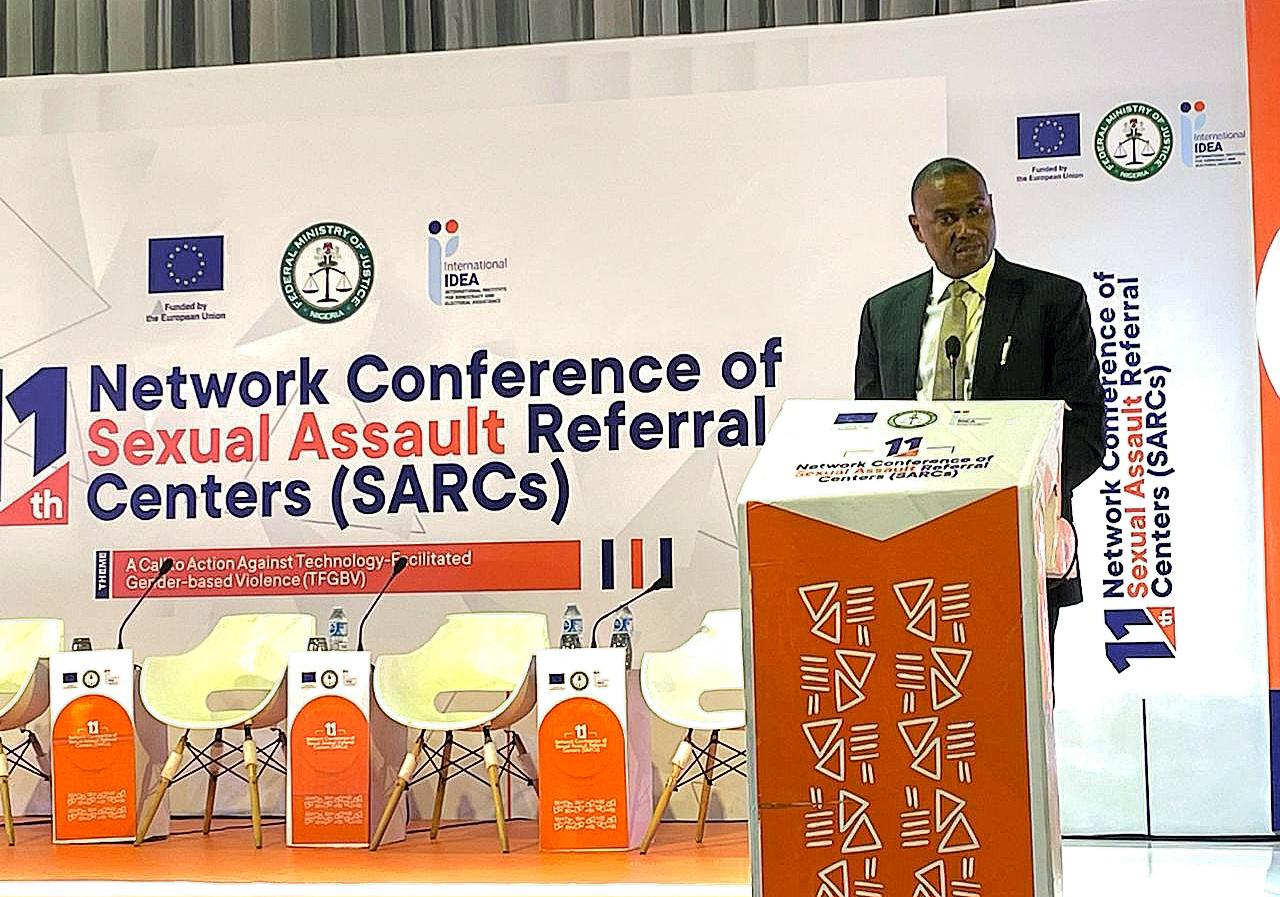
The Director of Public Prosecution (DPP) at the Federal Ministry of Justice, Mohammed Bakodo Abubakar, has called for the rapid modernisation of Nigeria’s justice system to confront the escalating threat of technology-facilitated gender-based violence (TFGBV).
He made the call in a keynote address at the 11th Network Conference of Sexual Assault Referral Centres (SARCs), held during the 2025 16 Days of Activism.
The convergence, themed “A Call to Action Against Technology-Facilitated Gender-Based Violence (TFGBV),” was organised by the International Institute for Democracy and Electoral Assistance (IDEA) “Rule of Law and Anti-Corruption” (RoLAC) Programme in collaboration with the Federal Ministry of Justice and other partners, and funded by the European Union.
Abubakar said “Nigeria is already facing a fast-growing crisis.
“As we gather here today, we are confronted with a crisis that evolves as rapidly as technology enables it. Technology-facilitated gender-based violence is not a distant threat. It is happening now. It is happening to us.”
He described harms ranging from deepfake pornography to digital coercion as “devastating and immediate.”
“These are not merely online issues. They are crimes with devastating real-world consequences. They destroy reputations, shatter mental health, compromise safety, and drive survivors from public life, employment, and their own homes.”
The DPP warned that existing laws, structures, and capacities are failing survivors:
“Let me be direct about where our justice system is failing survivors of technology-facilitated gender-based violence. Our legal frameworks are inadequate… we are attempting to address 21st-century crimes with laws written for a pre-digital era, ”Abubakar said
He noted that fragmented legislation and limited capacity have created “real barriers that deny justice every single day,” observing that “cyber-stalking, doxxing, and tech-enabled coercive control exist in legal grey zones.”
Abubakar also highlighted weak institutional coordination saying “Police don’t coordinate effectively with prosecutors… our communication with technology platforms is inactive at best… Civil society organisations operate in parallel to rather than in partnership with formal justice systems.”
He called for urgent reform, stressing that “These gaps are not inevitable. They are choices, and they are choices we can reverse. We are not powerless.”
Presenting recommendations on TFGBV policy and practice, TechSocietal Executive Director Temitope Ogundipe outlined priority actions, including TFGBV-specific prosecutorial guidelines, digital evidence Standard Operating Procedures, deepfake detection tools, mandatory digital-safety training for justice actors, survivor digital-safety plans, platform accountability, adolescent-friendly reporting channels, and donor investment in forensic tools and rehabilitation services.
She offered TechSocietal’s partnerships on protocol development, justice-actor training, platform-accountability advocacy, rapid response through MyLawBrella, and policy support.
In another keynote, Professor of Public Law Fatima Waziri-Azi identified systemic gaps including legal and regulatory weaknesses, prevailing harmful attitudes, and limited responsibility from technology platforms. Her call to action included strengthening legal frameworks, promoting digital literacy, expanding reporting mechanisms, driving community awareness, and integrating TFGBV into broader SGBV programmes.
The event also highlighted progress under the EU-funded Rule of Law and Anti-Corruption Programme (RoLAC II), including the expansion of Sexual Assault Referral Centres nationwide from 11 in 2017 to 50 SARCs currently supporting over 50,000 survivors.

