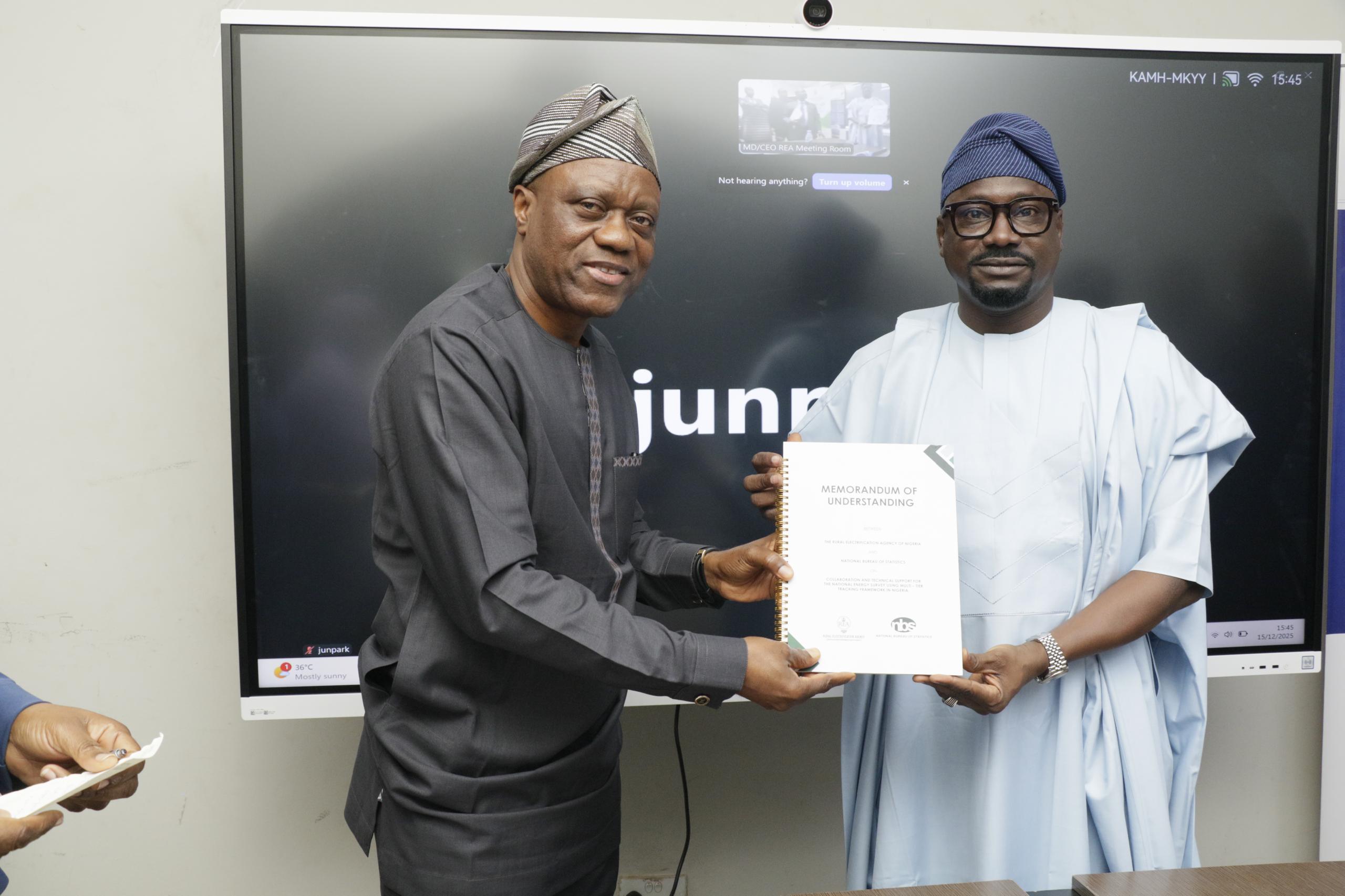
The Rural Electrification Agency (REA) and the National Bureau of Statistics (NBS) have signed a Memorandum of Understanding (MoU) to jointly conduct a comprehensive National Energy Survey using the Multi-Tier Tracking Framework (MTF) in a significant step toward strengthening evidence-based energy planning in Nigeria.
The agreement formalises a strategic collaboration between the two federal government agencies to deliver high-quality, analytical energy data that will support policy formulation and investment decisions across Nigeria’s power and energy sector.
The survey will be implemented under the Energy Sector Management Assistance Program (ESMAP) of the World Bank.
The MoU was signed in Abuja by the Managing Director/Chief Executive Officer of REA, Dr Abba Aliyu, and the Statistician-General of the Federation/Chief Executive Officer of NBS, Prince Adeyemi Adeniran.
Speaking at the signing ceremony, Dr Aliyu described the partnership as a critical milestone in advancing data-driven rural electrification planning.
He noted that the collaboration will generate granular and credible data on electricity access, affordability, and off-grid energy solutions across the country.
“This collaboration will provide granular, credible data on electricity access, affordability, and off-grid energy solutions across Nigeria. The findings will directly inform national electrification initiatives such as the National Electrification Strategy and Implementation Plan (NESIP), while also strengthening investor confidence in the sector,” he said.
The Statistician-General of the Federation and Chief Executive Officer of NBS, Prince Adeniran, emphasised the importance of robust statistical standards in national surveys, reaffirming NBS’s commitment to ensuring quality and reliability.
He said NBS is pleased to provide technical oversight, sampling expertise, and quality assurance to ensure that the survey adheres to global best practices. Reliable data is fundamental to effective policy and sustainable development.
According to him, under the MoU, REA and NBS will work collaboratively to:
Assess energy access at household, community, enterprise, and public institution levels using the Multi-Tier Framework.
Examine household energy affordability, expenditure patterns, and willingness to pay for grid and off-grid solutions, and analyse access to and usage of off-grid technologies, including solar home systems, mini-grids, and clean cooking solutions.
“REA will also serve as a key implementation and policy partner, providing sectoral expertise, stakeholder engagement, public awareness, and alignment with Nigeria’s rural electrification priorities”
“NBS will provide regulatory approval, sampling frames, methodological validation, technical supervision, and capacity building for enumerators to ensure data quality and credibility”
“The World Bank, through ESMAP, will fund and provide technical oversight for the survey and engage a qualified survey firm responsible for field data collection, analysis, and reporting”
Duration and Expected Impact
The MoU will remain in force for 18 months from the date of signing. Data generated from the survey is expected to support national energy planning, improve programme targeting, guide private sector investments, and accelerate Nigeria’s transition toward universal access to electricity and clean cooking solutions.
The partnership underscores the Federal Government’s commitment to strengthening inter-agency collaboration, improving the availability of reliable energy data, and advancing sustainable electrification for rural and underserved communities nationwide.
The Rural Electrification Agency (REA) is the implementing agency of the Federal Government of Nigeria under the Federal Ministry of Power, tasked with electrifying unserved and underserved communities to catalyse economic growth and improve quality of life.
Established under Section 127 of the Electricity Act 2023, REA implements several flagship initiatives, including the Rural Electrification Fund (REF), Nigeria Electrification Project (NEP), Distributed Access through Renewable Energy Scale-up (DARES), Energizing Education Programme (EEP), Energizing Economies Initiative (EEI), Solar Power Naija (SPN), and other national and international clean energy programmes.
The Agency also plays a key role in creating an enabling environment for private sector-led electrification through feasibility studies, energy audits, enumeration, data analysis, and stakeholder engagement.
Olusola Akintonde