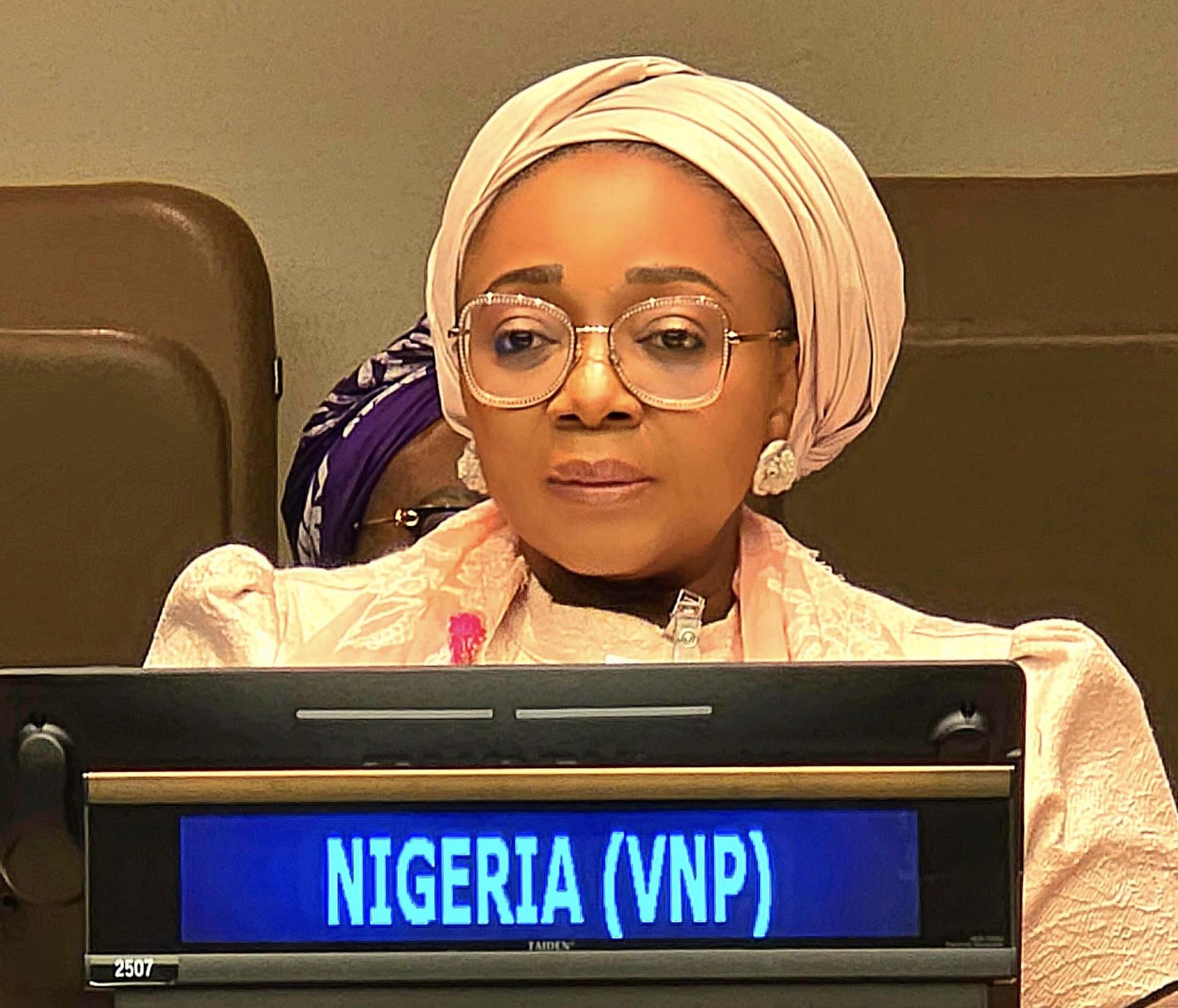
Minister of Women Affairs and Social Development, Hajiya Imaan Sulaiman-Ibrahim has presented a comprehensive policy roadmap detailing the Nigerian Government’s strategies to enhance women’s access to justice, promote economic empowerment, and strengthen social development initiatives across the country.
Delivering Nigeria’s Voluntary Country Statement on behalf of the African Group at the 70th Session of the Commission on the Status of Women at the United Nations Headquarters in New York, the Minister described justice for women as a cornerstone of equitable national development.
The Minister noted that the session’s review theme; women’s participation in public life and the elimination of violence against women and girls, is a mutually reinforcing priority requiring coordinated policy responses.
“The priority theme of CSW 70, ensuring strengthening access to justice for all women and girls, is a right, it’s not a privilege, and a foundation for equitable national development,”Sulaiman-Ibrahim said.
Reflecting on lessons from the COVID-19 period, the Minister said the crisis exposed structural inequalities and weaknesses in protection systems worldwide.
“For Nigeria, it reinforced the urgency for us to build a more resilient, a more inclusive, and a gender responsive social system, and to strengthen our social workforce,” she said.
With Nigeria’s population exceeding 240 million people and women and girls representing more than half, Sulaiman-Ibrahim said justice outcomes are closely tied to economic empowerment, political representation, civic identity, and institutional inclusion.
“Inclusive justice systems are not just optional, they are foundational for any national stability and security,” she stated.
Leadership Gains and Representation Gaps
Sulaiman-Ibrahim highlighted gains in women’s leadership across Nigeria’s executive, judiciary, and civil service institutions, noting that women now serve across multiple portfolios in the Federal Executive Council, while women also hold key positions in the civil service and judiciary.
However, she acknowledged that women remain significantly under-represented in elective offices.
“In Nigeria, we have less than five per cent representation. In the National Assembly, we have four senators out of 109. In the House of Representatives we have 17 women out of 360 seats,” Sulaiman-Ibrahim said.
She explained that though 13 state assemblies currently have no female lawmakers, Nigeria is advancing reforms, including the Special Reserve Seat Bill and mentorship programmes aimed at increasing women’s participation in elective politics.
Economic Empowerment and Institutional Reforms
The Minister identified economic empowerment as a key justice mechanism.
Through the Nigeria for Women Programme, over 560,000 women organised into community affinity groups collectively saved about ₦4.9 billion during the pilot phase.
Nigeria is now scaling the initiative through a $540 million partnership targeting 10 million women across all states and the 774 local government areas.
The country is also strengthening institutional responses to gender-based violence through a National GBV Dashboard, the expansion of Sexual Assault Referral Centres, and broader community partnerships.
International Dialogue
Delegates from Serbia and The Gambia commended Nigeria’s presentation and sought further clarification on the sustainability of empowerment initiatives and the link between economic inclusion and justice outcomes.
Responding, the Minister, Sulaiman-Ibrahim emphasised the importance of local ownership in sustaining reforms.
“My one-minute response to this question is that most of these interventions are localised and when you give local ownership, then there could be sustainability and scalability,” she said.
Through the presentation, Nigeria reaffirmed its commitment to global partnerships aimed at strengthening justice systems, advancing gender equality, and ensuring inclusive development outcomes for women and girls.