
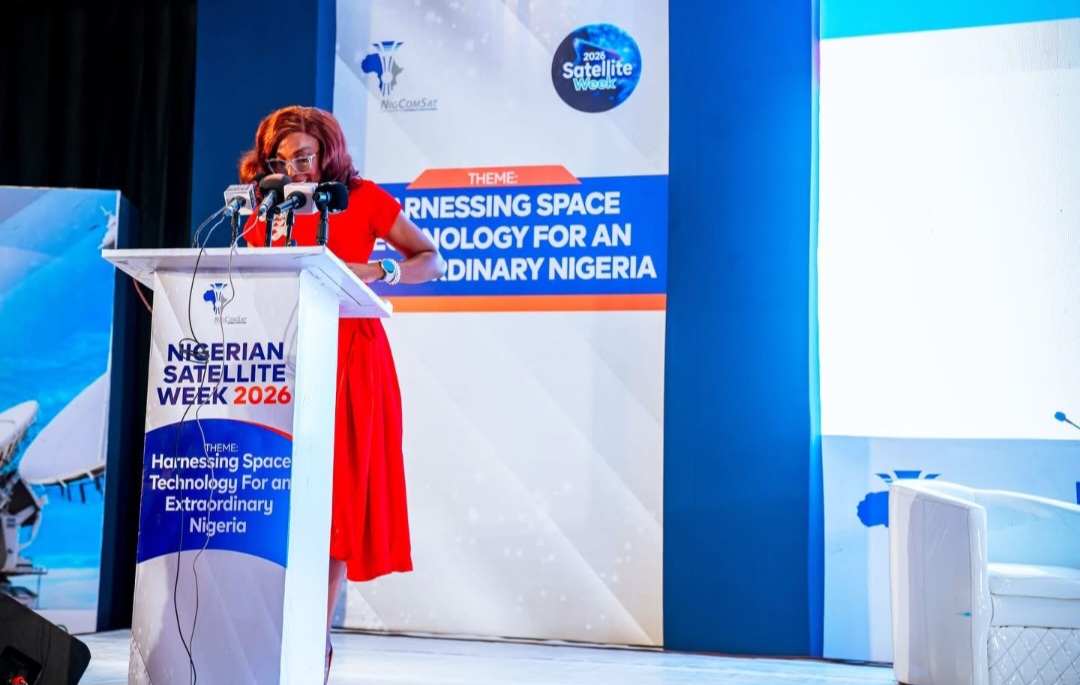
The Managing Director and CEO of the Nigerian Communications Satellite (NIGCOMSAT) Mrs. Nkechi Jane Egerton-Idehen, has announced a historic surge in the agency’s financial performance, with revenues growing from N650 million in 2023 to over N2 billion by the end of 2025.
Speaking at the opening of the 2026 Nigerian Satellite Week in Abuja, Egerton-Idehen described the milestone as a “Compounding return” on Nigeria’s sovereign decision to invest in space technology.
The event, which coincides with the 20th anniversary of NIGCOMSAT, serves as a platform to outline Nigeria’s next 25-year space roadmap.
Themed: “Harnessing Space for an Extraordinary Nigeria,” the two-day event brings together stakeholders from government, industry, and academia to explore Nigeria’s role in the rapidly expanding global space economy.
The MD emphasised that Nigeria currently ranks third in Africa for space assets, having successfully deployed seven individual assets over two decades.
“We mark 20 years not with nostalgia, but with a clear-eyed assessment of where we stand.The global space economy is undergoing its most consequential transformation, driven by the commercialization of Low-Earth Orbit (LEO) satellites and a 20% growth rate in the African satellite broadband market,” she explained.
Project 774
A central highlight of the address was the progress of Project 774, an initiative aimed at providing broadband connectivity to all 774 Local Government Area secretariats across the federation.
The MD underscored that the primary goal of the space program is people, not prestige, noting that satellite infrastructure is the only viable way to reach rural communities where terrestrial fiber-optic cables have yet to arrive.
Egerton-Idehen lauded President Bola Tinubu for the recent approval to acquire two new satellites NigComSat-2A and 2B. These assets will succeed the current NigComSat-1R as it nears the end of its service life.
She also highlighted Nigeria’s growing diplomatic influence in the sector, noting her role as Vice Chairperson of the Global Satellite Operators Association (GSOA)—the first time an African has held a leadership position in the organisation’s 20-year history.
In his remarks, the Minister of Communications, Innovation and Digital Economy, Dr. Bosun Tijani emphasised that satellite technology is no longer a distant or abstract concept but a critical backbone for the modern economy.
“The world is becoming more digital and infrastructure that powers this digital economy, that powers communication, data and connectivity is also becoming more strategic.
“It’s the backbone of any successful economy or society today. And many of us don’t pay attention to the fact that satellite technology sits right at the centre of that change that we’re seeing.
“Nigeria is the only country in the West African region with its own satellite. These new acquisitions show a clear commitment by President Bola Ahmed Tinubu to building the future rather than standing still,” he said.
The Minister further highlighted that the upgrades are part of a broader, unprecedented investment in national connectivity, which includes 90,000 kilometers of fiber-optic network, 4,000 telecommunication towers for rural and riverine communities and the Project REACH initiative to deepen the nation’s digital backbone.
Beyond hardware, Dr. Tijani underscored the importance of localised innovation.
He pointed to the recently launched 12 billion Naira Digital Economy Research Cluster Fund, which will support 36 professors and nearly 200 researchers across six clusters over the next three years.
The Minister also framed Nigeria’s progress as a win for the continent.
He revealed that Nigeria’s expanding fiber network would eventually extend to neighboring countries like Niger, Chad, and Cameroon, where internet costs can be up to ten times higher than in Lagos.
Earlier in the event, the Minister praised the leadership of Mrs. Jane Egerton-Idehen, the Managing Director of NigComSat, for fostering an ecosystem where startups can test satellite-based solutions for agriculture, security, and education.
“Infrastructure alone is not enough.
“What matters is what we build around it. We need more Nigerian solutions built on top of satellite technology to close the gap in learning outcomes and improve productivity for our farmers,” Tijani added.

