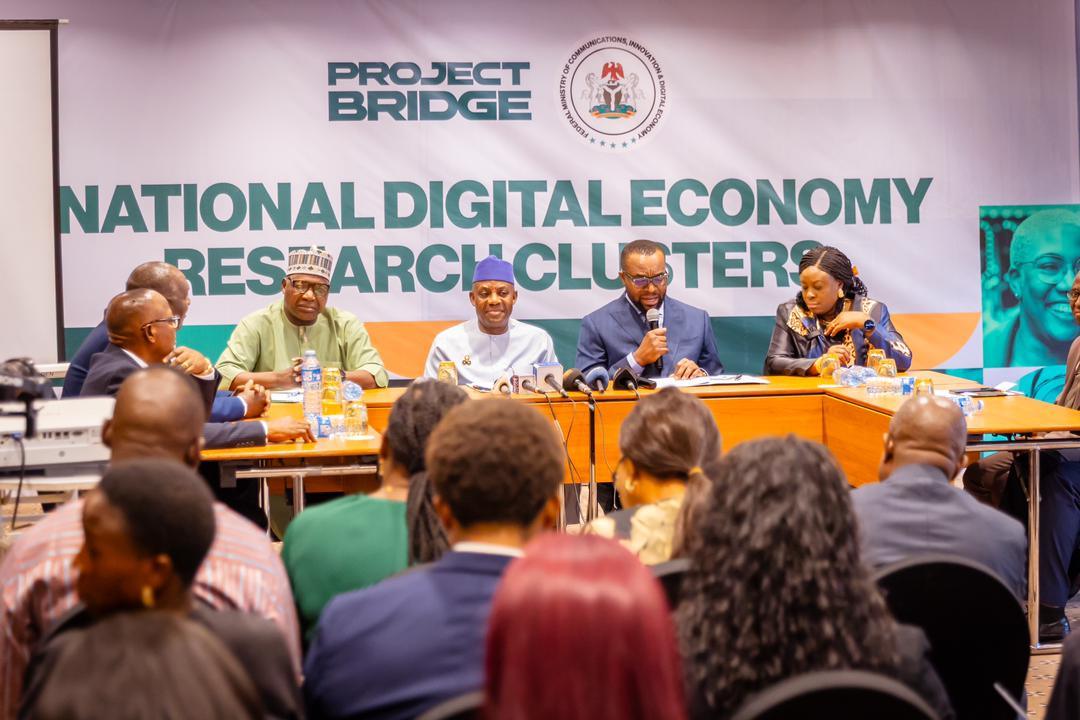
The Minister of Communications, Innovation and Digital Economy, Bosun Tijani, has announced the launch of the National Digital Economy Research Clusters under Project BRIDGE, a major initiative aimed at strengthening Nigeria’s digital infrastructure and innovation capacity.
Speaking at a press briefing in Abuja, Dr Tijani described the programme as a critical step toward positioning Nigeria as a global player in the digital economy.
The newly launched Digital Economy Research Clusters will focus on six priority areas: connectivity, digital public infrastructure, skills development, job creation, trust and safety, and artificial intelligence.
According to Tijani, the programme is designed to strengthen research capacity, support evidence-based policymaking, and position Nigeria as a key player in shaping the future of the global digital economy.
“We cannot rely solely on ideas developed elsewhere. We must generate our own insights, rooted in our realities. That is how we build better policy and position Nigeria as a serious partner for global investment.”
He highlighted the sector’s rapid ascent, noting that the digital economy’s contribution to Nigeria’s GDP has climbed from 16% to nearly 20%, with a clear target of reaching 21% under the administration of President Bola Ahmed Tinubu.
Highlighting the importance of research, Tijani said universities would play a central role in generating locally relevant solutions. He noted that the newly launched research clusters would focus on producing impactful, policy-driven innovations through collaboration and rigorous academic work.
Tijani added that sustained investment in research and innovation is essential for Nigeria to compete globally and avoid dependence on foreign-developed technologies.
The initiative is supported by international partners, including the World Bank, and aims to strengthen Nigeria’s research ecosystem while fostering long-term technological advancement.
In his remarks, the Minister of Education, Tunji Alausa, emphasised that Nigerian universities must evolve beyond theoretical instruction to become centres that nurture entrepreneurs, innovators, and global talent. He noted that while Nigerians continue to excel abroad, the country must rebuild its domestic capacity for innovation through deliberate investment in research and skills development.
He also revealed plans for government-backed certification programmes in partnership with global technology companies, enabling Nigerian students to gain industry-recognised credentials in high-demand fields such as cybersecurity, software development, AI, and machine learning.
Highlighting the global demand for digital talent, Alausa noted that over 2.2 million vacancies exist worldwide in tech-related fields, presenting a major opportunity for Nigerian youth to participate in the global digital economy remotely.
The minister further linked the initiative to broader economic goals, stating that investments in digital technology, agri-tech, and online services would play a crucial role in achieving the government’s ambition of building a trillion-dollar economy within the next four years.
The initiative is backed by a $2 billion credit facility from the World Bank, which will fund the deployment of 90,000 kilometres of fibre optic cables across Nigeria.
It is expected that across the clusters, over 200 researchers, including postdoctoral fellows and PhD candidates, will generate rigorous, policy-relevant research to guide Nigeria’s digital economy for years to come.