

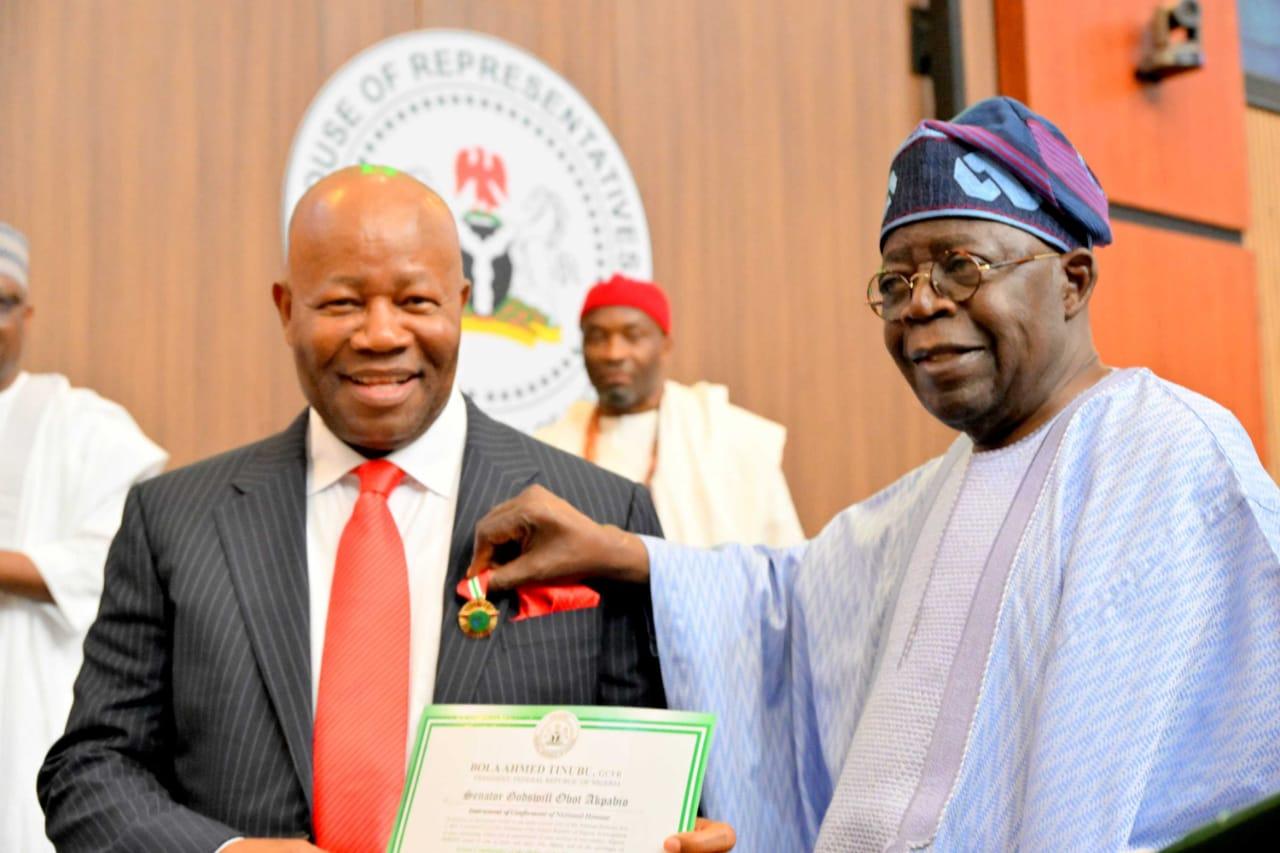
The president of the Nigerian Senate, Senator Godswill Akpabio, has advised President Bola Tinubu to ignore people criticising his administration as people who do not mean well for Nigeria.
He advised a joint sitting of the National Assembly to mark 26 years of Nigerian democracy.
In a speech titled “June 12: The Fire That Forged A Nation,” the Senate President said that the president rekindles the memory of a long and courageous journey, marked by struggle, sacrifice, and an unyielding belief in the ideals of democracy.
“That you, Mr. President—a veteran of the trenches, a symbol of democratic resistance, and a beneficiary of the people’s trust—now stand before us to speak from the Parliament of the people is nothing short of providence.
“The National Assembly is proud to host you, our President, our compatriot, and one of our own, as you fulfil the solemn constitutional duty of addressing the nation. This chamber honours you not merely as the president, but as one of the architects of the very democratic foundation we commemorate today.
“Today, we gather not to mourn injustice, but to honour resilience. We observe not the triumph of politicians, but the enduring faith of the Nigerian people in democracy—a faith that survived betrayal, braved teargas, defied armoured tanks, endured silence, and still chose the ballot over the bullet.
“On June 12, 1993, the torch of the long march to freedom was lit. Nigerians stood up to say, Our voice matters. Our vote counts.” Senator Akpabio said.
He said that the light of democracy was, however, extinguished on June 24, 1993, when a terse statement declared that the will of the Nigerian people, freely expressed in the historic June 12 Presidential Election, had been annulled.
“Tears, rage, and hope poured into the streets. Nigeria did not just lose an election; it lost its innocence. And across the country, the silence of shock was broken by the roar of resistance. The people rose. Angry students marched. Journalists spoke. Mothers wailed. Workers downed tools. Fathers stood before tanks. And young men and women, whose only crime was believing in democracy, laid down their lives. They died because they loved Nigeria enough to fight for her soul. This was not just a rejection of oppression but the beginning of a national awakening, signifying a rebirth as well as a reckoning.
“The intro of Chief Moshood Abiola’s campaign song captured the spirit of that day: ‘Nigeria on the march again.” Indeed, Nigeria was on the march towards democracy. But that cruel announcement turned the march for democracy into a march for justice,” he said.
Commendation
He commended President Bola Ahmed Tinubu and many others who stood tall in those days of darkness.
“While others chose silence or compromise, you chose courage. At great personal cost, NADECO, which you were part of, helped sustain the flame of liberty when it was most at risk of going out.
“So as we mark this day, let us remember those who bled so we could vote. Those who took risks, so we could speak. Those who were buried so that freedom might rise. Let us also pay tribute to all those who played pivotal roles in Nigeria’s democratic transition,” he said.
He also said that this year’s theme, “26 Years of Democracy: Renewing Our Commitment to National Development”, is not a slogan. It is a call to purpose. A reminder that democracy is not an end, but a means to national transformation.
” Under President Tinubu’s leadership, we have seen transformation in his bold approach to difficult reforms. From unifying the foreign exchange market, to local government autonomy, to the formation of the regional development commissions, to the Nigerian Education Loan Fund, to removing fuel subsidies, to attracting foreign investments, to tax reforms, this administration has not shied away from the hard decisions required to stabilise and grow our economy. These efforts are gradually restoring investor confidence, laying the foundations for long-term prosperity, and refocusing government expenditure toward productive investments,” he said.
The Senate President lauded President Tinubu for his boldness, vision, and unwavering belief in Nigeria’s future.
He noted that the 10th National Assembly, which marks its 2nd anniversary tomorrow, June 13, 2025, has played its part with diligence and distinction.
“From its inception, the 10th Senate demonstrated a renewed vigour for addressing the country’s complex challenges through purposeful legislation. This commitment is reflected in its extraordinary output: a total of 844 bills have been introduced within its first two years—an unprecedented figure that underscores the Senate’s proactive posture in tackling pressing national issues.
Out of this impressive volume, 107 bills are currently at the committee stage, undergoing the necessary scrutiny and stakeholder engagement that ensures quality legislation; 206 bills are awaiting first reading, reflecting a robust pipeline of legislative ideas prepared for formal introduction; and 409 bills have advanced to second reading.
“Notably, the Senate has passed 96 bills, a record for any Nigerian Senate at this stage of the legislative cycle. Even more significantly, 52 of these bills have been assented to by the President, translating into enforceable laws that will shape governance, economic development, public welfare, and national security. These bills include the National Education Fund, the local government autonomy bill, regional development commissions, tax reforms, universities and tertiary institutions, agricultural institutions, etc.
“Moreover, the Tenth Senate has acted decisively on 26 executive bills, showcasing a healthy balance of cooperation and oversight in its engagement with the executive arm. These executive-sponsored legislations address key policy areas and benefit from the Senate’s thorough review and refinement before passage.
“Beyond bills, the 10th Senate has received a total of 80 petitions from citizens and civil society. This is a testimony to public trust in the institution. Of these, 18 petitions have been fully adopted, providing redress, transparency, and institutional accountability,” he said.
Lessons of Democracy
The Senate President also said that the lesson of democracy is clear: where governance is a partnership, progress follows. But where governance is a contest, the people suffer.
“Therefore, as we commemorate 26 years of uninterrupted democratic governance, we must renew our national commitment to foster collaboration between the different arms of government.
“Democracy is not a gift. It is a trust we must protect. To the youth, you must not treat democracy with apathy. To civil society, you must not let memory fade. To the media, we must be held accountable through responsible journalism. And to every Nigerian, democracy must not be reduced to election days. It must live in our values, our institutions, and our daily lives.
Let us preserve the memory of June 12. I respectfully urge Mr. President to consider the establishment of a June 12 Museum—a living archive where the stories, artefacts, struggles, and sacrifices of the democratic movement will be housed, preserved, and taught. Nations that forget their past lose the moral compass for their future,” he said.
He added that “As President of the Senate, I reaffirm the unwavering commitment of the 10th National Assembly to the cause of the Nigerian people. We will continue to champion every policy that uplifts the poor, empowers our youth, strengthens our economy, and defends the dignity of every citizen and the nation. We owe it to those who fought. We owe it to those who fell. We owe it to those who still believe.
“May we never again betray the hope that was once betrayed. And may we never lose the freedom that was once denied”.
Confidence Okwuchi