

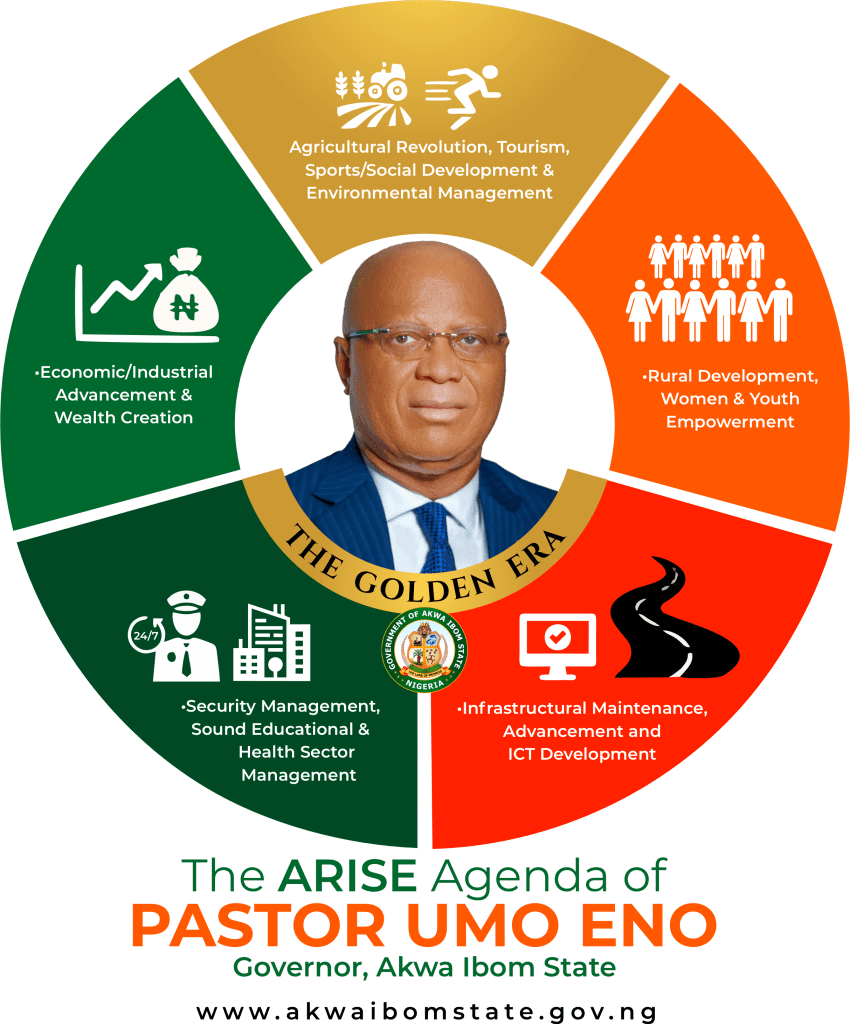
The Executive Assistant and Chief Delivery Advisor to the Governor of Akwa Ibom State, Aniefiok Johnson, has unveiled detailed next steps to complete more than 60 major projects across all five pillars of Governor Umo Eno’s ARISE Agenda, assuring that each is fully funded without resorting to borrowing.
Addressing participants at the ARISE Agenda two-year mid-term review in Uyo, Johnson said the next phase would focus on consolidating existing gains and ensuring that every project delivers measurable, long-term impact.
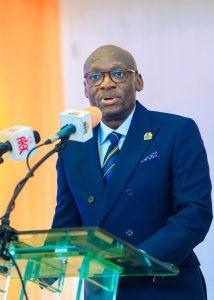
“Our task now is to move from progress to impact,” he declared, saying, “Every project has secured funding, timelines, and a clear delivery plan. The goal is simple — to finish strong and inclusively.”
Timelines for Key Projects
Among the listed projects, the 5,000-seater Ibom International Convention Centre and its adjoining 200-room hotel — abandoned for more than 15 years — are due for completion within 14 months. The ARISE Senior Citizen Centre, which began in January 2025, is set for commissioning in September 2025.
Public transportation will also be boosted with an initial fleet of 20 CNG-powered buses and supporting terminals scheduled to be operational by December 2025.
Education access will be improved through the Model Secondary School Project, due for completion in 2026, while healthcare capacity will be expanded via a 350-bed specialist hospital designed to serve not just Akwa Ibom but also Nigeria and the Gulf of Guinea.
Tourism and economic diversification initiatives include the Oron Maritime Infrastructure Hub, the transformation of a former gully site into a nine-hole golf course and resort, and the deployment of the Akwa GIS land information system to improve transparency and unlock real estate value.
Projects by Sector
The Delivery Advisor detailed the ARISE Agenda’s active portfolio as follows: nine agricultural, tourism, and environmental projects; 35 rural development and empowerment projects (including one per local government); 17 infrastructure projects; 13 security and social service projects; and 15 industrial and economic advancement projects — many with sub-projects not counted in the totals.
“We have stopped counting projects because the scale keeps expanding. But each one is carefully chosen for its long-term and inclusive benefits,” he explained.
Systems for Delivery
Johnson stressed that robust systems were in place to ensure completion, including an in-house monitoring unit comprising quantity surveyors, architects, and engineers to review all contracts for cost efficiency.
“When another set of eyes looks at the figures, we often find savings that can fund entirely new projects,” he said.
To curb inflated costs, new guidelines now require designs and bills of quantities before project approval. Twice a month, the Governor chairs a Project Advisory Committee meeting with delivery advisors, commissioners, and community stakeholders to track progress and resolve challenges.
Partnerships for Strength
Johnson announced ongoing collaboration with the Tony Blair Institute and the United Nations Development Programme (UNDP) to adopt global best practices in governance and project delivery systems.
Commitment to Results
He assured stakeholders that the “next steps” were firm commitments backed by vigilant tracking, coordination, and problem-solving over the next two years to deliver and sustain recorded gains.
“Whether a farm, a road, a school, or a seaport, it will be delivered as promised and yield tangible improvement in the lives of the people. This is about leaving a legacy that will outlive this administration and align with both state and national development goals,” he vowed.
Johnson reaffirmed that with the Governor’s office delivery unit fully committed, every project outlined in the presentation would be achieved through a proactive approach to governance.
PIAK