

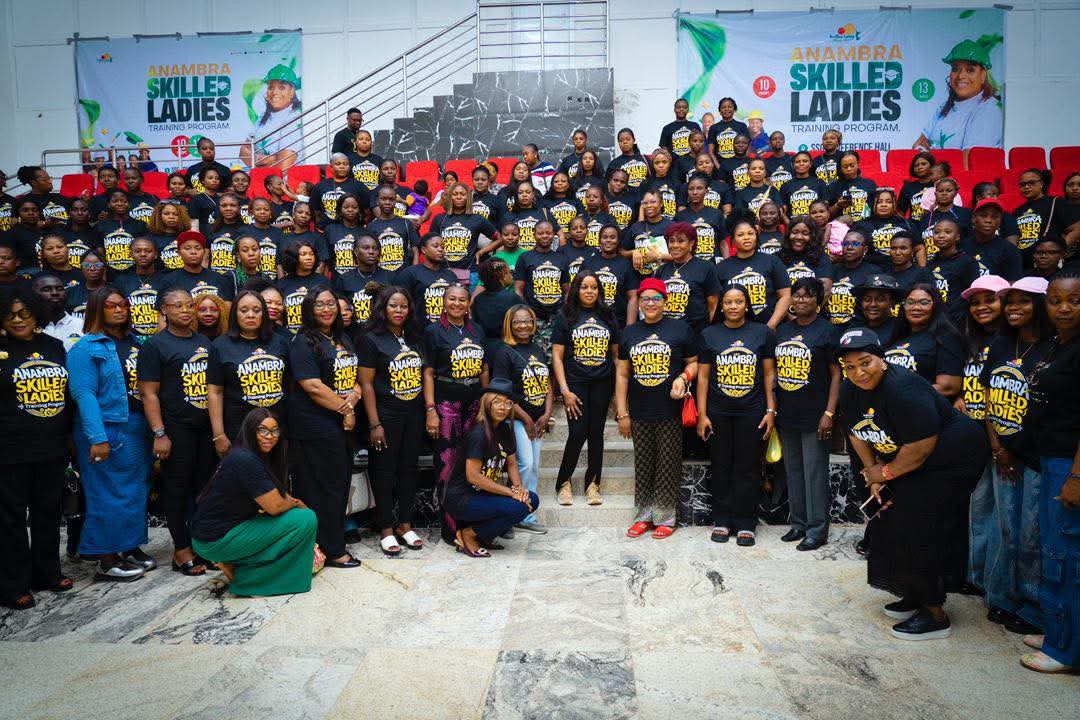
The wife of the Anambra State governor, Dr Nonye Soludo, has launched a large-scale skills development programme aimed at empowering thousands of women across the state with technical and entrepreneurial capabilities.
The initiative, known as the Anambra Skilled Ladies Programme, is being implemented through her non-governmental organisation, the Healthy Living with Nonye Soludo Initiative.
It seeks to train about 6,000 women in practical, high-demand vocational skills over several phases.
The first phase of the programme began on Friday in Awka, the capital of Anambra State, with 100 participants selected from more than 10,000 applicants who submitted entries within a week of the application portal opening.
Speaking at the inauguration ceremony held at the State Secretariat complex in Awka, Mrs. Soludo described the initiative as a practical intervention designed to promote women’s economic independence and challenge long-standing gender stereotypes in technical professions.

She said the programme was also her personal contribution to celebrating women during the global month dedicated to recognising the resilience, achievements and contributions of women worldwide.
“This event holds a special place in our history as a non-governmental crusade that celebrates women in the most practical way
“The Anambra Skilled Ladies Programme is a carefully designed entrepreneurial package that offers young women the opportunity to learn and prosper through lucrative, high-demand skills,” Mrs Soludo explained
According to her, the initial plan was to train 50 women in the first batch, but the number was doubled to 100 following the overwhelming response from applicants.
The two-month programme combines one month of intensive practical training with an additional month of internship.
Participants will receive hands-on instruction and supervision from industry trainers, while an independent monitoring team will track their progress throughout the training period.
Trainees will specialise in technical fields traditionally dominated by men, including solar and CCTV installation and repairs, air-conditioning repair and maintenance, tricycle (commercial tricycle) mechanics and painting.
Mrs. Soludo urged the participants to approach the training with dedication, discipline and resilience, emphasising that the opportunity could transform not only their own lives but also those of their families and communities.
“In these skill areas largely dominated by men, we want you to bring uniqueness and excellence,” she said. “We want you to become a beacon of hope for your families, communities and our state.”
Earlier, the state Commissioner for Health and coordinator of the initiative, Afam Obidike, said the first batch of trainees was selected from more than 10,800 applicants through a rigorous screening process.
He explained that the training programme would be implemented in phases, assuring applicants who were not selected in the first round that additional batches would be announced in the coming months.
According to him, the programme aims to produce a new generation of skilled female professionals capable of creating businesses, generating employment and closing gender gaps in technical trades.

Representatives of the training partners also highlighted the growing importance of practical skills in today’s economy, noting that technical competence increasingly offers opportunities for financial independence.
Some of the beneficiaries, Lilian Onyerionwu and Chidera Ezeadilue, said they were grateful to Dr Nonye Soludo for the opportunity, explaining that they could not afford the cost of similar private training programmes.
“We promise not to disappoint because this is a huge opportunity for us to change lives,” they said.
Organisers say the programme is expected to expand notably in subsequent phases, ultimately reaching about 6,000 women across the state.