



Formed in February 2013 through the merger of five major political parties – the Action Congress of Nigeria (ACN), the Congress for Progressive Change (CPC), the All Nigeria Peoples Party (ANPP), parts of the All Progressives Grand Alliance (APGA) and the New Peoples Democratic Party (PDP) – the APC has remained Nigeria’s ruling party since 2015. It has produced two presidents, the late Muhammadu Buhari and the incumbent Bola Tinubu.
The National Convention represents the highest decision-making platform within the party, where delegates elect national officers and set policy direction.
At the heart of the convention is the election of members of the National Working Committee (NWC), whose roles are pivotal in strengthening party structures and coordinating campaigns across the country.
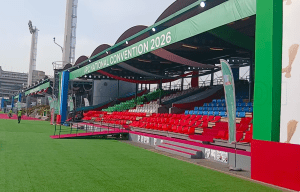
Ahead of the main proceedings, delegates have begun arriving at the venue, Eagle Square, dressed in party-branded attire and displaying APC colours and logos, signalling the commencement of activities and heightened political engagement.
Among key figures seeking re-election is the National Chairman, Nentawe Yilwatda, who is expected to enjoy broad support from party stakeholders. Also cleared to contest is the National Secretary, Ajibola Basiru, alongside the Deputy National Chairman (North), Ali Bukar Dalori.
The screening of aspirants has been conducted by a committee led by Ekiti State Governor Biodun Oyebanji, who has assured party members of a transparent and credible process in line with the party’s constitution and Nigeria’s Electoral Act.
The convention follows a series of congresses held at the ward, local government, state, and zonal levels reflecting the party’s internal democratic processes.

Political analysts view the gathering as a significant test of unity within the APC, amid recent internal consultations and efforts to consolidate its position as Nigeria’s leading political party.
Beyond leadership elections, the convention is also expected to set the tone for the APC’s strategy ahead of the 2027 general elections, which includes strengthening grassroots mobilisation and fostering national cohesion.
As delegates from across Nigeria’s six geopolitical zones converge in Abuja, their attention will be on the party’s ability to project unity, stability, and a clear, development-focused agenda consistent with national aspirations.

The outcome of the convention is expected to further define the APC’s role in Nigeria’s democratic journey and its contribution to sustainable governance and national development.
Over 8,000 delegates from various geopolitical zones are expected at Eagle Square today.
The Independent National Electoral Commission (INEC) will be present at the All Progressives Congress (APC) National Convention today to oversee and authenticate the conduct of the party’s internal elections, ensuring that the process is transparent, credible, and in line with established electoral guidelines.